I am happy to announce that our latest work "On the Veracity of Local, Model-agnostic Explanations in Audio Classification: Targeted Investigations with Adversarial Examples" (together w/ @katxiip, Arthur Flexer and Gerhard Widmer from @cpjku) has been accepted to @ismir2021 🎉🥳
We are proud to announce that our institute won two tasks in the 2024 edition of @DCASE_Challenge
🥇Task 4: Sound Event Detection with Heterogeneous Training Dataset
🥇Task 8: Language-based Audio Retrieval
Check out the DCASE website for more https://t.co/Gu8hmM6Egn
#MIR#DCASE
This time tomorrow I will be presenting our work on initialising input-convex networks at the #NeurIPS23 poster session!
links: https://t.co/uKNIF8rm8U
Do not hesitate to come by for a chat!
NEW: Dataset paper by Silvan David Peter, @carloscancino, @fosfrancesco, Andrew Philip McLeod, Florian Henkel, Emmanouil Karystinaios & @GerhardWidmer: "Automatic Note-Level Score-to-Performance Alignments in the ASAP Dataset",largest fully note-aligned ds
https://t.co/36horaeBJ7
We are happy to announce the #NeurIPS2023 Creative AI Track. This track will invite ML researchers to showcase their work during the conference in the form of visual, language, musical, and performing arts. Proposals are due by *June 15*.
https://t.co/N3M1jsBYWx
Do we make valid inferences in our MIR experiments?
If you're interested in learning more about validity in MIR, check out the latest work of my colleague Arthur Flexer together with Bob L. T. Sturm, now available on arXiv: https://t.co/sRnl9Tosv4
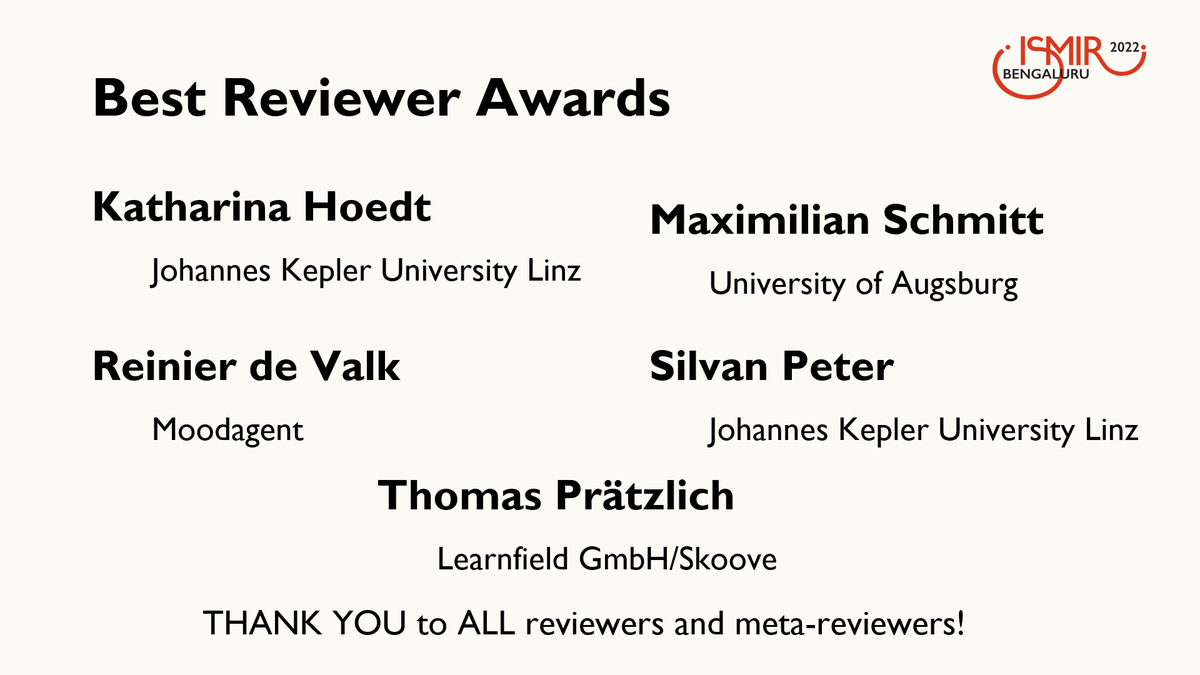
ISMIR Awards! This year's Best Reviewer Awards are for: Katharina Hoedt, @valktalk, Maximilian Schmit, Reinier de VAlk, Silvan Peter, and Thomas Pratzlich. Thank you to all our reviewers and meta-reviewers!
Can we get one step closer to more human-friendly explanations for music classifiers?
We investigated this in our latest work (w/ Francesco Foscarin, @veroamilbe, Arthur Flexer and Gerhard Widmer), accepted at #ismir2022 🥳
Check out the preprint now: https://t.co/7TpL4TALi2
New name, new paper 🙃 Our work on "Defending a Music Recommender Against Hubness-Based Adversarial Attacks" (w/ Arthur Flexer and Gerhard Widmer @cpjku) was recently accepted at SMC-22: https://t.co/x8Feo3ykfO 🥳
``Defending a Music Recommender Against Hubness-Based Adversarial Attacks. (arXiv:2205.12032v1 [https://t.co/3pcQCkeyAA]),'' Katharina Hoedt, Arthur Flexer, Gerhard Widmer, https://t.co/k6qWHqftxO
New name, new paper 🙃 Our work on "Defending a Music Recommender Against Hubness-Based Adversarial Attacks" (w/ Arthur Flexer and Gerhard Widmer @cpjku) was recently accepted at SMC-22: https://t.co/x8Feo3ykfO 🥳
In case you missed it: I am one of the contributors to the first ICLR blog post track this year! I (tried to) write about Normalizer-Free networks (https://t.co/P6AbpDYlQA) and what they can and can not tell us about normalization:
https://t.co/DsJTo80K4v
NEW: Research paper by ArthurFlexer, Taric Lallai and Katja Rašl: "On Evaluation of Inter- and Intra-Rater Agreement in Music Recommendation" presents 2 user studies in quantification of general similarity between pieces.
https://t.co/qgUy6hGDRZ
I am happy to announce that our latest work "On the Veracity of Local, Model-agnostic Explanations in Audio Classification: Targeted Investigations with Adversarial Examples" (together w/ @katxiip, Arthur Flexer and Gerhard Widmer from @cpjku) has been accepted to @ismir2021 🎉🥳
Upon request I recorded a presentation that I was invited to give at the AIDD workshop, past Wednesday.
It’s about tricks of the trade, so I hope there is something in there for someone out there.
And yes, #Vimeo was the easiest way to share the video:
https://t.co/YDTG7KW3E4