Senior Editor at Committee to Protect Journalists, an independent nonprofit that promotes @pressfreedom worldwide. Previously @TRF @VOAAfrica @ipsnews @UNOCHA
Le CPJ est vivement préoccupé par la garde à vue depuis mardi de Mor Mbaye Cissé, reporter de @Seneweb, accusé de diffusion de fausses nouvelles pour ses écrits sur une affaire de vol impliquant le fils d’un magistrat.
Les autorités sénégalaises doivent privilégier des réponses appropriées au travail journalistique et éviter le recours à la privation de liberté.
La réforme des lois sénégalaises est également plus que nécessaire après l’énième arrestation d’un journaliste sénégalais pour diffusion de fausses nouvelles.
En savoir plus : https://t.co/bLwEWy17kq
Deux ans après que le journaliste burkinabè Serge Atiana Oulon a été enlevé à son domicile le 24 juin 2024, le Comité pour la protection des journalistes (CPJ) appelle les autorités du Burkina Faso à révéler où il se trouve et à lui permettre de retourner auprès de ses proches.
Oulon est détenu dans un centre de détention secret de la capitale, Ouagadougou, où les prisonniers sont battus, régulièrement privés de nourriture et contraints de dormir dans des conditions déplorables, a déclaré au CPJ un ancien détenu qui a vu le journaliste pour la dernière fois à la fin de l’année 2025. « Nous étions traités comme du bétail », a-t-il ajouté.
Au moins sept journalistes ont été victimes de disparitions forcées au Burkina Faso depuis la prise de pouvoir des militaires en 2022. Cinq d’entre eux ont été enrôlés de force puis libérés : Guézouma Sanogo, Boukari Ouoba, Phil Roland Zongo, Kalifara Séré et Luc Pagbelguem. Un autre journaliste burkinabè, dont le CPJ ne révèle pas l’identité pour des raisons de sécurité, est détenu depuis 2024.
En savoir plus: https://t.co/B8vRy8LxMz
Two years after Burkinabe journalist Serge Atiana Oulon was taken from his home on June 24, 2024, CPJ calls on authorities in Burkina Faso to reveal his whereabouts and reunite him with his loved ones.
Oulon was being held at a secret detention facility in the capital Ouagadougou, where prisoners are beaten, regularly deprived of food, and sleep in poor conditions, a former detainee, who last saw the journalist in late 2025, told CPJ. “We were treated like cattle,” he added.
At least seven journalists have been forcibly disappeared in Burkina Faso since the military took power in 2022. Five were conscripted and released: Guézouma Sanogo, Boukari Ouoba, Phil Roland Zongo, Kalifara Séré, and Luc Pagbelguem. One other Burkinabe journalist, whose name CPJ is not disclosing for security reasons, has been detained since 2024.
Read more: https://t.co/B8vRy8LxMz
The Committee to Protect Journalists calls on Mozambican authorities to return the equipment of prominent investigative journalist Estacio Valoi and to end the intimidation of reporters covering environmental crimes and conflict in northern Cabo Delgado province.
On June 16, three National Criminal Investigation Service (SERNIC) agents went to Valoi’s home, served him with a judicial order, and confiscated his phones, computers, and tablets, the journalist told CPJ.
Valoi said in December that he was facing a “coordinated offensive” of “intimidation” over his reporting into timber smuggling in Cabo Delgado where the government has been fighting an Islamic State-linked insurgency since 2017.
“Journalists in Cabo Delgado already face extraordinary risks reporting on conflict, corruption and environmental crimes without adding judicial harassment to their safety fears,” said CPJ Africa Director Angela Quintal. “Mozambican authorities must return Estacio Valoi’s equipment that is essential to his work and ensure journalists can do their jobs freely and safely.”
Read more: https://t.co/omBckXZGgg
Le Comité pour la protection des journalistes appelle les autorités maliennes à libérer deux journalistes de renom emprisonnés la semaine dernière pour avoir critiqué le gouvernement militaire du pays, déjà fragilisé, concernant son bilan en matière de liberté de la presse et ses pertes face aux insurgés.
« Les autorités maliennes doivent cesser leurs arrestations frénétiques de journalistes, abandonner les charges retenues contre Abdrahamane Keïta et Chahana Takiou, et les libérer, ainsi que leur confrère Youssouf Sissoko », a déclaré Moussa Ngom, représentant du CPJ pour l’Afrique francophone.
« Il est ironique que les autorités maliennes aient utilisé la loi sur la cybercriminalité pour arrêter Chahana Takiou pour avoir dénoncé son utilisation abusive contre la presse. Elles n’ont fait que confirmer la justesse de ses propos. »
En savoir plus: https://t.co/Dvy1Ye1trN
CPJ is proud to have contributed to @FbdnStories’ #MozambiqueExposed project, investigating the disappearances of journalists Ibraimo Mbaruco and Arlindo Chissale and the lack of justice for the killings of João Chamusse and Albino Sibia.
“Attacks on journalists are not addressed. There’s zero accountability and complete impunity,” CPJ's @angelaquintal told Forbidden Stories as one of their 100-plus interviewees.
The stories reveal a broader pattern of enforced disappearances and political killings, with the involvement of figures linked to the ruling Frelimo party.
Read more: https://t.co/VliYBhxEKU
“We walk on a tightrope. There’s no guarantee that you’ll be safe after reports … We are always living under the shadow of fear,” an Ethiopian journalist told CPJ, one of several who spoke on condition of anonymity about the impossibility of reporting effectively on the country’s June 1 election.
Journalists revealed that intimidation, detention, license suspensions, accreditation revocations, and informal threats are hollowing out independent coverage and causing reporters to flee their home towns and the profession.
One editor said: “I cannot say that there is a media outlet serving the public with regard to the election. The media has forgotten the meaning of election.”
Read more: https://t.co/3XdIpPOleg
In the three years since Nigeria’s President Bola Ahmed Tinubu assumed office on May 29, 2023, journalists have been repeatedly arrested, attacked, and harassed — yet, the government has sought to deny this reality.
Watch CPJ’s interviews with @NewsCentralTV's Karina Adobaba-Harry, @fijnigeria's Sodeeq Atanda, and @wikkitimes' Yawale Adamu to hear about their ordeals.
Read more: https://t.co/38r9bv1Z9p
In the countdown to Ethiopia’s June 1 election, @TheReporterET's Bewket Abebe flew to the town of Humera to report from one of the country’s most contested territories. He never made his meeting.
Security personnel searched his phone and detained him for three days in a crowded cell.
“The detention place was overflowing and crammed. It was hot and unsanitary,” Bewket told CPJ.
With journalists summoned, arrested, threatened, and pushed into self-censorship, Ethiopian reporters say the real election story is fear and the public is being left in the dark.
Read more: https://t.co/3XdIpPNNoI
Good news 🎉 Senegalese journalist René Capain Bassène — an innocent man who was serving a life sentence for a murder he didn’t commit — has been released after 8 years in prison.
CPJ’s Francophone Africa Representative Moussa Ngom is on the ground with Bassène to celebrate his release.
This is a win for journalism, for Bassène’s innocence, and a win for press freedom. CPJ is grateful to everyone who has stood in solidarity in the fight for his release.
The Committee to Protect Journalists calls on authorities to investigate reports that at least five Nation Media Group (@ntvkenya@NationAfrica) journalists were harassed and assaulted by members of the public in Nairobi on Monday, the first day of a public transport strike against high fuel prices.
https://t.co/RP752y9api
As the protests enter their second day, journalists out in the field should consult CPJ’s guidance on covering civil disorder:
https://t.co/oa1uOZcI1e
The Committee to Protect Journalists calls on authorities in the Democratic Republic of the Congo to release journalist Stéphane Shisso, who was arrested in January after reporting on erosion caused by mining in Kolwezi, and to ensure the safety of his colleague Guelord Shamba, who is in hiding.
“It is a grave injustice that DRC authorities have detained journalist Stéphane Shisso for more than four months, without bringing him before a court or disclosing charges against him,” said CPJ Africa Director @angelaquintal. “Authorities must guarantee Guelord Shamba's safety so that he can return home and reassure family and colleagues who have not heard from him since January.”
Kolwezi is a global center for mining cobalt, a mineral used in cell phones and electric car batteries. Rights groups say people are being forcibly evicted to make way for the giant mines.
Read more: https://t.co/BefibDIpUR
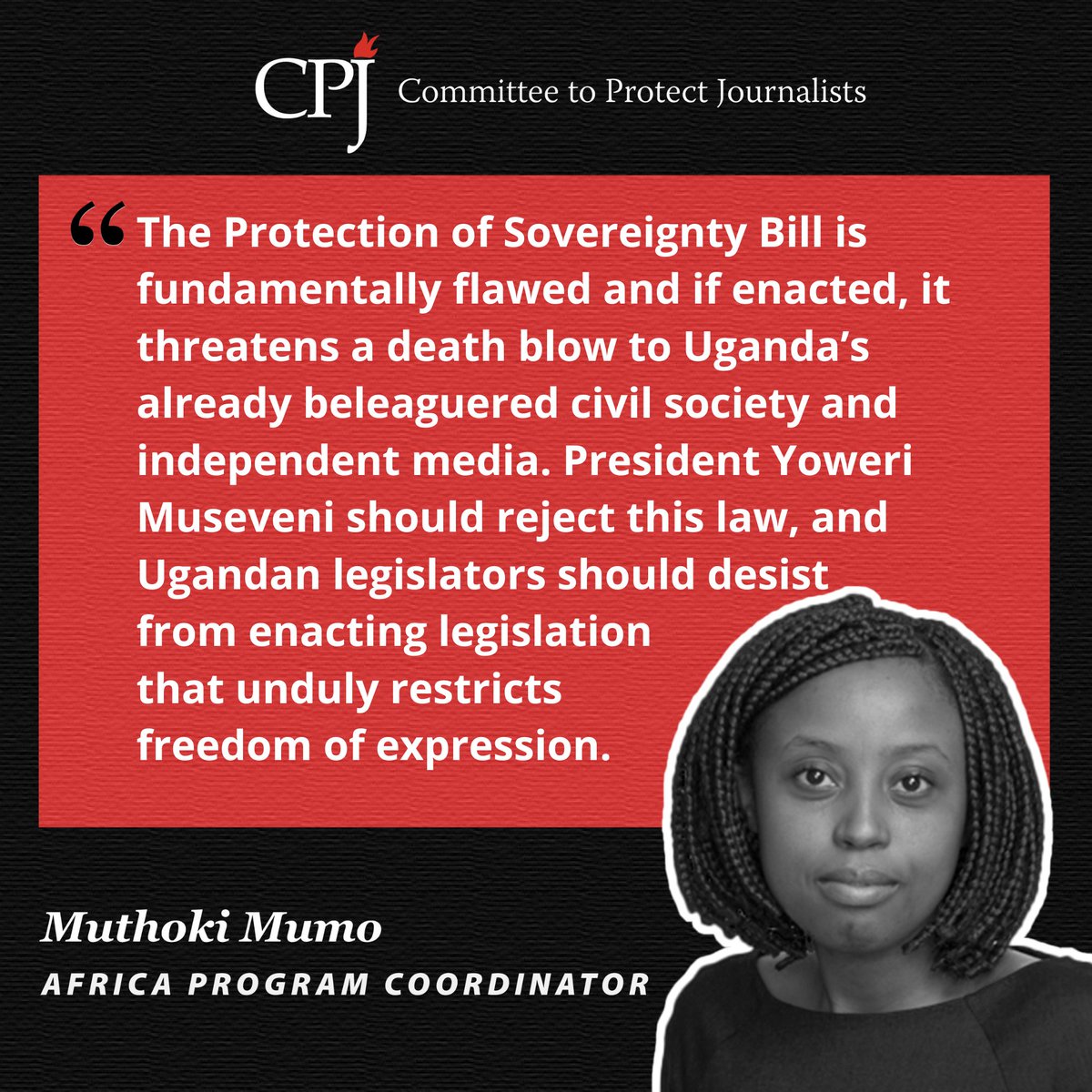
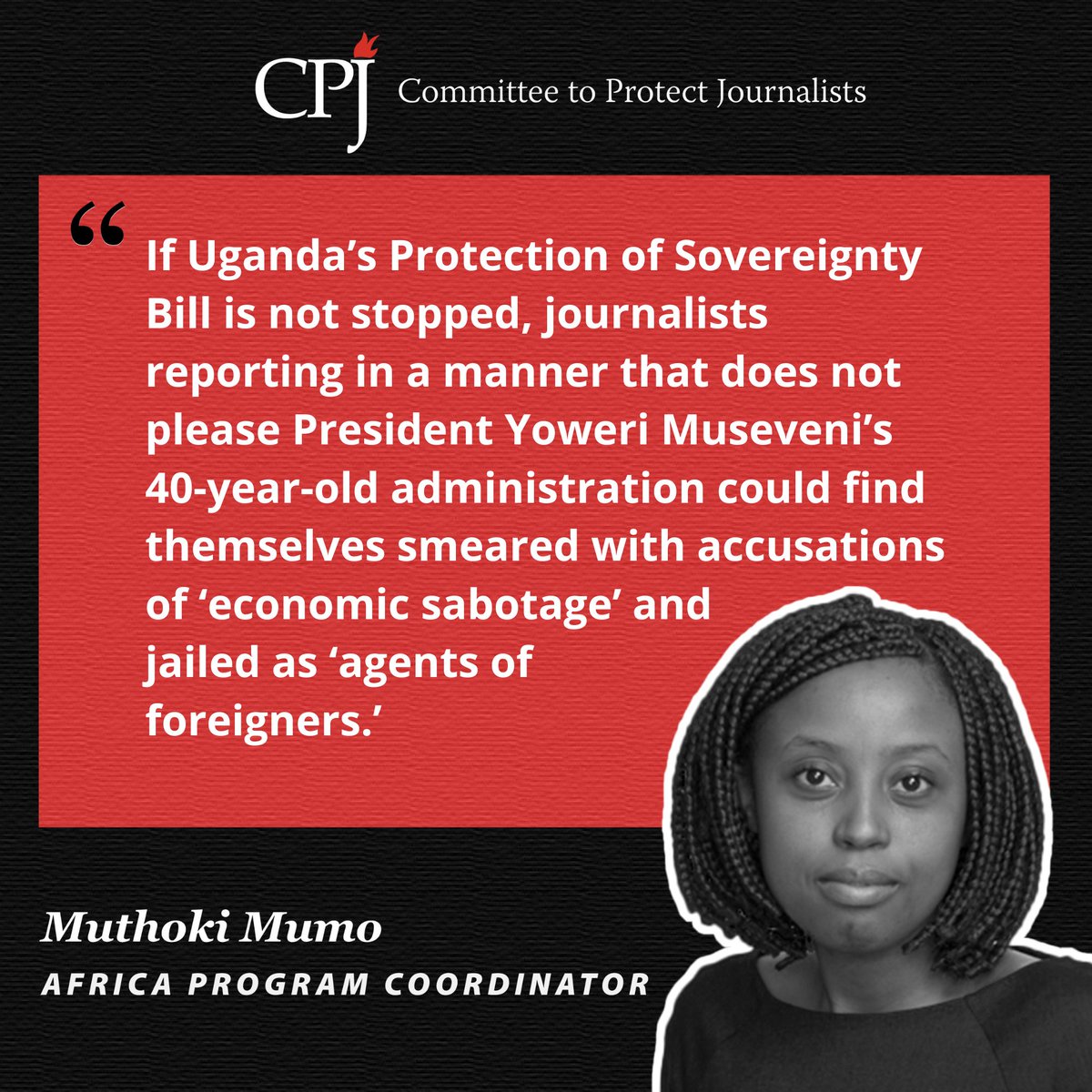
Uganda’s Protection of Sovereignty Bill, which parliament approved on Tuesday, risks imposing Russian-style state control on many journalists.
Those working with international outlets or receiving foreign funding would be designated “agents of foreigners” who could face lengthy prison terms for a broad swathe of activities.
Read more: https://t.co/EZ4VasOAZ0
The Committee to Protect Journalists calls for an independent and credible investigation into the death of Rwandan YouTube commentator Aimable Karasira Uzaramba of an alleged overdose on Wednesday — the day of his release after five years in prison.
“Aimable Karasira Uzaramba’s death in state custody on the day he was expected to finally walk free is devastating,” said CPJ Africa Program Coordinator Muthoki Mumo. “Given past reports that Karasira was tortured behind bars and his unjust, five-year detention, Rwandan authorities clearly have questions to answer.”
Karasira was arrested in 2021, and in September 2025 he was sentenced to five years in prison on charges of inciting divisions. An ethnic Tutsi who lost relatives in the genocide, Karasira criticized the government and official narratives of the genocide on his YouTube channel and others.
Read more: https://t.co/steqhdn9DH
#Uganda: @pressfreedom is relieved that @AlternativeUga journalist Arnold Anthony Mukose was finally released on bail on Tuesday, after being snatched off the street by security operatives on March 29 and detained in Luziira Maximum Security Prison for more than five weeks.
Mukose is being prosecuted under Uganda Communications Commission (@UCC_Official) licensing regulations with broadcasting “fake news” and “false signals” that First Lady Janet Museveni was dead, amid speculation over her absence from public view.
Alternative Digitalk regards the charges as retaliatory for the outlet’s coverage of and involvement in a petition which struck down Uganda’s cybercrime and criminal defamation laws. Mukose was seized immediately after appearing on a radio show celebrating his court victory.
Read more: https://t.co/VqrHiUjnoG
Join our team! CPJ is #hiring a remote communications associate to develop and implement communications strategies to maximize the impact of CPJ’s work in defense of press freedom worldwide.
🗓️ Deadline is May 18, 2026.
Apply today: https://t.co/erPXYQ1n0u
🎧 NOUVEAU PODCAST: Le CPJ lance un nouveau podcast sur le journaliste et auteur sénégalais René Capain Bassène — un homme innocent qui purge une peine de prison à perpétuité pour meurtre.
Ce podcast en six épisodes documente l’un des cas de liberté de la presse les plus emblématiques d’Afrique de l’Ouest — à travers les voix des personnes directement impliquées, avec des détails inédits sur le procès de Bassène, y compris des témoignages de torture et d’aveux forcés qui remettent sérieusement en question le verdict.
🔉 Écoutez-le ici à partir du 3 mai : https://t.co/g3uozUsXtd
Ugandan journalists face up to 20 years in jail under draconian foreign agents bill that would also limit foreign media funding to $100,000 and subject newsrooms to intrusive state oversight.
Read more: https://t.co/bIJenQCqZS
For months, Zambian lawyer @JosiahKalala has been working late into the night on a case he believes could define the future of press freedom in the country: preparing arguments, reviewing legal provisions in the cybercrime laws, and consulting colleagues.
“The laws grant wide powers of surveillance, interception, and data access without sufficiently robust judicial oversight,” said Kalala, head of @CofZambia. “If left unchecked, they have the potential to undermine fundamental freedoms.”
With a @PowerFMZambia journalist tasered at a @UPNDZM event this month, radio @99Mpongwe raided, and elections challenging President Hakainde Hichilema due in August, Zambian newsroom leaders spoke to CPJ about rising intimidation, harassment, and self-censorship.
Read more: https://t.co/Xa9B7d1Y5x