And now hopefully you understand this meme.
The point was always to augment, not just automate.
It's beautiful that AI now makes creating simulations so accessible... Having AI teach us is one of the greatest possibilities computing has ever opened up. 35/
https://t.co/912yIKn8xV
Alright, let's wrap up. Today we've covered some techniques that were about understanding code... but actually I think this is a much bigger issue.
It's still important for humans to understand how things work in general! Not just to verify, but to participate.
And surprise surprise, this is not a new idea. It harkens back to the very origins of our field of computing... 33/
@geoffreylitt Not just Notion. Language is all about this. It gives you vocabulary which evokes the same images to help us have the shared mental model. Notion just has its own vocabularies.
Papert had this beautiful idea he called living in Mathland: if you want to learn math, live in Mathland — just like if you want to learn French, you go live in France.
Could we build an environment where children learn math naturally, as a consequence of their curiosity?
So how do we apply that to code? Can we make worlds you inhabit and naturally intuit how the system works and how it's changing? 25/
There's only one problem: reading is hard work 😅
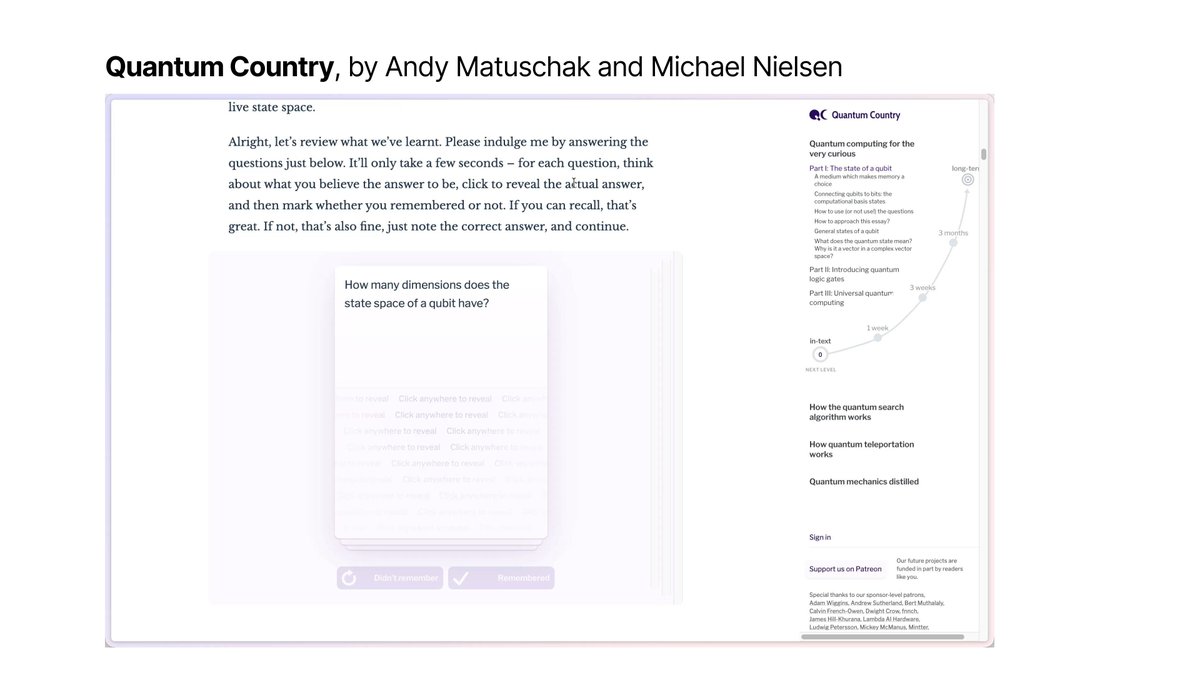
As @andy_matuschak says: "books don't work"! It's too easy to fool yourself into thinking you did the reading when you really didn't retain or understand.
How do we fix this? I took inspiration from Andy and @michael_nielsen 's work on embedding spaced repetition quizzes in essays. 20/
OK, so fine, understanding matters.
But this raises the next question: how? How do we build this human understanding when we're working with AI and moving fast?
Well, turns out this is not the first time anyone has ever thought about how to communicate understanding. I think we can look to education as an inspiration. Can we steal the best ideas ever invented for education and apply to this problem?? 10/
BTW, this relates closely to the idea of Cognitive Debt popularized by Margaret Storey and @simonw.
It's like tech debt: you can get away with not understanding what's going on in the short term, but it'll bite you eventually. 9/
It's never just one loop! A project is many, many loops with the agent.
And the understanding you have of the system is part of your ability to come up with the next idea to evolve it.
You need a rich set of concepts in your mind to think creatively and fluently about how to move something forward. If you're lacking that fluency, your ability to participate in the project is meaningfully limited. 8/
@paraschopra Great. I really liked this perspective of reasoning.
So can we say that mathematics and physics are sophisticated reasoning tools created by some people to convince others about one’s understanding of reality?
@mrdavenport@pcho Feedback #8:
@mrdavenport
I would love to have an option to replay what Koji has said. Useful when I didn’t listen properly for the first time. The only current alternative is to read the transcript.
@brilliantorg A few observations on how interaction visuals in the app could be refined to lower cognitive load and make concepts click faster 👇
Course: Mathematical Thinking
Level 1: Visualize Fractions
#1: “Segmented hexagon” communicates fraction more intuitively than an “outlined one”.
Outlined hexagon:
Your brain has to work, mentally dividing it before the fraction makes sense.
Segmented hexagon:
Because the brain spots shapes faster than it computes numbers, you see the parts instantly and the fraction clicks without effort.
@mrdavenport@pcho Feedback #7:
@mrdavenport
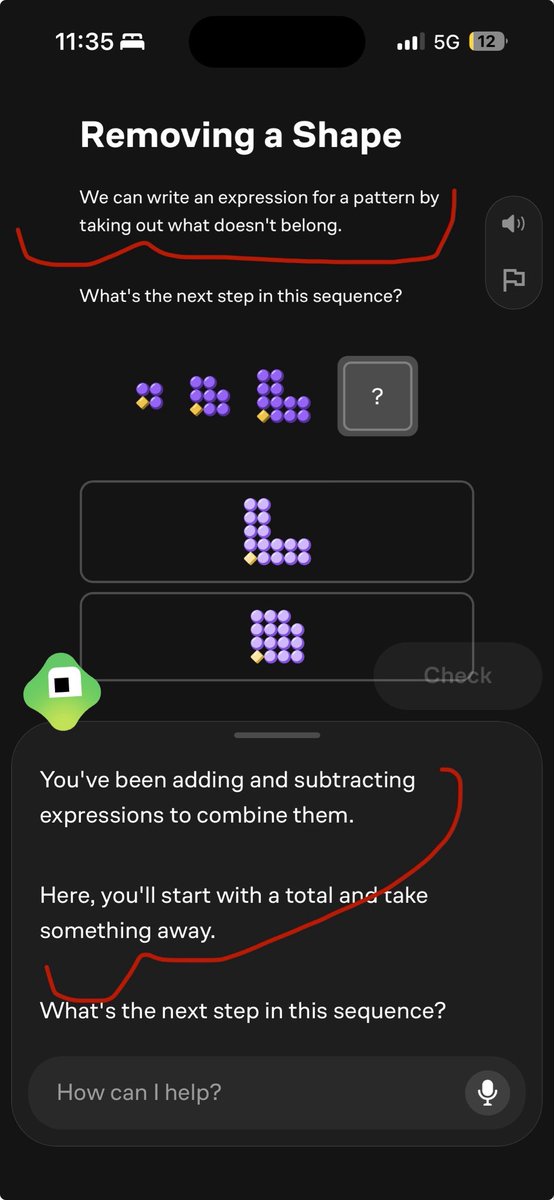
In new AI tutor mode, I feel unnecessary cognitive load in some of the problems, where Koji’s voice content differs much from the short introductory text. Because now I have to both listen the audio and read the text to ensure I didn’t miss anything.
@mrdavenport@pcho I didn’t feel this issue when Koji speaks exactly what’s in the introduction or when the introduction contains a part of the voice content or when the introduction is too short.
It looks like “redundancy effect” and “split attention effect” from Cognitive Load Theory.