Yesterday, at the request of the Honourable Sam George, Minister of Communications, Digital Technology and Innovation, my team of technology policy experts and I met with the Minister and his team,including technical leads, heads of agencies, associates, and lawyers, for five nonstop hours to discuss MANI's 98-page review report of his Ministry's bills. It was very productive. Thank you.@samgeorgegh
Newsfile ended. The questions did not. After listening to @samgeorgegh and @NITAGhana Director-General Dr. Mark-Oliver Kevor on Newsfile, one issue stood out: transparency.
“Trust us” is not a regulatory framework. The revised drafts may be documents, but the larger issue is democratic. Who gets to see the evolution of laws that will shape Ghana’s digital future: everyone, or only a select few?
Read more:
🔗 https://t.co/t5NaAXe7qZ
When citizens are consulted only after decisions are already politically packaged, representation quietly becomes assumption. Democracy is not a four-year transfer of public thinking power. The vote gives leaders authority to represent, not permission to replace the voice, participation, and judgment of the people.
Read more:
🔗 https://t.co/HoSMDBdVJs
IMANI's VP, @BBSimons, has delivered a sharp critique of the proposed NITA Bill, warning that the legislation risks becoming a dangerous overreach that could undermine Ghana’s digital economy, innovation ecosystem, and technology sector growth.
https://t.co/RYfDR0Coay
#IMANI
“Ka bi, ma me nka bi” and the Question of Who Gets to Say What, When and How
A new governance analysis from IMANI examines the growing tension between free expression, selective law enforcement, and political power in Ghana’s democracy.
Drawing on political rhetoric, arrest data, public perception surveys, and recent speech-related prosecutions, the article argues that freedom of expression in Ghana is increasingly shaped not by constitutional equality, but by proximity to political influence and institutional protection.
Using the Akan democratic philosophy, “Ka bi, ma me nka bi,” which translates to “say some, and let me also say some,” the piece questions whether ordinary citizens truly enjoy the same protections as political elites when expressing controversial opinions.
The analysis highlights:
🔸 Rising arrests linked to speech and online commentary.
🔸 Concerns over selective enforcement of “false publication” laws.
🔸 Declining public trust in judicial fairness and accountability.
🔸 The growing perception that powerful figures are treated differently under the law.
“When the law is applied selectively, it ceases to be a tool of justice and becomes an instrument of intimidation.”
Referencing Afrobarometer and Media Foundation for West Africa data, the analysis argues that Ghana’s speech environment increasingly reflects unequal legal exposure between ordinary citizens and politically connected actors.
The piece also examines the broader institutional incentives within law enforcement and raises concerns about the criminalisation of online commentary, political criticism, and digital expression.
Read the full analysis on our website:
🔗 https://t.co/TVekqd7JYZ
#IMANIvoices #FreeSpeech #RuleOfLaw #Governance #Democracy #CivilLiberties
8. CLAIM:
“The concerns are exaggerated.”
REBUTTAL:
The economic implications are not theoretical.
The fee structures publicly cited include:
GH₵35,000 for Data Brokers,
GH₵30,000 for Cybersecurity Providers,
GH₵28,000 for Data Analytics Providers,
GH₵20,000 for Fintech Entities,
GH₵10,000 for E-Commerce Platforms,
GH₵6,000 for Mobile Application Developers.
Inside an economy battling:
unemployment,
startup mortality,
unstable electricity,
weak venture capital access,
and collapsing purchasing power.
Then citizens are told this is merely:
“regulatory burden.”
The frightening part is not merely the fees.
It is the philosophy hiding underneath them.
Healthy regulation says:
“Operate responsibly.”
Dangerous regulation says:
“You require our continuing permission to exist.”
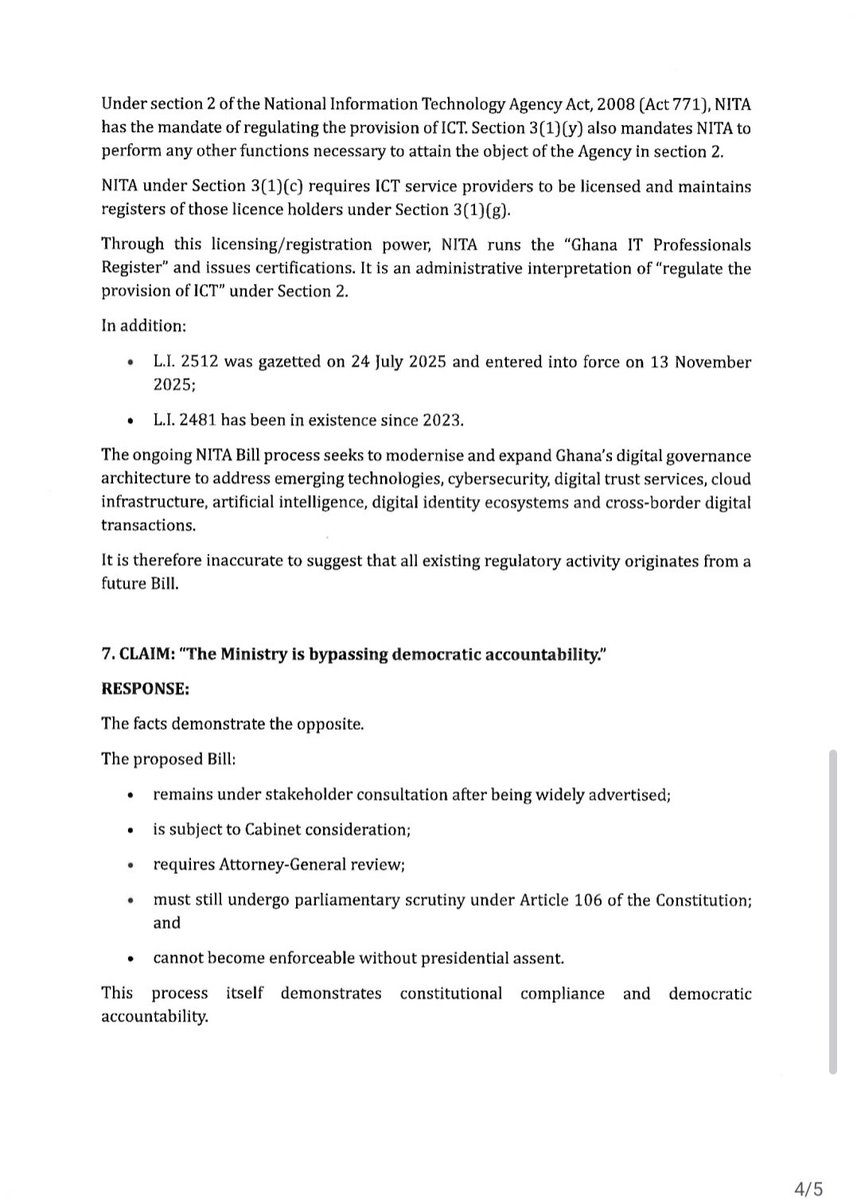
7. CLAIM:
“The Ministry is following democratic process and consultation.”
REBUTTAL:
Consultation alone does not cure constitutional overreach.
A stakeholder meeting cannot magically create powers Parliament never clearly granted.
The deeper concern is whether executive agencies are gradually constructing:
economic control systems,
licensing ecosystems,
recurring fee structures,
and layered compliance regimes
first, then searching for constitutional reinforcement afterward.
That is the fear underneath this controversy.
And the proposed Bill itself appears to acknowledge the current legal gaps by attempting to expressly create powers now being defended through broad interpretation.
6. CLAIM:
“Act 772 allows ICT licensing and certification.”
REBUTTAL:
This is perhaps the weakest part of NITA’s public defense.
The Electronic Transactions Act, 2008 (Act 772) was never designed as a universal occupational licensing regime for ordinary ICT professionals.
Act 772 specifically targets:
authentication services,
encryption services,
digital certificates,
and related electronic transaction infrastructure.
More dangerously for NITA, Section 38(1) expressly states:
“A licence shall not be issued or granted by the Agency to an individual.”
That sentence alone detonates a large portion of the present confusion.
Because:
software developers,
coders,
app creators,
UI designers,
data analysts,
and ordinary ICT professionals
are natural persons.
Act 772 was not constructed like:
the General Legal Council,
the Medical and Dental Council,
or other statutory professional licensing bodies.
No comprehensive occupational licensing architecture exists inside Acts 771 or 772 for ordinary ICT practitioners.
None.
5. CLAIM:
“NITA is not acting ultra vires.”
REBUTTAL:
The ultra vires concern exists precisely because NITA appears to be extending broad statutory wording beyond Parliament’s clear intention.
The Supreme Court has repeatedly affirmed that statutory bodies must remain within the four corners of their enabling legislation.
That is precisely why:
Article 23,
Article 296,
and the ultra vires doctrine exist.
Article 23 requires administrative bodies to act:
fairly,
reasonably,
and within lawful authority.
Article 296 prohibits arbitrary exercise of discretionary power.
Government agencies cannot simply discover a broad phrase like:
“regulate ICT”
and interpret it as ownership papers over Ghana’s entire digital economy.
4. CLAIM:
“The fees are lawful because they exist in L.I. 2512.”
REBUTTAL:
This is where NITA’s legal position begins sweating heavily under constitutional scrutiny.
A pricing schedule is not a constitutional birth certificate for regulatory authority.
The Fees and Charges (Miscellaneous Provisions) Act was fundamentally designed as a national pricing framework for services already lawfully grounded elsewhere in statute.
Not as a magical legal factory for manufacturing entirely new supervisory empires.
Pricing does not equal permission.
Revenue collection does not automatically become constitutional authority.
And bureaucratic appetite does not become law merely because an invoice was gazetted.
The existence of a fee inside a Legislative Instrument does not automatically validate the entire underlying regulatory architecture.
Courts still examine:
statutory grounding,
proportionality,
administrative fairness,
constitutional compatibility,
and ultra vires conduct.
Always.
3. CLAIM:
“The proposed Bill is not secretly being operationalised.”
REBUTTAL:
The problem is not merely whether the Bill has formally passed.
The problem is whether operational structures associated with the future regulatory architecture were already being functionally deployed before Parliament completed scrutiny.
Citizens discovered:
registration portals,
certification systems,
compliance structures,
renewal frameworks,
fee schedules,
and quasi-licensing ecosystems
already targeting broad sections of the digital economy.
That naturally triggered constitutional concern.
Because the public narrative initially presented these systems as future-facing reforms tied to the proposed Bill itself.
Then after backlash, the explanation shifted to:
“No, these systems already existed.”
That contradiction is precisely what triggered public suspicion.
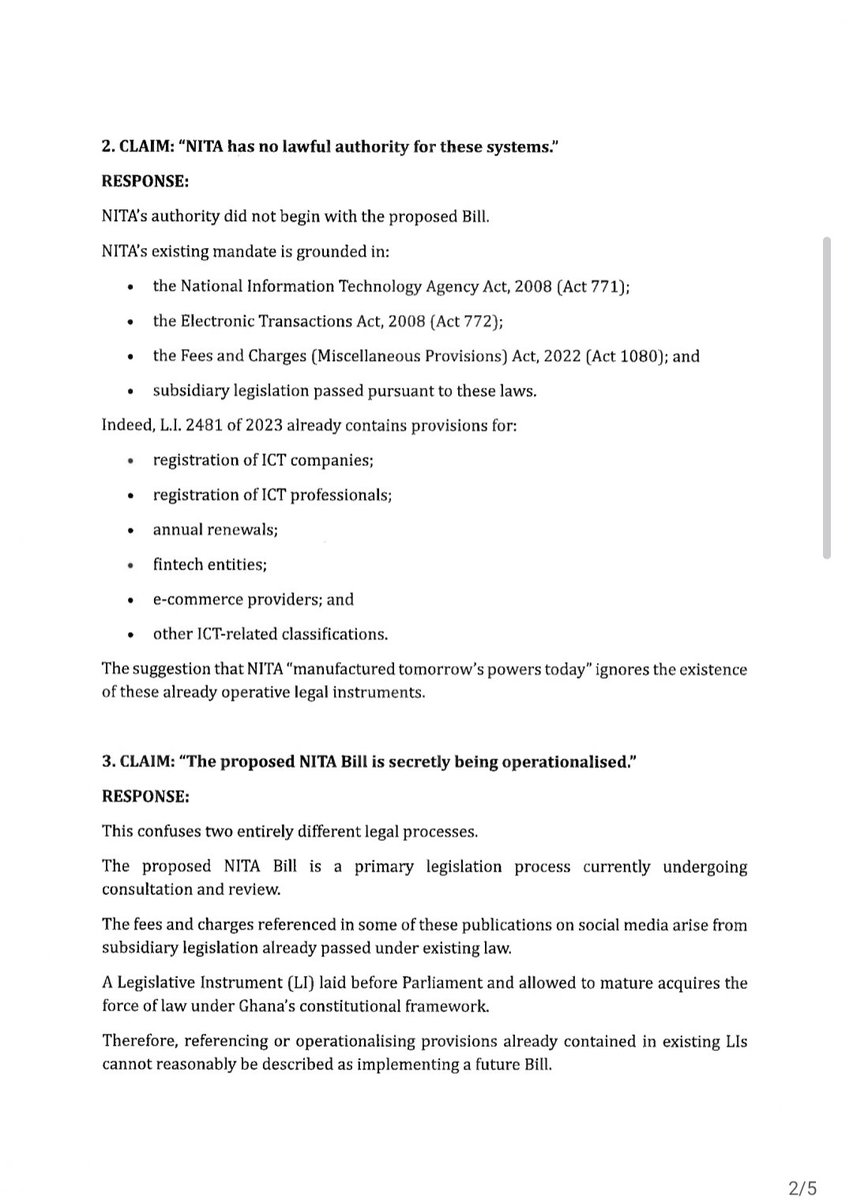
2. CLAIM:
“NITA already has lawful authority under Acts 771, 772 and existing LIs.”
REBUTTAL:
Regulatory authority is not infinite authority.
Act 771 gives NITA broad coordination and ICT regulatory objectives. It does not expressly establish a universal occupational licensing regime over broad categories of ICT professionals, startups, fintechs, cloud providers, app developers, digital creators, or private digital enterprises.
Nothing inside Act 771 explicitly authorises the monetised gatekeeping ecosystem now emerging around Ghana’s digital economy.
NITA’s interpretation stretches infrastructure regulation into occupational and commercial control.
That distinction matters enormously in constitutional law.
Public institutions are creatures of statute.
They possess only powers:
expressly granted; or
necessarily incidental to lawful functions.
Not powers manufactured through broad interpretation and defended later through press statements.
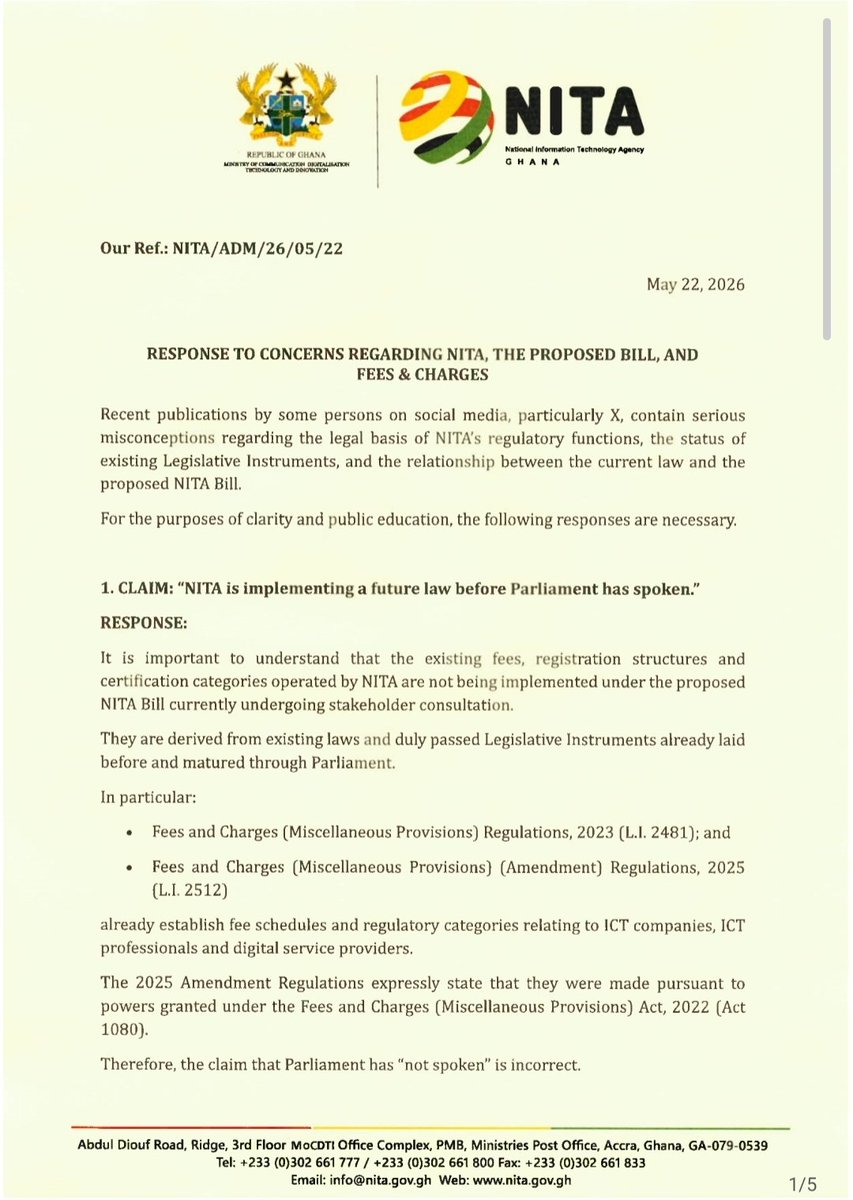
1. CLAIM:
“NITA is implementing existing law, not a future Bill.”
REBUTTAL:
This defense creates the central contradiction now haunting the entire controversy.
For months, the Ministry publicly justified the proposed NITA Bill as necessary to modernise Ghana’s digital governance architecture through expanded regulatory systems involving AI governance, cybersecurity oversight, licensing reforms, certification frameworks, compliance structures, cloud regulation, and digital trust services.
Then, once scrutiny intensified, the explanation suddenly changed to:
“These powers already existed.”
Those two positions cannot comfortably coexist forever under constitutional examination.
Because if Acts 771 and 772 already adequately empower NITA to run this sprawling ecosystem, then the constitutional urgency behind the proposed Bill itself becomes deeply questionable.
Why seek broader statutory reinforcement for powers already allegedly sufficient?
The proposed Bill itself quietly exposes the weakness in the current framework.
It reads less like ordinary reform and more like retroactive legal reinforcement for powers already being exercised ahead of clear statutory grounding.
Should governments license software developers and ICT professionals?
A new IMANI analysis argues that Ghana’s proposed NITA licensing framework risks creating barriers to innovation, digital entrepreneurship, and technological growth.
https://t.co/NFze9839c7
#IMANI
@samgeorgegh Arrogance is not constitutional authority.
The moment government officials start dismissing legitimate public concern as “bandwagon noise” and “spurious claims,” while hiding behind aggressive press releases instead of humble constitutional clarity, something dangerous begins creeping into governance.
You do not regulate a digital economy by sounding irritated that citizens dared to read the law too.
That tone is exactly what alarms people.
Because democracies decay quietly when public servants begin behaving like irritated landlords of state power instead of temporary custodians under constitutional limits.
Nobody is attacking technology.
People are questioning whether Ghana is slowly building a permission-based digital economy where innovation survives only after paying tribute to layered bureaucratic gatekeepers.
That concern is legitimate.
A ministry that truly feels constitutionally secure does not respond like a wounded empire caught sweating under bright civic scrutiny.
It responds with precision, restraint, humility, and clear statutory grounding.
Not contempt.
I have always reiterated that personally and officially, I am always open to informed and constructive criticism and opinions.
Criticisms that jump on bandwagon trends and fail to be based on fact are treated with contempt because they are not only mischievous but intended to misinform.
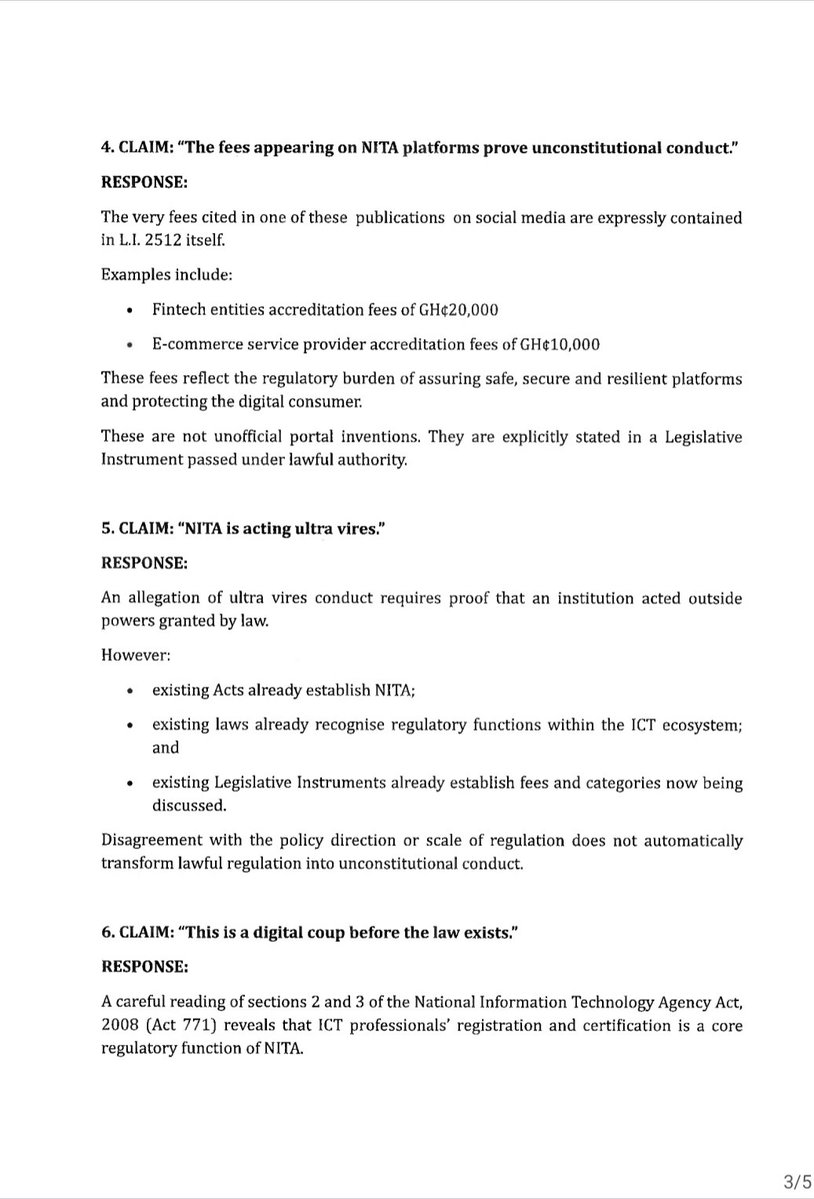
To all the 'IT Professionals' who all of a sudden are making all manner of spurious claims that the @MoCDTI through its Agency - @NITAGhana - is acting illegally, please read the National Information Technology Agency Act, 2008 (Act 771), Electronic Transactions Act, 2008 (Act 772), the Fees and Charges (Miscellaneous Provisions) Regulations, 2023 (L.I. 2481) and the Fees and Charges (Miscellaneous Provisions) (Amendments) Regulations 2025 (L.I. 2512).
The Ministry is simply ENFORCING existing legislation that has been on our books since 2008, 2023 and 2025. The proposed new legislation has NOT even been laid before Parliament.
I welcome anyone to point out which specific action of the Agency is NOT backed by a provision under the stated legislation. We have a Country to build, and we will ensure enforcement and sanity in our Technology space. Cheers.
9. FINAL CONSTITUTIONAL QUESTION
The issue is no longer simply whether NITA can regulate aspects of ICT.
The issue is whether Ghana is drifting toward a future where executive agencies begin constructing broad economic control systems first and searching for constitutional permission afterward.
First comes:
centralisation,
registration,
licensing,
certification,
renewals,
fees,
layered compliance,
overlapping institutional control,
and finally aggressive institutional responses whenever citizens ask dangerous constitutional questions.
The quiet comedy underneath NITA’s response is that an entire state institution wrote pages defending itself while carefully avoiding the citizen whose arguments forced the response into existence.
The answer now must be:
civic vigilance,
constitutional restraint,
transparent lawmaking,
and citizen-led accountability
before administrative overreach quietly becomes normalised.
8. CLAIM:
“The concerns are exaggerated.”
REBUTTAL:
The economic implications are not theoretical.
The fee structures publicly cited include:
GH₵35,000 for Data Brokers,
GH₵30,000 for Cybersecurity Providers,
GH₵28,000 for Data Analytics Providers,
GH₵20,000 for Fintech Entities,
GH₵10,000 for E-Commerce Platforms,
GH₵6,000 for Mobile Application Developers.
Inside an economy battling:
unemployment,
startup mortality,
unstable electricity,
weak venture capital access,
and collapsing purchasing power.
Then citizens are told this is merely:
“regulatory burden.”
The frightening part is not merely the fees.
It is the philosophy hiding underneath them.
Healthy regulation says:
“Operate responsibly.”
Dangerous regulation says:
“You require our continuing permission to exist.”