windows, without the ctrl+c list: region record to mp4, clipboard history, Win+X for the whole admin menu.
22 keys, in the card.
which one are you stealing?
Claude code: 22 keys nobody uses - rewind a whole conversation, stash a half-written prompt, background the running agent.
all 22 are in the card. save it.
grok, cursor and windows are below ↓
which one had you not seen?
cursor accepts an autocomplete one word at a time — Ctrl+→. almost nobody finds it.
22 keys like that, in the card.
last one: windows ↓
what's the one you'd add?
prompting isn't a skill.
saying exactly what you want is a skill - the same one that makes someone good at briefing a person.
we gave it a new name and started charging for it.
what's the last thing you had to re-explain to both a colleague and a model?
2023: "please can you write me an essay about X" "oh my god this is incredible, thank you so much"
2026: "no. shorter. stop adding em dashes. that's not what i asked. try again."
the models changed. so did we, we went from grateful to annoyed in about eighteen months, and we talk to it now the way we talk to a printer that isn't working.
which one are you?
i saved the same picture four ways:
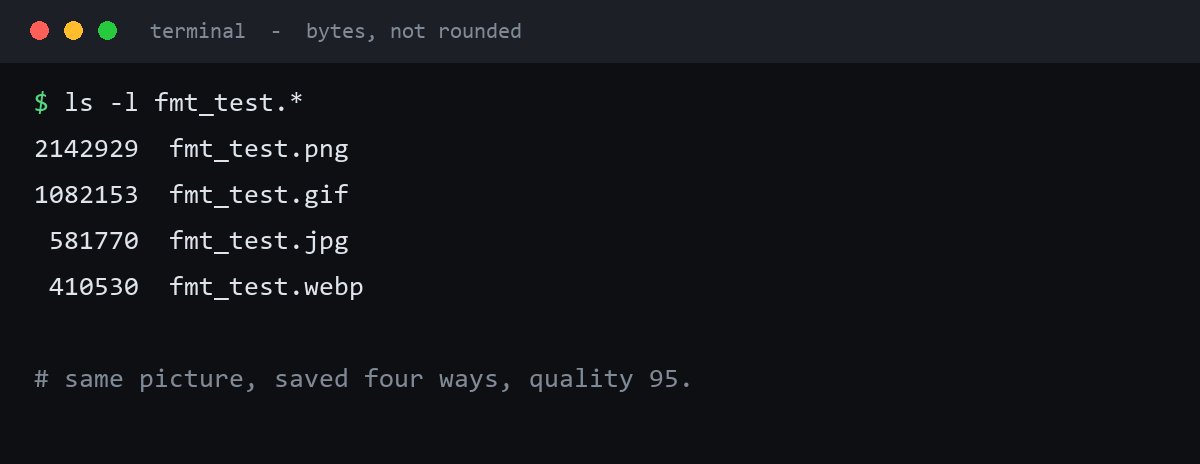
png 2.14 MB
gif 1.08 MB
jpeg 0.58 MB
webp 0.41 MB
jpeg and webp are a quarter of the size because they throw away detail they think you won't notice, and they never give it back. png keeps every pixel and charges you for it.
every screenshot you send is that trade.
did you know which one to pick before now?
September 5, 1977, 12:56 UTC. Voyager 1 leaves Earth.
It has been flying for 49 years. It is now around 25.6 billion kilometres away, which makes it the most distant object humans have ever built. It runs on a nuclear power source that loses about four watts of output every year, and the only reason it still works is that engineers keep switching instruments off to save the power.
Some time in November 2026 it crosses a line that's strange to think about: it becomes one full light day from Earth. If you sent it a message then, it would take twenty-four hours to arrive, and twenty-four hours for the answer.
Its radio signal reaches us at a fraction of a billionth of a watt. Most of the people who built it are gone. The ones still working on it are in their eighties. It is still transmitting, and it will keep going after every one of us stops listening.
the longest thing you'll ever work on — do you expect to see it finished?
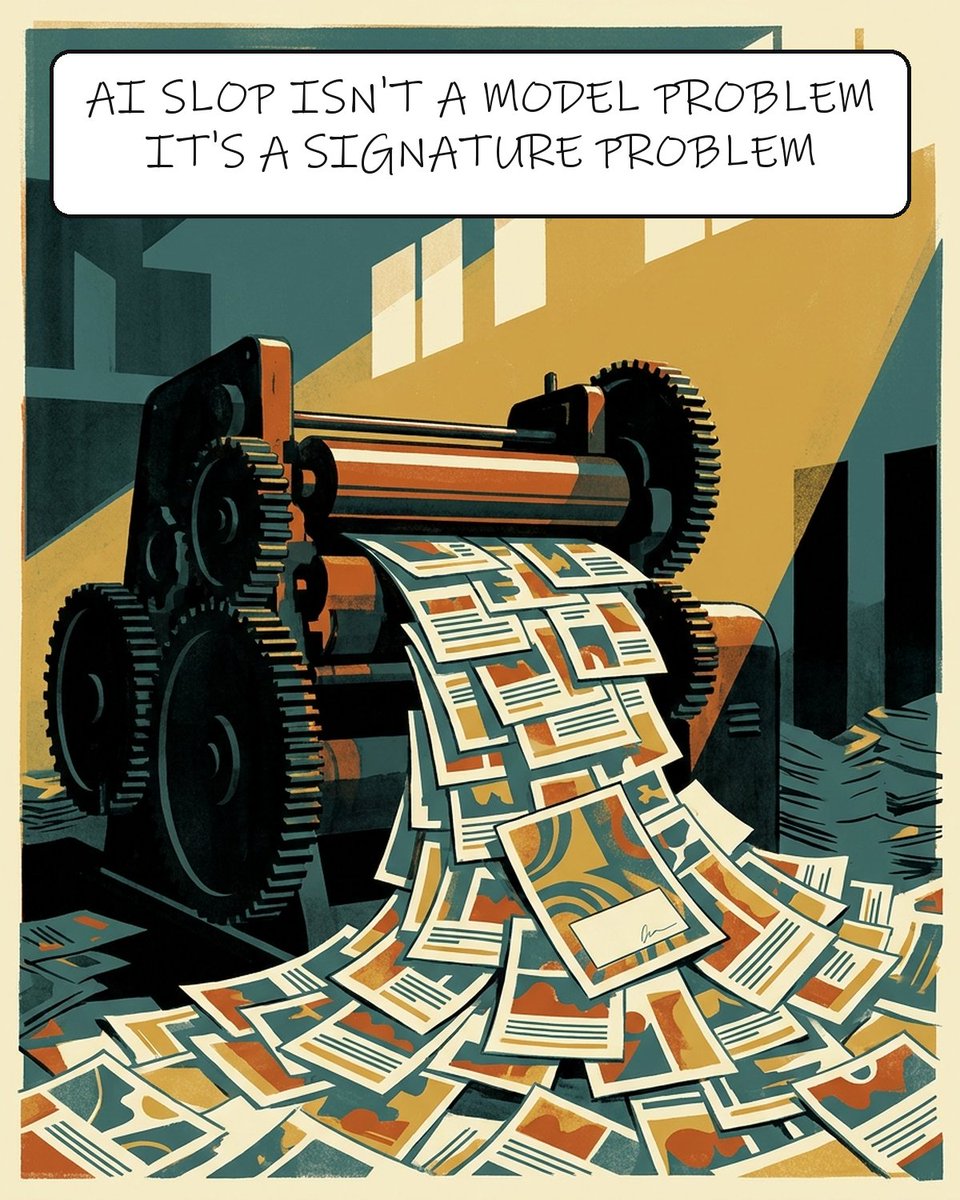
AI slop isn't a model problem. It's a signature problem.
We spent a hundred years building a culture where your name on something meant you stood behind it. Then we built a tool that produces work faster than anyone can be bothered to sign it.
That's the whole thing.
what's the last thing you read online where you actually knew who wrote it?
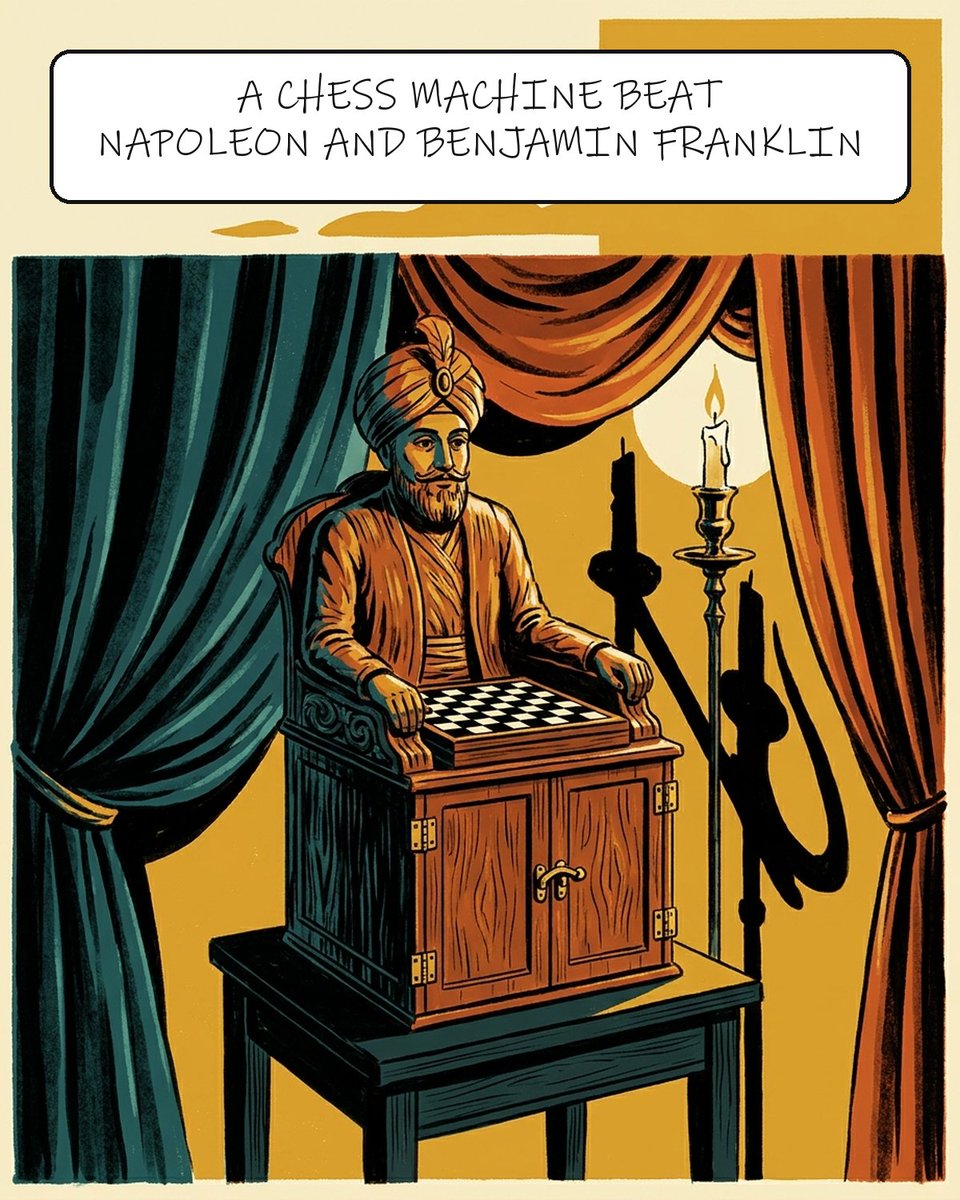
1770. A chess machine is unveiled for Empress Maria Theresa. It goes on to tour Europe for 84 years, beating Napoleon Bonaparte and Benjamin Franklin.
There was a man inside it.
Wolfgang von Kempelen built it after a French illusionist upstaged him at the Empress's court. The cabinet was carved to look like a seated man in a turban, with a chessboard in its lap. In the compartment underneath sat a chess master, following the game and moving the pieces with levers and magnets. The operator changed over the years. Everyone suspected the trick, but nobody described it accurately while the machine still existed.
It burned in a fire in 1854. The first full explanation came in 1857, from the son of one of its owners.
Amazon named its crowdsourcing service after it. Human beings, doing the work a machine appears to be doing.
The machine that beat Napoleon at chess had a chess master inside it.
what's the oldest piece of technology you ever believed was magic?
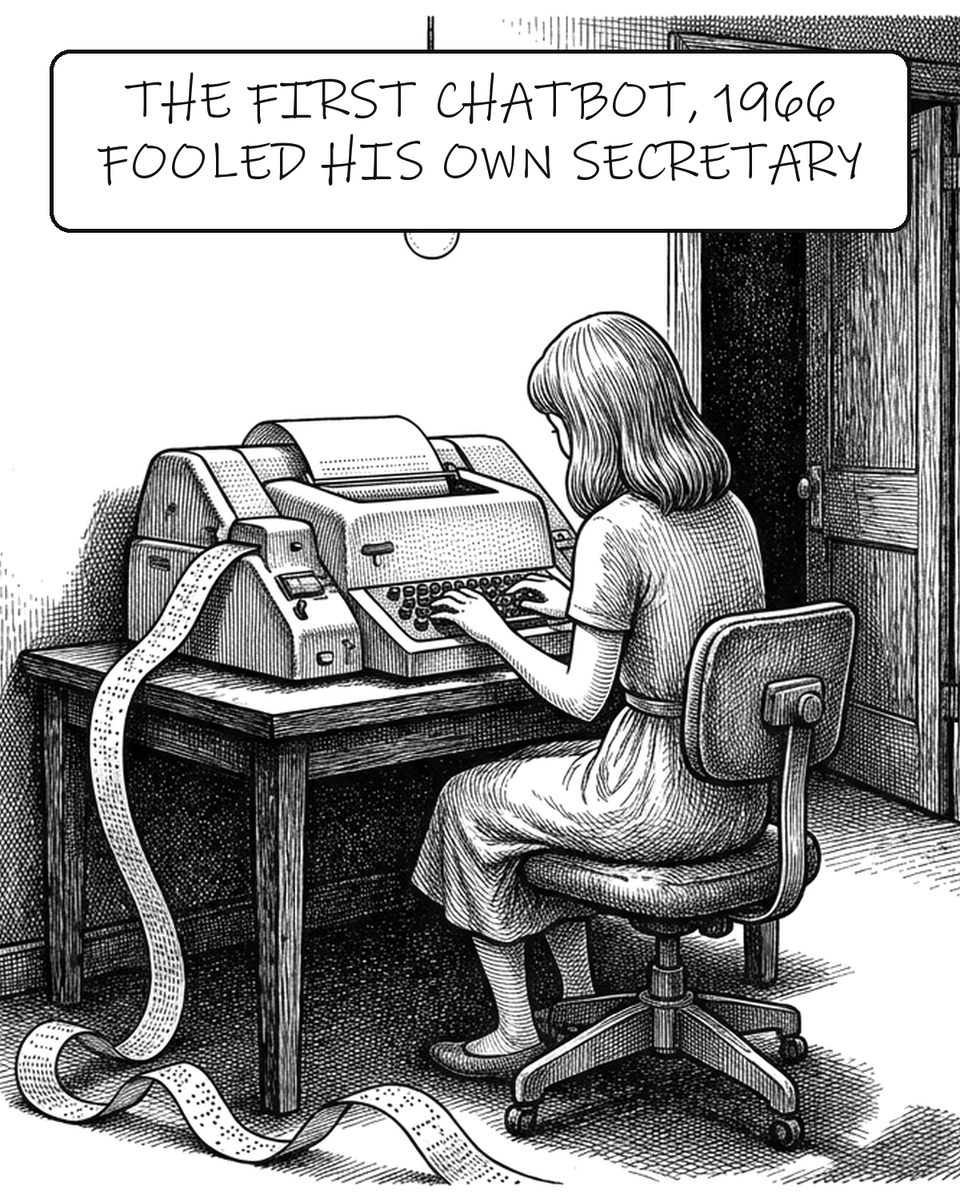
1966. MIT. A program called ELIZA that you could type to, and it typed back like a therapist. It understood nothing.
No model. No training. No data. A few hundred lines of pattern matching that scanned your words for keywords and reflected them back at you as questions.
Its author, Joseph Weizenbaum, built it to prove that machine understanding was an illusion.
Then his own secretary asked him to leave the room so she could talk to it in private.
He wrote afterward that he hadn't realized "extremely short exposures to a relatively simple computer program could induce powerful delusional thinking in quite normal people." That's from his 1976 book, Computer Power and Human Reason.
The effect has a name now. The ELIZA effect. Humans fill in the understanding that isn't there.
The original source code was lost for 55 years. It turned up in the MIT archives in 2021. It still runs.
60 years on, we're still arguing about exactly the same thing.
what's the most human thing an AI has ever said to you?
I tested what actually gets seen on here last week.
8 posts. my threads peaked at 36 views, the rest sat between 11 and 16.
one video post: 454.
a 10k account in my niche posted a list like mine: 145,000 views.
turns out the content wasn't the problem. the first hour was.
what's your biggest post ever, and what was different about it?
What 1 million tokens costs across AI labs right now — output pricing, straight from their own pages:
🧠 Claude Fable 5.1 ~ $50
🤖 GPT-6 Astra ~ $50
🧠 Claude Opus 5 ~ $25
🤖 GPT-5.6 Sol ~ $20
🤖 GPT-5.6 Terra ~ $12
🧠 Claude Sonnet 5 ~ $10
🧠 Claude Haiku 4.5 ~ $5
💎 Gemini 3.8 Flash ~ $3.75
🐋 DeepSeek V4 Pro ~ $1.98
🤖 GPT-5.6 Luna ~ $1.20
🐋 DeepSeek Flash ~ $0.60
Same unit. Same 1 million tokens. An 83x price gap between the top and the bottom.
The frontier is not where the value is — but it's where the attention is.
Input prices range from $0.15 to $10. Full breakdown in the reply.
Which one do you actually pay for — and what are you running on it?
The 7 originals — open them, these creators deserve the views:
• https://t.co/wPvWC9jjfX
• https://t.co/cEH1dcbbDs
• https://t.co/OWRefaeEbd
• https://t.co/3f4jCM2JJZ
• https://t.co/hkPQdOQq91
• https://t.co/KRLCobnSOA
• https://t.co/2qxIiGuU7f
The Seoul prompt is in post 6, @EHuanglu's full chat log is in his thread.
Which one fooled you into thinking it wasn't AI?
Follow — I aggregate what's actually working in AI so you don't have to scroll.
For the first time in history, GPT-6 Astra created a fly that is simply a fly.
Not a chatbot pretending to be a fly. Not a simplified animation.
A digital fly running its own connectome brain, perceiving a real room through its own senses and interacting with the environment using the power of AR.
The entire loop is surprisingly wild:
Spectacles capture the retina, light rays, hands, and the surrounding room → the room is converted into an inventory → sensory information is fed into the fly’s neural system → the MaleCNS connectome processes it → descending neurons and motor pools generate actions → the commands return to the Spectacles → wings, legs, and head respond.
In other words, the fly sees through its own eyes, processes the world through its own simulated brain, and acts through its own virtual body.
We are moving from AI that generates outputs to AI that actually has a body, senses, a brain, and a closed perception-action loop.
The 🪰 is no longer just simulated.
It is experiencing a world
The developer @pt_pavlo is pinned below in the post
GPT-6 Astra is 4 days old and the outputs are already unreal.
1/ Living worlds, not 3D models
@tomkrcha generated BOTH trains at runtime from TypeScript + Three.js — no 3D model files, just geometry functions.
His technique, verbatim: "You want 100 wheels next to each other? It's just 1 wheel with a for loop and different properties."
10K likes in 48 hours.
6 more below — every video is the real output, credited 🧵
7/ A fly that is simply a fly
Built by @pt_pavlo, posted by @ZentrixHQ: Spectacles capture the room → the room becomes a sensory inventory → the fly's connectome brain processes it → motor neurons fire → wings, legs and head respond.
A closed perception–action loop. Simulation, not animation.