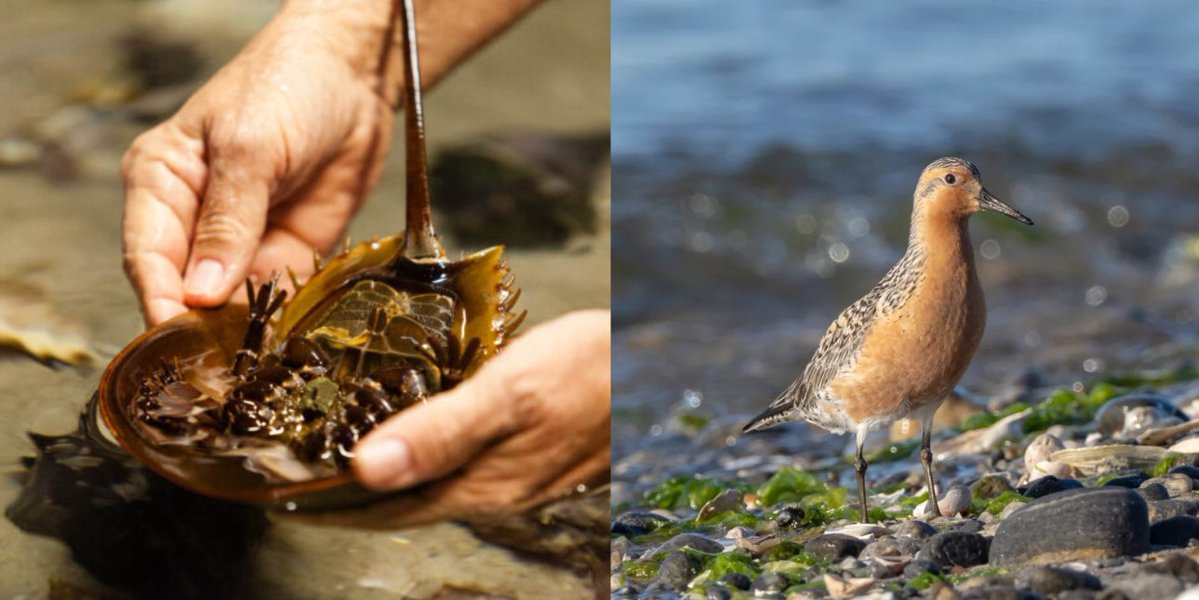
Two-thirds of the horseshoe crabs taken from Delaware Bay get chopped up for bait. It's caused one shorebird to decline by 94%.
Fishermen cut up horseshoe crabs to bait traps for eel and whelk. Unlike the biomedical harvest, where crabs are bled and released, none of these come back.
Every spring, rufa red knots fly from the southern tip of South America to the Arctic. Nine thousand miles. Partway up they stop at Delaware Bay, timed to the exact two weeks when horseshoe crabs are spawning, and eat almost nothing but crab eggs.
They need to roughly double their body weight in that window. It's the only refueling stop on the route that works.
Fewer crabs, fewer eggs. A bird that arrives and can't put on the weight doesn't make it to the Arctic, and if it does, it doesn't have the reserves to breed.
The rufa red knot population is down as much as 94% over 40 years. It's listed as threatened.
The whole thing runs on a two-week overlap between an animal that predates trees and a bird crossing two continents. Take enough crabs off that beach and the overlap stops working.
Please sign
Petition to help South Africa save the Pangolins
A Million Pangolins Were Trafficked in a Decade. South Africa Is Fighting It Nearly Alone.
Eight pangolin species are now threatened with extinction and four are critically endangered.
https://t.co/AupvVb3Prv