Heartiest congratulations to Purnima Devi Barman, distinguished wildlife biologist and conservationist, on being named a recipient of the prestigious 2026 Wayfinder Award presented by the National Geographic Society and Kia America.
A celebrated conservation champion from Assam, she has earned global recognition for her remarkable efforts in protecting and restoring the population of the Greater Adjutant Stork (Hargila), inspiring communities and advancing wildlife conservation through her dedication and leadership.
Wishing her continued success in her mission to safeguard biodiversity and bring pride to Assam and India.
@StorkSister 🙏
@IthassPunjyab Nau Nihal was married to a girl from Fatehgarh Churian, a grand wedding function over many days and attended even by the British invitees. Incidentally, my village is right there. In my childhood saw buildings from that period. Now all gone.
As you watch Aaron Rai in the PGA Championship, you might notice he uses iron covers for his clubs and wears two gloves — two habits often viewed as golf faux pas. But both are actually inspiring.
Rai grew up in a working-class family in England, where his father sacrificed heavily to support his golf career. When Aaron got an expensive set of irons as a kid, his dad would clean every groove with a pin and baby oil after practice because the clubs meant that much to them. The iron covers became a reminder to appreciate what you have.
And the two gloves? Rai started wearing them as a kid during cold-weather golf in England and eventually became so comfortable with the feel that he never stopped.
Not gimmicks. Just gratitude… and comfort.
He was Satyendra Nath Bose, an Indian physicist whose quiet brilliance in the 1920s forever altered our understanding of the quantum world.
In 1924, Bose, then a 30-year-old professor in British India, sent a groundbreaking manuscript directly to Albert Einstein. The paper offered a novel, more elegant derivation of Planck's law for blackbody radiation by treating light quanta (photons) as indistinguishable particles—a radical departure from classical statistical methods. Impressed by its insight, Einstein personally translated the work into German and facilitated its publication in the prestigious Zeitschrift für Physik.
This exchange sparked a brief but profound collaboration. Einstein extended Bose's statistical approach to material atoms, predicting a bizarre new state of matter at ultra-low temperatures: what we now call a Bose-Einstein condensate (BEC), where particles behave as a single quantum wave. Bose's original framework became known as Bose-Einstein statistics, and the class of particles that obey it—those with integer spin, including photons, gluons, W and Z bosons, and the Higgs boson—was later named bosons in his honor by Paul Dirac.
Unlike fermions (matter particles like electrons), which obey the Pauli exclusion principle and cannot occupy the same quantum state, bosons can pile into identical states en masse. This "social" behavior underpins extraordinary macroscopic phenomena: the coherent light of lasers, the zero-resistance flow in superconductors, and the collective quantum coherence in BECs.
Despite the monumental impact—his statistics describe half of all fundamental particles and enabled key advances in quantum field theory, condensed matter physics, and particle physics—Bose remained remarkably unassuming. He continued teaching at universities in Dhaka and Calcutta (now Kolkata), mentored students, pursued ideas in X-ray crystallography, unified field theory, and other areas, and never sought the spotlight. Nominated several times for the Nobel Prize (notably for Bose-Einstein statistics and his later work), he was never awarded it, and his name rarely appears in popular accounts of 20th-century physics.
There's a poignant humility in his story: a man whose legacy literally names one of the two fundamental families of particles in the universe, yet whose personal fame never matched the scale of his contribution. Bose reminds us that true influence often arrives without fanfare. Some breakthroughs echo through textbooks and technologies, while their creators work in the background, content to let the universe carry their ideas forward—even if history's spotlight rarely finds them.
@PanjabiBlood99 Its a buzzard, more likely a Common Buzzard. If the video is from Punjab, it should be told that it an offence under wildlife act 1972 to keep this bird as a pet.
Gujarat sees a GIB chick after a decade, through a novel conservation measure - the jumpstart approach, coordinated by the Ministry, State Forest Departments of Rajasthan and Gujarat, and Wildlife Institute of India.
Envisioned by PM Shri @narendramodi ji in 2011 to conserve GIB in its natural habitats including Gujrat, Project GIB was launched in 2016.
As a result the number of birds in conservation breeding centres, started at Sam and Ramdevra in Rajasthan, have reached 73 with addition of 5 new chicks in this season and we are moving ahead towards rewilding of birds in near future.
In achieving another milestone, a female GIB, tagged in August 2025, had laid an infertile egg in Kutch, as this population has lost all its males long back. In a major trans-state conservation effort, a captive-bred GIB egg from the conservation breeding program in Rajasthan was transported by road over 19 hours in a handheld portable incubator and was replaced in the nest on 22 March.
The female completed incubating this fertile egg and hatched it on March 26. The field monitoring team found the young chick being reared by its foster mother.
This effort is among one of the many steps to recover the critically endangered Great Indian Bustard populations.
With the commitment to save GIB, we are making great progress in India’s conservation journey.
Congratulations to all scientists, field officers and wildlife enthusiasts who made this possible.
We are keeping our fingers crossed for the survival of the chick. At the same time we remain committed to leaving no stone unturned to make the endeavour successful.
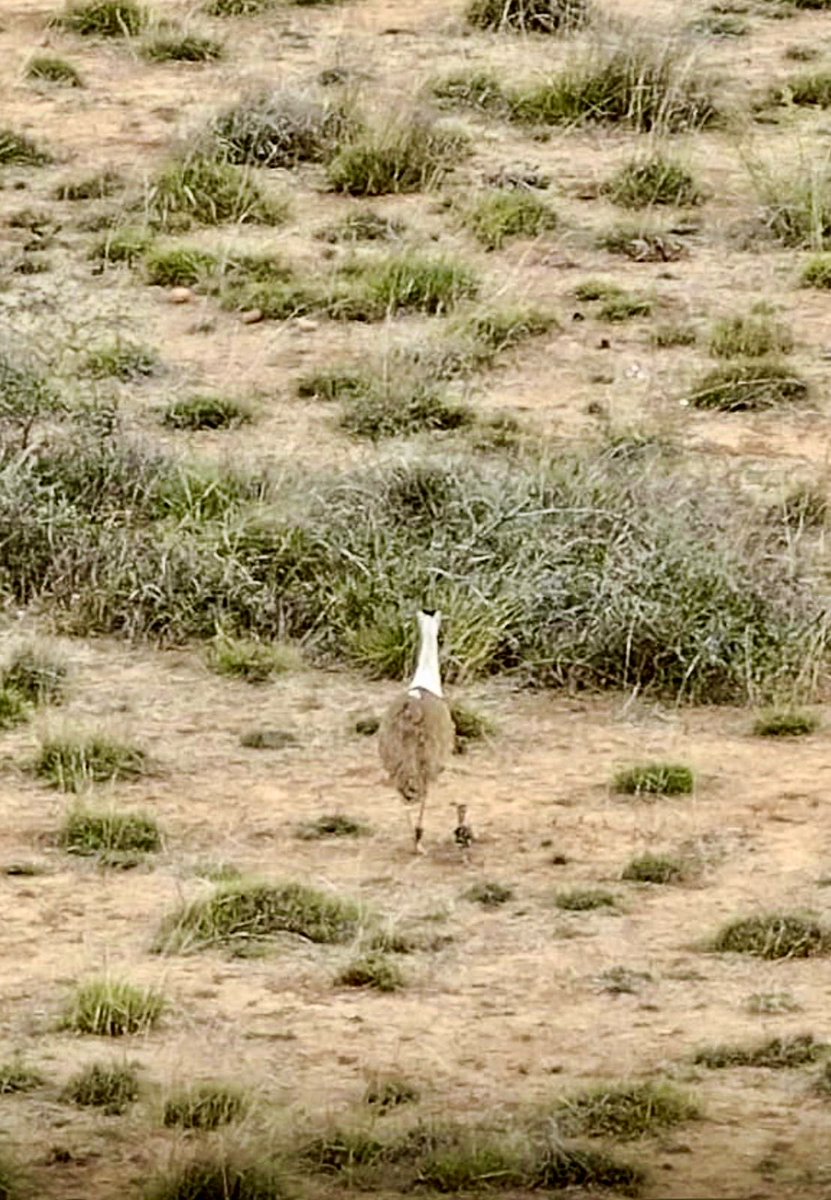
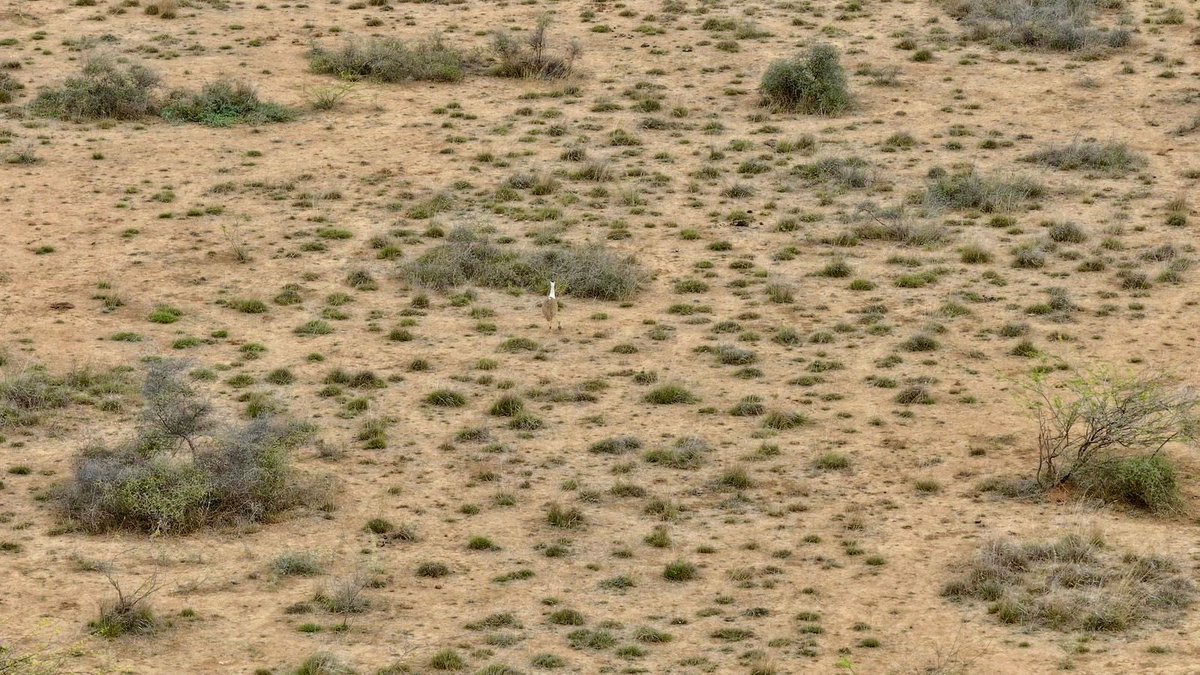
🎥 The GIB takes a stroll with her chick.
Dr. Zach Bush shares a mind-blowing nature insight: Birdsongs in each region have evolved to interact with tree pores (stomata), helping them open to breathe more oxygen and CO₂—kickstarting the life cycle.
Historical / science nugget: Studies on plant bioacoustics (e.g., from Yeungnam University and others) show sound vibrations—like birdsong or "green music"—can influence stomata opening, boost nutrient/water uptake, and enhance growth by triggering molecular changes in plants. While not every regional birdsong is proven to "perfectly match" local trees, vibrations from natural sounds act as a gentle signal for better respiration and vitality.
Bush extends it to us: Nature's sounds and beauty do the same for the human body—up-leveling metabolism, energy, and resilience no matter diet or toxins around you.
Get outside aggressively—listen to the birds, feel the shift. Nature is the ultimate viral healer.
What's your favorite way nature "turns you back on"—birdsong, ocean waves, forest walks?