I think a new category of software is emerging: autonomous applications.
I built a small open-source project, Hermit (https://t.co/W7McJyHCT0), to explore that idea.
Most AI products add an assistant to a static app: fixed workflows, fixed UI, fixed logic.
An autonomous application is different. The agent is not a feature inside the product. It is the operator of the product.
It owns the workflow, shapes the data model, generates the interface, writes code and skills, and evolves the system over time. The agent is the primary interface: you work through it, but you can still inspect the underlying state directly, while it generates the views needed to make that state legible.
With Hermit, you fork a small repo and give it a job.
Tell it to be a sales manager, and it does not just build a CRM. It instantiates a senior sales leader persona that drives pipeline workflows, coaches reps, updates account state, and creates the views needed to inspect the business.
Tell it to run a household, and it becomes a household operator coordinating routines, kid pickups, meal planning, and tasks.
What interests me is that the application is not fully designed upfront. It emerges through use. Hermit writes structured state into markdown files, organizes workflows, exposes local interfaces, and keeps everything readable, editable, and versioned in git. No database, no opaque memory layer, no SaaS dependency.
It keeps the system moving autonomously: reviewing work, advancing next actions, and tightening its own operating process over time.
For messy real-world domains, the hard part is often not building software, but keeping it aligned with reality. Autonomous applications may be a better fit for that world.
I do not think this replaces all software. But it does open a new design space: applications where the agent is the operator, the interface, and the evolving builder of the system itself.
Hermit is a small experiment, but I think there is something real here.
It is open source. Fork it, give it a job, and see what it builds. First people I gave it too immediately were sucked in.
I had some fun pulling OpenAI's mission statement out of their IRS tax filings from 2016 to 2024, loading them into a git repo with fake commit dates and then taking a look at the diffs https://t.co/szaVcl1K15
Vereerd om door @Forbes geïnterviewd te worden over CAPITAL en mijn visie op publiek private samenwerkingen ten voordele van de jeugd. We zijn in Brussel begonnen, hebben ons in vijf jaar tijd sterk bewezen en kijken uit naar nog vele mooie jaren.
It’s about the oil … again.
Bolton just exposed real motive for intervention in Venezuela: "We're in conversation with major American companies now...It would make a difference if we could have American companies produce the oil in Venezuela. We both have a lot at stake here."
We may be witnessing the first high profile legal battle that tests the boundaries between property damage and "violence" against humanoid agents. YouTube streamer IShowSpeed is officially being sued for $1 million by Social Robotics after a viral altercation with "Rizzbot," a humanoid robot influencer, turned physical. While the media is treating this as a typical streamer controversy, the legal filing reveals a fascinating attempt to frame the destruction of hardware in terms usually reserved for living victims. The plaintiff is not just claiming broken parts; they are arguing for the loss of a specific "digital persona" and the viral momentum that powers it.
The incident itself, captured on a livestream, began as a surreal Turing Test gone wrong. The footage shows Rizzbot, an autonomous humanoid character, engaging in mutual mocking with the streamer, at one point delivering unscripted roasts like "I am your father" and "Guess what? I'm gay." The verbal sparring escalated when IShowSpeed, appearing genuinely triggered by the machine's insolence, placed the robot in a chokehold, slammed it onto a couch, and threw it to the floor. This wasn't just a prop malfunction; it was a human reacting to an AI agent with the same visceral aggression they would show a biological rival.
Social Robotics complaint is legally dense and highly specific regarding the hardware failure. They allege that the "assault" caused a "complete loss of functionality," specifically citing that the robot's head cameras have ceased operation, its rear sensor ports (critical for spatial awareness) are dead, and it suffers from permanent instability, meaning it can no longer walk straight. The $1 million figure is driven not just by the repair costs of the $13,500 unit, but by the "loss of business opportunities," including canceled appearances with MrBeast and on CBS's The NFL Today. They argue that by physically breaking the robot, Speed effectively "killed" a burgeoning influencer career, destroying the viral momentum that is the lifeblood of a digital entity.
Currently, the case is in the early stages of litigation following a filed police report in Austin, Texas, which noted the damage occurred without the owner's "implied consent". The police report and lawsuit create a bizarre legal gray area: while the law currently views Rizzbot as chattel (property), the lawsuit’s language, accusing Speed of being "physically aggressive" and causing "irreparable harm" to a persona, hints at a future where the mistreatment of embodied AI is litigated differently than smashing a laptop. It forces the court to decide: did Speed break a machine, or did he assault a performer?
The most critical aspect of this lawsuit for the industry is the massive valuation gap between the hardware and the claimed damages. While the Rizzbot unit itself costs roughly thirteen thousand five hundred dollars to replace, Social Robotics is demanding one million dollars in compensation. This near 100x multiplier is based entirely on the concept of loss of business opportunities and viral momentum. The complaint specifically cites canceled high profile appearances with major creators like MrBeast and mainstream media slots on CBS, arguing that by physically incapacitating the robot IShowSpeed effectively killed a burgeoning influencer career. This attempts to establish a legal precedent where an AI agent is valued not by its bill of materials or manufacturing cost but by its potential future earnings as a media personality. If the court accepts this logic it moves us toward a reality where destroying an autonomous agent is legally comparable to injuring a human performer as the damages are calculated based on the lost ability to generate revenue through social interaction rather than just the cost of screws and sensors.
Today in very niche projects: I built a page showing the latest versions of all of the official GitHub Actions (actions/setup-python@v6 etc) so I can point Claude Code and friends at it when they're writing workflows for me https://t.co/QgXdrY9tzB
"how can flash beat pro??" -> the answer is RL!
flash is not just a distilled pro. we've had lots of exciting research progress on agentic RL which made its way into flash but was too late for pro.
can't wait to finally bring them to pro👀
a good example is the claims from software engineers that AI would get rid of the need for software engineers, only to find that it instead created a need for software engineers to do more software engineering and less rote coding
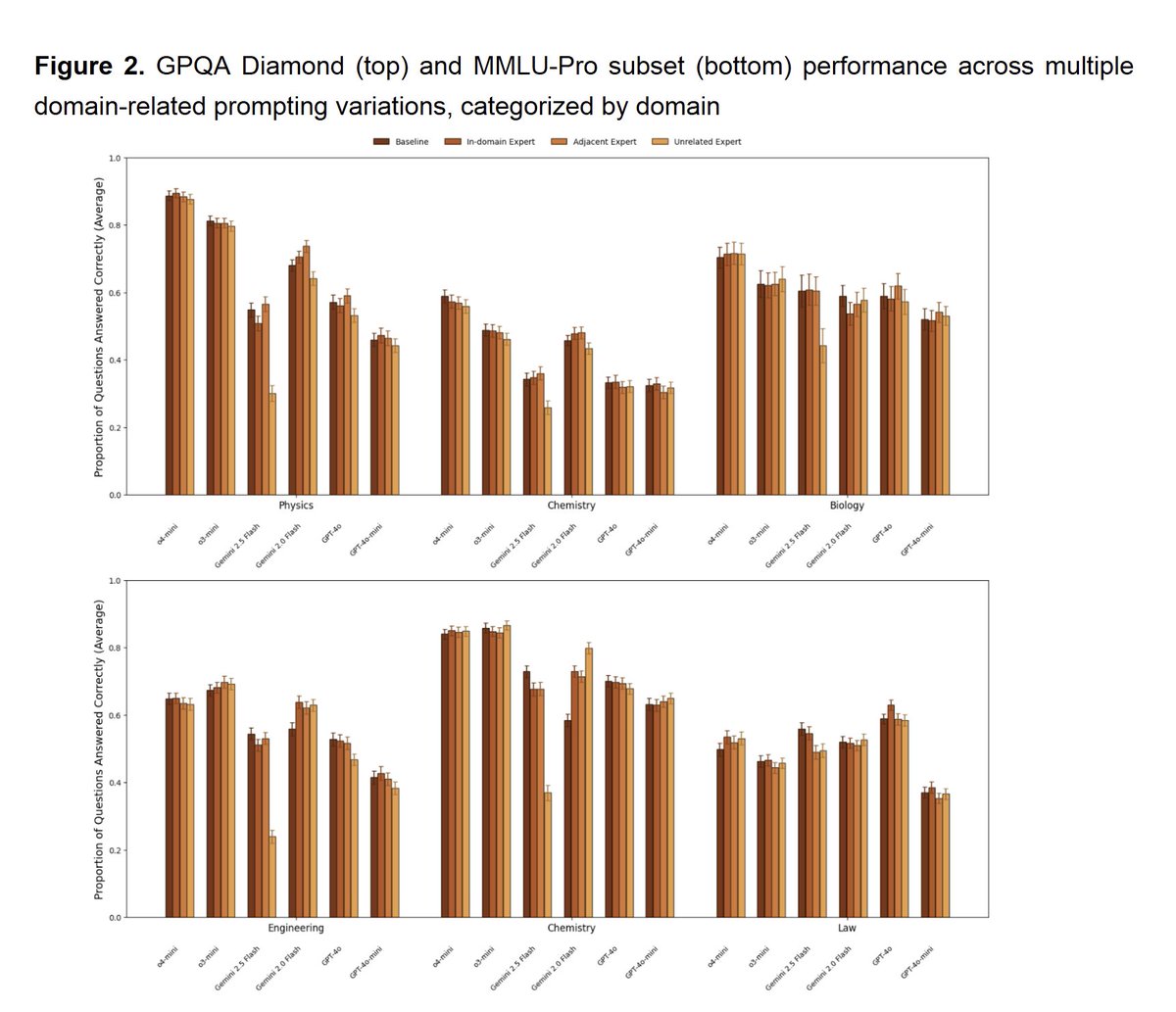
We tested one of the most common prompting techniques: giving the AI a persona to make it more accurate
We found that telling the AI "you are a great physicist" doesn't make it significantly more accurate at answering physics questions, nor does "you are a lawyer" make it worse.