President Biden on treatment of Native Americans in Federal Indian Boarding Schools: "The federal government has never apologized for what happened, until today. I formally apologize as President of the United States for what we did. I formally apologize and it's long overdue."
The 2024 AP World History Exam scores:
5: 12%; 4: 32%; 3: 20%; 2: 28%; 1: 9%.
All subjects’ AP score distributions for 2024 will be posted here when available: https://t.co/zpj3T3VUab
We’re off! Mrs Banas and Mr Cardillo are headed to #Sarajevo, Bosnia-Herzegovina for the first stop on their Fund for Teachers trip! Follow along as we visit Bosnia and Croatia for the next 12 days. #fft@FundforTeachers 🇧🇦🇭🇷
Students who earned scores of 1 or 2 have stronger college outcomes than those who didn’t take AP. Learn more about how #APExams and #APCourses impact students’ post-high school experience. https://t.co/jKpP0PrCDl
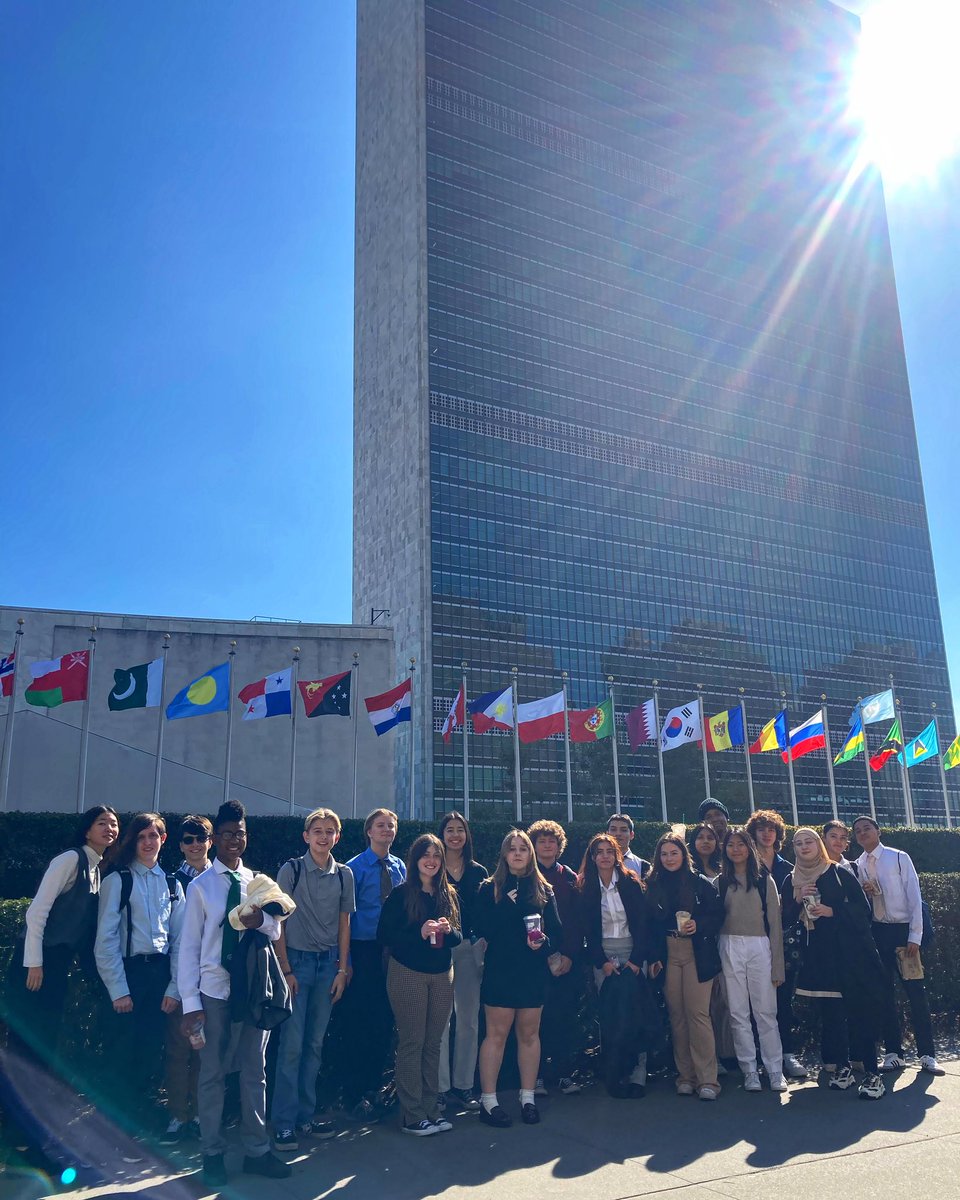
They will be representing either North Korea or Japan and will be debating topics such as nuclear proliferation, child labor, tax dodging, the internet gap, education after COVID and plastic pollution. We also have representation on the Security Council as Japan. 🇺🇳
Andriy, 11, stands in a classroom that is severely damaged by shelling in Ukraine.
The war and COVID-19 have led to a fourth year of disrupted education for students across the country.
UNICEF is working to help get every child’s learning back on track. #LetMeLearn
"People said it was about hijab,” Sharzad says. “But really it’s about choice. I want to be able to choose what I wear, what music I listen to, what religion I choose to practise. Right from birth we’re constantly struggling for freedom.”
Rare to see such impressive gains as these: AP World History teachers expanded access to ~40,000 more students, and scores increased significantly – with an especially large jump in the % of 5s. As a result, 36,000 more students earned scores of 3+ this year than last!
So pleased to unveil EPOCH’s monument to Black soldiers who fought in the Civil War and are buried in Hartford’s Old North Cemetery. Thanks to @UConnHistory, City of Hartford, and Hartford Communities that Care.
Abandoned temples in the Cambodian jungle date back over a thousand years. These temples are part of a large network of structures spread across Cambodia. They were commissioned by the kings of the Khmer Empire more than a millennium ago. The Khmer Empire ruled Southeast Asia from the 800s to the 1400s. Many of the temples were constructed in the style of temple-mountains, representing Mount Meru, the divine abode in Hindu and Buddhist traditions.
During the latter half of the empire, there was a significant shift from Hinduism to Buddhism, resulting in some temples incorporating symbolism from both religions. One intriguing aspect of these temples is that historians are uncertain about the reasons behind their abandonment. Angkor Wat (pic 4), the most famous temple-mountain in Cambodia, offers an example. Built in the 1100s, it was continuously used until the 1400s when it was largely abandoned.
The exact cause for the desertion of the temple and the surrounding city remains unknown to historians and scientists. Some theories suggest environmental changes affecting the water supply, while others propose the cultural shift from Hinduism to Buddhism as a contributing factor. Modern-day archaeological techniques have begun unveiling the secrets of these temples, revealing intricate networks of temples and boulevards, as well as sophisticated engineering.