+919165974789
UPI id - 9165974789-3@ybl
I got scammed of 8500 by this UPI number and UPI id . anyone help me to find out his full details as his name his personal number and location. Please cyber cell help Is their anyone else who can help me @NPCI_NPCI@gurgaonpolice
@TrustScore_1 H1B is a temporary work visa.
so nothing wrong.
no impact on wife or kid (better schools in India ofr 3rd grade)
apt lease brokage are covered by the company. so no impact here also.
He can come to India and go again. 60 days is more than enough to pack the bags.
35 WEBSITES THAT ARE ACTUALLY USEFUL
1. archive. org — access old content
2. wolframalpha. com — solve anything
3. removebg. com — remove image background
4. tinypng. com — compress images free
5. smallpdf. com — edit PDFs free
6. ilovepdf. com — merge & split PDFs
7. deepl. com — best translator online
8. grammarly. com — fix your writing
9. hemingwayapp. com — simplify writing
10. chatgpt. com — ask any question
11. perplexity. ai — smart search engine
12. notion. so — organize your whole life
13. trello. com — manage any project
14. canva. com — design for free
15. unsplash. com — free photos
16. pexels. com — free videos & photos
17. flaticon. com — free icons
18. coolors. co — pick color palettes
19. fonts. google. com — free fonts
20. namecheap. com — buy cheap domains
21. github. com — free code hosting
22. replit. com — code from browser
23. regex101. com — test any code
24. explainshell. com — understand commands
25. fast. com — check internet speed
26. haveibeenpwned. com — check if hacked
27. virustotal. com — scan files for virus
28. downdetector. com — check if site is down
29. 10minutemail. com — temp email address
30. justpaste. it — share text instantly
31. screely. com — make screenshots beautiful
32. carbon. now. sh — share code beautifully
33. squoosh. app — compress any image
34. similarsites. com — find similar websites
35. shortcuts. design — design shortcuts list
Writing microservices “in production” is mostly understanding and building around the failure patterns.
1. Timeouts + retries with jitter. No infinite retries. Cap at 2 to 3.
2. Idempotency keys on every write endpoint. Assume clients will resend.
3. Circuit breaker + bulkheads. One slow dependency shouldn’t take the whole fleet.
4. Outbox pattern for events. Stop doing “write DB then publish” in 2 steps.
5. Rate limits and backpressure. Protect downstreams, shed load early.
6. DLQ + replay tooling. no replay means you’re not event-driven, you’re just hoping.
7. Correlation IDs + tracing. Because if you can’t debug p95 in 10 minutes, you’ll bleed hours.
Your service is healthy until the dependency it calls starts failing.
Without protection, failure spreads.
That is why the Circuit Breaker Pattern exists 👇
Circuit Breaker Pattern prevents a system from repeatedly calling a failing service.
Instead of continuously retrying and exhausting resources, it “breaks the circuit” and stops calls temporarily.
It is inspired by electrical circuit breakers.
The problem
Service A calls Service B.
Service B becomes slow or starts returning errors.
If A keeps retrying:
- Threads get blocked
- Connection pools get exhausted
- Latency increases
- Failure cascades
One failing dependency can bring down the entire system.
How Circuit Breaker works
It has three states:
1. Closed → Normal operation. Requests flow normally. Failures are monitored.
2. Open → Failure threshold exceeded. Requests fail immediately without calling the dependency.
3. Half-Open → After a timeout, a few test requests are allowed.If successful → switch to Closed.If failures continue → go back to Open.
Why it matters
- Prevents cascading failures
- Protects system resources
- Improves overall resilience
- Fails fast instead of hanging
Failing fast is often safer than retrying blindly.
When to use it
- Microservices architecture
- External API integrations
- Payment gateways
- Database or cache dependencies
- High-traffic distributed systems
Avoid it in simple monoliths without remote dependencies.
Circuit Breaker does not prevent failure. It prevents failure from spreading.
Resilience is not about avoiding outages. It is about containing them.
An API Gateway is not just a reverse proxy. It’s the control plane in front of your services.
If you’re building microservices and don’t have one, your architecture will eventually get messy.
Here’s what it actually does 👇
What is an API Gateway?
It’s a single entry point that sits between clients and your backend services.
Instead of:
Client → Service A
Client → Service B
Client → Service C
You have:
Client → API Gateway → Internal Services
The gateway handles cross-cutting concerns so your services don’t have to.
What does it do?
An API Gateway typically handles authentication, authorization, rate limiting, request routing, response aggregation, logging, monitoring, and sometimes caching.
It can:
- Validate JWT tokens
- Enforce rate limits
- Route /users to User Service
- Route /payments to Payment Service
- Combine multiple service responses into one
Your microservices stay focused on business logic.
When do you need it?
You likely need an API Gateway when:
- You have multiple microservices
- You want centralized authentication
- You need rate limiting at the edge
- You want to hide internal service structure
- You are exposing public APIs
If you have a simple monolith, you probably don’t need one yet.
Common real-world examples:
Netflix, Amazon, and most SaaS platforms use API gateways to manage traffic at scale.
Popular solutions include:
- NGINX
- Kong
- AWS API Gateway
- Envoy
Without an API Gateway:
Every service reimplements auth, logging, and rate limiting.
With an API Gateway:
Infrastructure concerns are centralized and standardized.
It’s not just traffic routing. It’s architecture discipline.
Building microservices? Repost. Follow. Bookmark this.
Pessimistic vs Optimistic Locking
Frequently asked Backend interview question
[Pessimistic Locking]:-
- The record is unavailable to other threads until the current thread finishes working with it.
- Even reading the data by other threads is impossible until the lock is removed.
- Example: EntityManager.lock(entity, LockModeType.PESSIMISTIC_WRITE) in JPA.
- Disadvantages: reduces productivity with a high level of concurrent access.
- When to use: when there is a critical need for data accuracy.
[Optimistic Locking]:-
- Does not block the data when reading, but checks the version of the record when saving.
- Example: the @Version annotation in JPA (a column for storing the version).
- If the version is changed by another thread, an OptimisticLockException is thrown.
- Disadvantages: requires conflict resolution.
- When to use: with a large number of reads and a low probability of conflicts.
Which approach do you use most often in your projects?
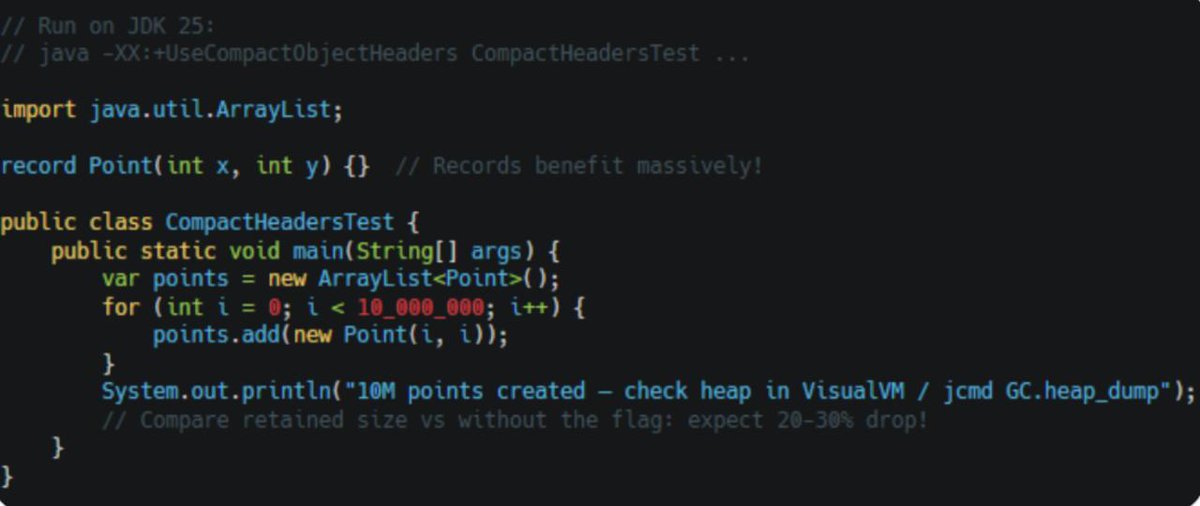
Java 25: an upgrade that saves up to 30% of RAM (without code modifications)
In JDK 25, one of the most significant optimizations in a long time was introduced - Compact Object Headers (JEP 519).
What changes:
- The size of the object header is reduced from approximately ~12 bytes to 8 bytes
- Less memory per object = less heap
- Less heap = less pressure on the GC
- Less GC = faster service + cheaper cloud
Where the benefit is maximum:
Spring Boot, microservices, DTOs, records, caches - everything where there are a lot of small objects.
It's enabled with one option:
-XX:+UseCompactObjectHeaders
According to reviews in real systems:
A 15–30% reduction in heap is a common occurrence.
Just test it on your own services - and reap the free savings.
@0xlelouch_ Are both your friends married and have kids ?
This will change the scenario u mentioned. I'm in the same boat (both A & B)
Friend A will be saving min - 5k $
monthly salary(in-hand, min) - 9.5 - 10k
spends:
rent - 1,000 - 1.2k
car ins - 400
food basic - 600
misc - 2k
What I see in most Java resumes:
- Java
- Spring
- Microservices
Great, I see you know Java. But as a senior, can you build, run, scale, observe, and secure Java systems in production?
A few tips and topics with accurate subskills that you need to mention if you need your resume to stand out:
1. Distributed Caching – mention Redis/Memcached
2. Monitoring & Observability – most popular ones are Splunk, Dynatrace, Grafana, ELK
3. Messaging – list one among Kafka, JMS or RabbitMQ
4. Testing – most popular frameworks/methods are TDD, Mockito, JUnit
5. CI/CD & Containers – devops skills like Jenkins, GitHub Actions, Docker, Kubernetes make your profile distinct
6. Frameworks – no prize for guessing: Spring Boot, Spring MVC, Apache Camel
7. Microservices Internals – try to mention one or two at least from Config Server, API Gateway, Service Discovery, Resilience4j
8. Multithreading & Concurrency – do not skip, mention a few of Executors, ForkJoin, CompletableFuture
9. Security – most used and popular ones are Spring Security, OAuth2, JWT
10. Persistence – you should have been using Hibernate, JPA or MyBatis so put one
11. API Development – basics of APIs: REST, Swagger, OpenAPI
12. Reactive Programming – your resume shines with words like WebFlux, Reactor or RxJava
13. Build Tools – mention Maven/Gradle
14. Code Quality – mentioning SonarQube, PMD, Checkstyle shows you care about quality
15. Cloud – shouldn't miss one from AWS, GCP, Azure
16. Java Versions – list a few Java 8 to 21 features you used
17. Design Principles – foundations of large codebase: SOLID, Design Patterns, Clean Architecture
If you are targeting Senior, Staff, or Lead roles:
- Focus on impact, not buzzwords
- Show production ownership
- Highlight architecture and reliability thinking
Good luck
❌ NEVER BUY A PROPERTY IN INDIA WITHOUT THESE DOCUMENTS!
Bookmark it🔖
1. TITLE DEED
Proves that the seller is the legal owner and has the right to sell the property.
2. MOTHER DEED
Shows the complete history of ownership and helps verify that the title is legally traceable.
3. ENCUMBRANCE CERTIFICATE
Confirms whether the property is free from loans, mortgages, or legal claims.
4. POSSESSION CERTIFICATE
Confirms who is in actual physical possession of the property.
5. PROPERTY TAX RECEIPTS
Indicates regular tax payment and absence of local authority dues.
6. KHATA / PATTA CERTIFICATES
Reflects the property’s entry in government and municipal records.
7. CONVERSION CERTIFICATE
Confirms that the land has been legally converted from agricultural to non-agricultural use, making construction and sale lawful.
8. LOCATION SKETCH & SURVEY MAP
Identifies exact boundaries and prevents boundary or survey disputes.


![makakmayum_sid's tweet photo. Pessimistic vs Optimistic Locking
Frequently asked Backend interview question
[Pessimistic Locking]:-
- The record is unavailable to other threads until the current thread finishes working with it.
- Even reading the data by other threads is impossible until the lock is removed.
- Example: EntityManager.lock(entity, LockModeType.PESSIMISTIC_WRITE) in JPA.
- Disadvantages: reduces productivity with a high level of concurrent access.
- When to use: when there is a critical need for data accuracy.
[Optimistic Locking]:-
- Does not block the data when reading, but checks the version of the record when saving.
- Example: the @Version annotation in JPA (a column for storing the version).
- If the version is changed by another thread, an OptimisticLockException is thrown.
- Disadvantages: requires conflict resolution.
- When to use: with a large number of reads and a low probability of conflicts.
Which approach do you use most often in your projects?](https://pbs.twimg.com/media/HB6NK4HbUAAVyoT.jpg)