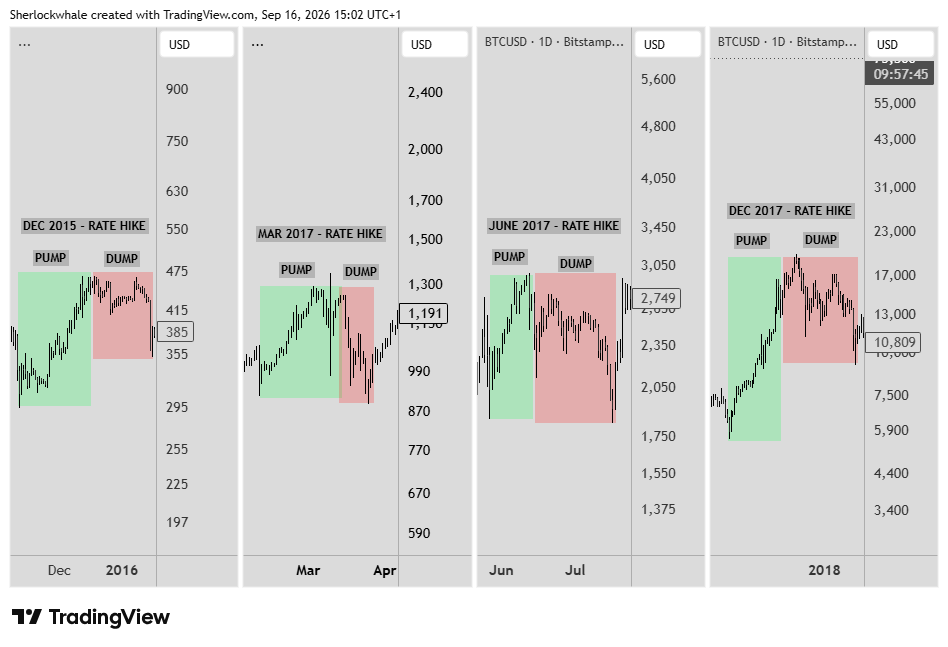
Bitcoin rallied 20%+ into five previous Fed hikes and was lower 30 days later in every case.
Now it’s up 20.4% ahead of today’s Fed decision.
I found five earlier hikes where Bitcoin had already rallied this much. A month later, every one was red:
December 2015: -19.0%
March 2017: -6.7%
June 2017: -9.4%
December 2017: -16.5%
February 2023: -5.8%
The median return was -9.4%, but at some point during the next month, Bitcoin traded a median 19.0% below the decision day price.
From $75.9K, that is roughly $61.5K.
Five cases across only three tightening cycles are not enough to call this certain. But drop the requirement from a 20% monthly rally to just 10%, and Bitcoin was still lower after seven of eight hikes.
If the Fed hikes today, Bitcoin will have 30 days to be the first exception to this datapoint.
But if it follow the median path then you will have $61.5K before October 16.
정부가 증시 부양책을 너무 미리 공개해서 외국인들에게 탈출 타이밍을 줬음
국민연금은 국내 주식 비중을 늘리고 리밸런싱 매도도 미루면서 코스피 하단을 받치고 있었음
이 내용이 공개되자 외국인들이 국민연금이 쉽게 못 판다는 걸 알고 대규모 매도에 나섰음
외국인은 올해 들어 7월 8일까지 코스피에서 154조원 넘게 순매도했는데 국민연금 ��이 포함된 연기금 순매도는 9조원 수준에 그침
한마디로 외국인은 국민연금이 받쳐주는 동안 물량을 넘기고 현금화한 셈
코스피가 9000선을 넘나들다 7200선까지 급락했는데 국민연금은 별도 매도 없이 국내 주식 비중이 자동으로 허용 범위에 들어오면서 고점 매도 기회도 놓침
🚨 Leopold Aschenbrenner parie 8,45 milliards de dollars contre les semi-conducteurs portés par le boom de l'IA.
Ancien chercheur chez OpenAI, licencié pour avoir alerté que la Chine pouvait voler les modèles d'IA de l'entreprise.
Il a ensuite transformé 225 millions de dollars en 5,5 milliards en 12 mois.
Sa déclaration trimestrielle 13F, le dépôt obligatoire des grands fonds auprès du régulateur américain, dévoile son portefeuille et révèle une position vendeuse ouverte sur tout l'écosystème des semi-conducteurs IA.
Le top 10 de ces positions:
$2.04B🔴VanEck Semiconductor ETF $SMH [Put]
$1.57B🔴 Nvidia $NVDA [Put]
$1.07B🔴 Oracle $ORCL [Put]
$1.01B🔴 Broadcom $AVGO [Put]
$969M🔴 Advanced Micro Devices $AMD [Put]
$879M🟢Bloom Energy $BE
$724M🟢SanDisk $SNDK
$584M🔴Micron $MU [Put]
$556M🟢CoreWeave $CRWV
$535M🔴Taiwan Semiconductor $TSM [Put]
Cas Intel emblématique : un call bullish de 747 M$ il y a trois mois, désormais basculé en achat de puts.
En face, ce qu'il garde et renforce : les mineurs de Bitcoin qui se reconvertissent en infrastructures de data centers IA. Applied Digital, IREN, CleanSpark, Riot Platforms, Bitfarms, plus une entrée neuve sur HIVE Digital.
La ligne CleanSpark voit son nombre de titres bondir de 648 %.
Le trade synthétique : être long sur les sociétés qui coulent le béton et fournissent l'énergie des data centers, shorter (via puts) les puces qui tournent à l'intérieur.
Bloom Energy reste l'une de ses positions majeures en valeur, à 879 M$
You can pump a $50M coin to $1B with $1.5M of real buying.
Scott Phillips (@ScottPh77711570) on how new token listings actually work:
"There's a huge industry of market makers operating out of Dubai. Their business model is: we're gonna pump your coin, and we want 30% of the profit when we dump it on exit liquidity day."
"They run the ball up. Buy, sell, buy. Create momentum ignition. Retail finally buys in the middle of a bull run — and then it dumps."
"Buying 20-day highs works best on the top decile. By the fourth decile, you get negative momentum effects."
"Anything in the bottom 20% of market cap on Binance perps that makes a 20-day high — short it. That is a very strong edge."
"The market maker contract runs 90 days. It's priced as a call option on the 7-day VWAP after launch."
"Once the strike kicks in, delta hedging from market makers drives these coins down."
"Wait 7 days. Short it for 90 days. I kid you not."
"That's not an edge big enough for institutional. That's an edge for retail guys with a small account."
So you’re telling me World Liberty Financial (WLFI)
a project linked to the Trump family
deposited billions of its own tokens, used them as collateral
and borrowed tens of millions against it
inside a protocol where it controls most of the liquidity
This happened on April 9, 2026
- around 5 billion WLFI tokens used as collateral
- $75 million borrowed in stablecoins
- all through the Dolomite lending protocol
- WLFI represents around 55% of the entire protocol liquidity
So how does that even work
They deposit their own token, borrow stablecoins against it and keep the position open as long as the price holds
But here’s where it gets uncomfortable
- the main stablecoin pool is used at around 93%
- meaning most liquidity is already borrowed
- retail users could struggle to withdraw
- funds inside the system start to feel “locked”
And it gets worse
Dolomite was co-founded by someone connected to WLFI
meaning the borrower and the infrastructure are linked
same circle on both sides of the trade
Then you have this
- over $40 million moved to Coinbase Prime
just hours before a major Trump-related geopolitical announcement
The team denies everything
But if it’s real
then it’s a closed loop
where the same circle is providing liquidity
borrowing from it and holding it up at the same time
Insane crime
@trader_zc_ Most CTs tend to have a one-sided perspective, but among them, You reacts the quickest, so I keep an eye on your updates. It’s interesting because this view often aligns with mine.