#NonMedicalSwitching not only ignores the process physicians and patients underwent to find a successful medical therapy, but it also disregards the impact of switching medications arbitrarily.
Learn more: https://t.co/dbqDbIPlvS
#DYK? If protections against #NonMedicalSwitching apply only for a single coverage
year, patients risk losing access to their medication each year – even though their need for treatment continues indefinitely.
Learn more: https://t.co/dbqDbIPlvS
Restricting #NonMedicalSwitching can protect not only patient health but also the physician-patient relationship’s role in guiding patient care.
Learn more: https://t.co/dbqDbIPlvS
Patients with #MultipleSclerosis may experience:
🔶 Worsening symptoms
🔶 Decreased mobility
🔶 New side effects
Learn more about #NonMedicalSwitching: https://t.co/ivM9B5U3Xd
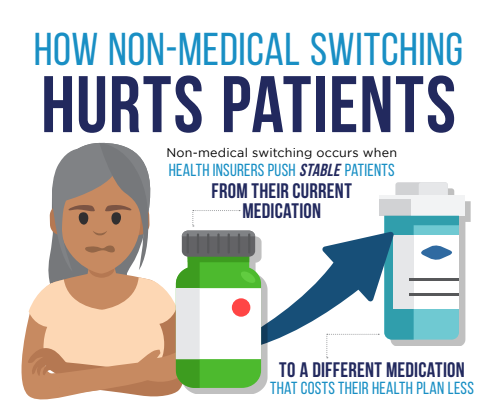
Health plans may push patients from their current botulinum neurotoxin to one that’s less expensive for the insurer. That's called #NonMedicalSwitching.
Learn more: https://t.co/hKCLdVsuqZ
#NonMedicalSwitching prioritizes insurers’ interests over patients’ health and it often comes with consequences, such as:
🔸 New side-effects
🔸 Re-emerging symptoms
🔸 Adverse interactions with meds
Learn more from @patientaccess: https://t.co/QAswPfnUT1
Policymakers can help patients stay on their medication by requiring health plans to maintain coverage for patients whose:
🔸 Medication continues to be prescribed by their doctor for an ongoing condition
Learn more about #NonMedicalSwitching: https://t.co/CPksfctVmx
#NonMedicalSwitching leaves patients vulnerable to formulary changes that
their health plans may make, sometimes without notice. These changes can
eliminate patients’ access to the medication they need.
Learn more: https://t.co/CPksfctnwZ
#DYK? Patients with chronic or serious medical conditions must sometimes work with physicians for months to identify a medication that’s effective for them.
Watch to learn more about #NonMedicalSwitching: https://t.co/3rA91GlPns
With conditions for which few viable treatments exist, eliminating options can leave patients with dangerously limited alternatives.
Learn more about #NonMedicalSwitching: https://t.co/7v7buDQgf3
#DYK? Suddenly changing medications can cause negative side effects.
Learn more about the correlation between #NonMedicalSwitching and patients with #MentalIllness: https://t.co/EEkLwEYxHI
#NonMedicalSwitching impacts patients with chronic and complex illnesses, who depend upon advanced medical therapies to stabilize their condition and maintain normal lives.
Watch to learn more: https://t.co/3rA91GlPns
Restricting #NonMedicalSwitching can protect not only patient health but also the physician-patient relationship’s role in guiding patient care.
Watch to learn more: https://t.co/ycYe9hs7v8
Restricting #NonMedicalSwitching can protect not only patient health but also the physician-patient relationship’s role in guiding patient care.
Watch video to learn more: https://t.co/ycYe9hs7v8
Once a patient is stabilized on a treatment, and health plan coverage for that treatment is secured, that coverage should continue for as long as the patient stays with that insurer.
Learn more about #NonMedicalSwitching and its impact on patients: https://t.co/dbqDbIPlvS
#DYK? If protections against #NonMedicalSwitching apply only for a single coverage
year, patients risk losing access to their medication each year.
Learn more: https://t.co/dbqDbIPlvS
Switching between non-identical treatments can cause:
🔸 Medical complications
🔸 Symptom resurgence
🔸 New side effects
Learn more: https://t.co/dbqDbIPlvS
#DYK? Patients with chronic diseases are most affected by #NonMedicalSwitching because they rely upon a stable medication regimen to go about their day-to-day lives.
Learn more: https://t.co/dbqDbIPlvS
Restricting #NonMedicalSwitching can protect not only patient health but also the physician-patient relationship’s role in guiding care.
Learn more: https://t.co/WCEYcu3tkB