This is a great point and this entire buildout is on the back of the hyperscalers / chip designers exporting their IG credit ratings to keep the cost of capital reasonable.
Hyperscalers have issued $300bn of corporate debt in the past year, but that's their direct exposure.
They have ~4x that exposure (~$1.2tn) in aggregate future rentals as the lessee of data centers. Those data center financings are underwritten using the strength of the IG tenant.
Chip makers have also provided lease guarantees for deals where they are not the tenant/lessee (ex Broadcom providing a ~$30bn g'tee of Anthropic's lease in the AI XPV deal) as a backstop.
These are huge balance sheets, and they have capacity, but that capacity is finite.
As it gets tapped, the marginal cost of financing compute reprices up towards where neoclouds borrow.
I've been critical in the past of AI compute indexes and the willingness to price compute based on the spot rental price, but now that the AI reset is sinking into the repricing of AI buildout debt its time to realize that the cost of capital is what determines the price of compute.
The most important number in GPU pricing right now isn't $/GPU-hour. It's the gap between what a hyperscaler pays to borrow (~90bp over Treasuries) and what a neocloud pays (~1,100bp).
The cost of compute is now set by the cost of capital, and the spot rental rate no longer tells you much.
The price of an H100 isn't one number. The same chip in the same rack costs a different amount depending on whose balance sheet it sits on. A ~1,000bp funding gap is a structural cost advantage that no amount of operating skill closes.
For example, take one GPU-hour apart. Most of it isn't power or space. It's paying back the chip, the interest on the loan that bought it, and the return the equity expects. A $40–55k all-in GPU, 75% debt-funded, at ~7,000 utilized hours a year is a financing instrument that happens to do matrix multiplication.
As the +500bp on neocloud debt (10%→15%) adds $0.20���0.30 to the break-even cost of every GPU-hour, which is then added on to the rental price.
That's 8–10% of the H100 index, from a credit spread alone, driven almost entirely by the cost of capital.
That means that the compute spot index is a derivative of the AI infra debt credit curve and the squeeze on neocloud margins.
@GlobalMktObserv These are 20 year fixed rate bonds man. Against the backdrop of a sharp rise in long term rates. This chart means absolutely nothing until you strip that out.
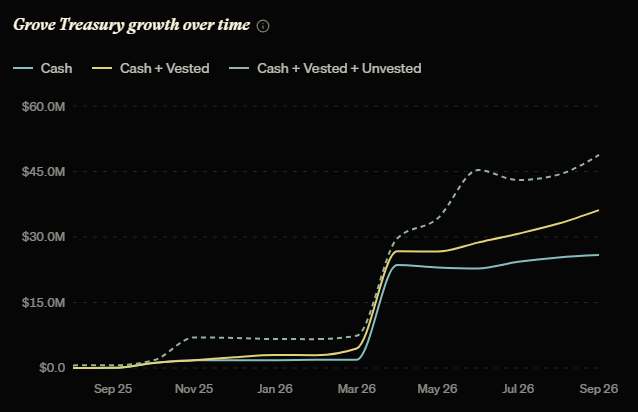
At @grovedotfinance, we want to set the standard for financial transparency. The release of our refreshed data site is just the first step in a series of initiatives we have planned to give greater visibility into the protocol's underlying performance and financial health.
One of my favorite new pages is the treasury page, which tracks the growth of Grove's protocol book value over time. This page alongside every other will be updated monthly so tokenholders can quickly check in on Grove's holdings, risk, financials, and product progress.
If you there's anything you'd like to see added, please reach out!
~$26bn of aggregate peak TVL here across major "dead" chains. Today all have faded by 95%+.
In a couple years, who will join this cohort? L1s from the '21 cycle that have hung on? L2s without major distribution? Chains that have launched this cycle?
I was using Notion for this exact use case and have almost entirely dropped it for Dropbox, now that they’re leaning in to MCPs.
The file flexibility for Dropbox is just better. There are still some bumps to get over but it’s more natural than fitting everything into pages and databases.
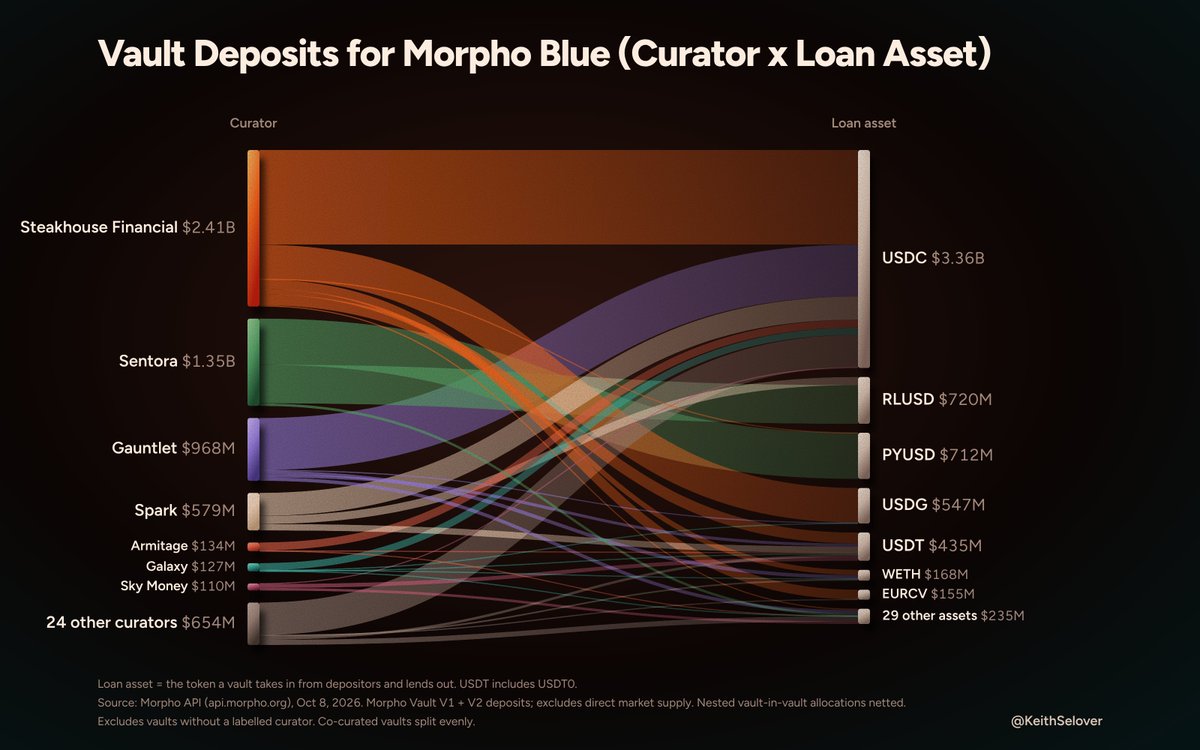
People used to have this sense that every curator was allocating to the same markets. It's not what you see anymore. Tons of differentiation below. Particularly between SHF and Sentora.
From talking to some of these teams (not a primary source myself) that’s exactly right. If you have a 24hr notice period before you liquidate, you’re looking at historical drawdowns in a 24hr period to calc VaR and margin of safety at diff OC levels.
Def easier to do this kind of analysis with 24/7 collat like crypto than 24/5 or whatever people can get offchain stocks to
It took a lot of work from both the @grovedotfinance and @galaxyhq teams to bring this deal from concept to first dollars out the door. We leveraged many of the lessons from Galaxy CLO 2025-1 and believe this warehouse creates a scalable, repeatable framework for connecting onchain capital with offchain credit.
Deals like this are exactly what Grove was built to do.
Grove and Galaxy Digital Announce $500 Million Warehouse Lending Facility
Grove serves as the warehouse lender, financing @galaxyhq's origination of institutional loans secured by digital assets.