Big thanks to @tokenterminal for the detailed Q1 2026 report.
Our north star remains the same: disciplined risk curation and transparent infrastructure our users trust.
Full metrics and team commentary below
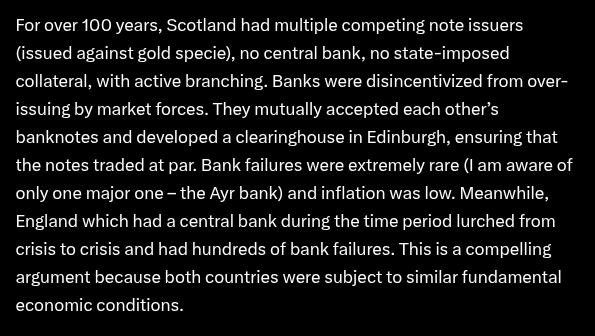
When someone refer to free banking, it is my view that he should start with Scotland.
There is so much to learn.
In 1 month, @SteakhouseFi will tell you why.
🏴🏴🏴
3/ There are no perfect historical analogies for or against stablecoins as private money. Canada did not have crises under free banking for the same reason it had no crisis in 2008: its banking system was national, oligopolistic, and more heavily regulated than in the U.S.
I'm assuming this is mostly rage-baiting hyperbole, but it's still worth drawing the distinction here, especially given how new onchain vault products are and how few people have actually looked under the hood.
The hedge fund comparison breaks down at the part that actually matters, which is custody. A fund manager holds your assets and moves them around at their own discretion. A Morpho vault curator never touches the deposits at all. The smart contract holds the funds, the protocol enforces the rules, and the curator only sets parameters. We could disappear tomorrow and your money would sit exactly where it is, governed by code anyone can read.
And it goes further than custody. The Guardian role on our @SteakhouseFi vaults isn't us, it's the depositors, all of them in aggregate. If Steakhouse proposes adding a new collateral, any depositor can start a vote to veto it, and we set the quorum deliberately low so it only takes a small fraction of them to block it. Nothing gets slipped in behind your back. New collateral sits behind a timelock, so if you don't like what's coming you can either help vote it down or just withdraw before it ever goes live. You would have to wait until the next investor update to learn about mandate drift in a hedge fund. Here you get a vote and an exit before anything changes.
What curators configure is asset backed lending, with transparent and strongly enforced constraints. Every position is a loan against posted collateral, with a published liquidation loan to value, a named oracle, a defined rate model, and hard supply caps. It's hardly a black box though I concede it can be hard to parse and compare. It is, however, evidently not opaque.
Compare that honestly to a credit hedge fund. There you get a quarterly letter, marks you can't independently verify, concentration you can't see, unilateral discretion, and a manager who is literally holding your money. With a vault you get every loan, every allocation, every realized loss, and every fee, live, queryable by anyone, enforced by code instead of promised in a pitch deck. It's not less transparent than a fund. It's dramatically more.
You are right that the data can be scattered and that nobody has fully packaged it yet. That is absolutely a frontend and user experience problem. We also believe it is eminently fixable and our philosophy is to show our work and maximize the constraints we operate our vaults with.
The reason we build onchain is to put more transparency into a system that has spent decades getting good at the opposite. We're not perfect and there's considerably more that needs to be done to achieve that, but we believe we're on the right trajectory.
Can someone show me when T-Bills were illiquid ?
And repo against treasuries illiquid for more than a day?
When did a G-MMF break the buck (trap inside)?
What are those moments @greg_ip ?
5/ A few additional points. I accept that the Genius act limits both the leverage and risk inherent in fractional banking that led to historic crises. But it doesn't eliminate it, because even the safest assets can become illiquid at moments of stress.
@greg_ip@nic_carter@izakaminska I don't have access to the article but let's be serious.
Making it in the title and starting with free banking as private money and saying there is a comeback is clearly excluding banks deposits.
If you want stablecoins to have access to the Fed why not make it the title?
🥩🏡 @SteakhouseFi is pulling away from the pack.
Steakhouse currently holds a ~$1 billion lead over the next largest @Morpho vault curator, up from virtually no lead a year ago.
A curator ecosystem to follow 👇
RWAs are about to have their stablecoin moment.
Introducing Grove Basin: programmable credit infrastructure enabling eligible tokenholders instant stablecoin liquidity for approved exits from tokenized offchain assets.
Up to $1 bn in committed daily liquidity.
Tap in 🚰
Ulrich Bindseil seems to be on a warpath since leaving the @ecb . Amazing what happens when people can actually say what they think.
https://t.co/JONdpegwGz
Gems:
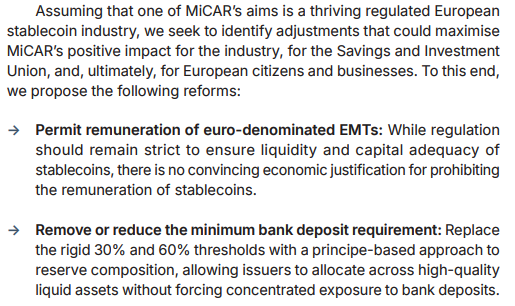
"Relying excessively on bank deposits for backing brings an element of fractional backing to EMI-issued EMTs which in times of financial stress could lead to fragility, even with banking regulation and liquidity support for banks"
"remunerated stablecoins would not be expected to offer yields as high as those of short-term, high-quality debt instruments that back them. Rather, their remuneration would likely be lower due to their superiority as moneys – a convenience yield (which mirrors their need to hold only assets of highest liquidity and credit quality)."
"without promoting euro-denominated stablecoins, the euro will continue to underperform relative to the role it could play in international finance."
"Of course, there remains some uncertainty over the impact of remunerated stablecoins on the banking and broader financial systems, but it is vital to move away from knee-jerk claims about stablecoins’ impacts on banks"
"The minimum required deposit share of stablecoin reserves under MiCAR appears to be not only a symptom of the influence of banks on MiCAR, but also of a collective failure to understand flow of funds dynamic which led to the wrong conclusion that stablecoins absorb deposits if they invest their reserves into securities, while they do not if they hold deposits with banks"
The new @BlackRock tokenized MMF is quite structural shift.
- an actual MMF (2a-7), not a private fund
- still bad for retail and DeFi composability
- 📌strategy to provide singleness of money for GENIUS stablecoins ⚓️
- fees are high but not crazy (20bps)
https://t.co/cGs0xCwoY3
If I were a saboteur trying to destroy the Euro from within while remaining undetected, I would not be doing anything differently than what the ECB is already doing.
Once again, framing stablecoins as private liabilities to express it is bad. While forgetting to say that bank deposits are exactly the same (both issuers are private companies and supervised by the central bank).
Funny to use SVB as example of the biggest risk of stablecoins as ... it is showing that banks are the key risk (which MICA forces stablecoins to have outsized exposure for no reasons).
So much energy used to compete against EUR stablecoins to sell their own CBDC, whatever it is. Great use of public funding.
Stablecoins are not an efficient way to strengthen the international role of the euro, says President Christine @Lagarde.
The best solution remains deeper capital market integration through the savings and investment union and a stronger safe asset base https://t.co/Xewr8ysz9B
At our European Policy Reception during @ParisBlockWeek, we caught up with our good friends over at @SteakhouseFi!
Co-Founder, @SebVentures, gave Adriana Ennab a rundown on exactly why they partnered with us!
Watch till the end to find out his views on fighting for your 4%👀
On the EURCV, the "spike" is due to the migration to V2 and the launch at the same time of new markets.
As a lender, you shouldn't be on the V1, the V2 has incentives and is more future proof. You can use our app for migration https://t.co/K0BU0PVYo3
As a borrower, the market remain the same. We launched new ones that are a bit safer, but no plan yet to force any migration. The goal for EURCV for now is to find more borrowers. Rates will harmonize and get smoother over the next weeks.