My highlight this week was @solana breakpoint, an acid trip of both fun and seriousness, also great to see the facial expressions of Solana folx hearing for the first time the word being pronounced “So Lahner” which, why not
Sky isn’t typically in the CT FUD gossip cycle the way a lot of the other large DeFi protocols are.
I feel like every couple years someone new takes a shot at the protocol and it never goes anywhere. I’d guess this is that.
There’s a reason Sky has been around for a decade and has navigated every cycle this space has been thru. There’s a reason it is still a protocol with billions in TVL and hundreds of millions in rev.
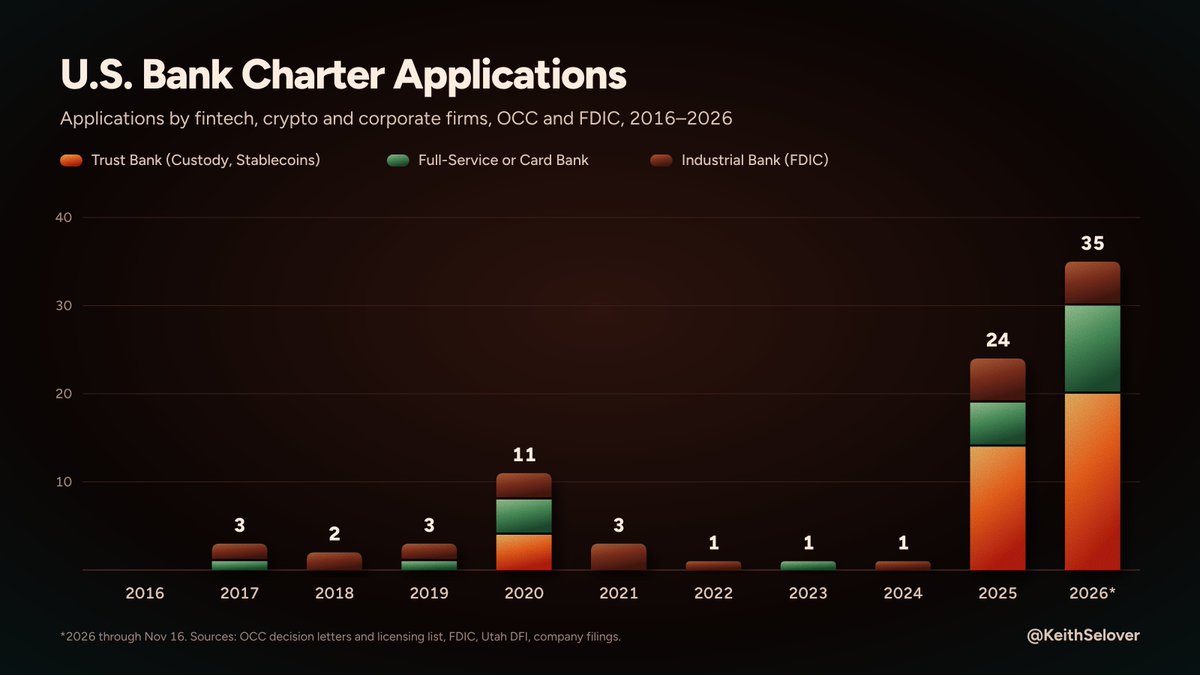
If you work in fintech you're always hearing that "everyone's applying for a bank charter" and "the window is open."
I want to go one layer down and demystify this a bit. Applicants and their motives are not homogenous, and they're not all applying for the same charters.
Trust Bank
This is the biggest jump in applications and it's mainly for custody (holding other people's assets). It doesn't let you take deposits or make loans.
Stablecoin issuers and traditional custodians want this one. For custodians, it replaces a patchwork of state licenses with one federal license. For stablecoin issuers, they have a federally supervised place to hold their GENIUS-compliant reserves.
Who Applied: Circle, Ripple, Paxos, Coinbase, BitGo, Fidelity Digital Assets, Kraken, Galaxy, Bridge (Stripe), Morgan Stanley.
Full-Service Bank
This one allows you to take deposits and make loans. Today, most fintechs use a partner bank for this instead of doing it directly. Getting their own charter would let them 1) fund loans more cheaply with deposits and 2) reduce reliance on their partner banks (although you don't hear a lot of fintechs aiming to cut them out entirely).
This is the intense charter, granted by the OCC with deposits insured by the FDIC and Fed supervision over the parent company.
Who Applied: Upstart, Mercury, Sezzle, Avant, Mission Lane, plus foreign banks entering the U.S. like Nubank, Revolut and Itaú.
Industrial Bank
This is similar to a full-service bank in that it takes deposits and makes loans. It's a state license (mostly Utah) and insured by the FDIC. The difference is in the treatment of the parent co. Owning a regular bank puts your whole company under Fed supervision and limits it to financial businesses. Industrial banks are the exception, so they're the only way a company like an automaker can own a bank.
Who Applied: Ford, GM, Stellantis, Edward Jones, PayPal, Affirm, Klarna
How fintechs turn onchain vaults into a client-facing product, from strategy to design.
On November 19, @adcv_ breaks it down at a @block_stories webinar on onchain asset management.
Register here: https://t.co/4pDuAhwVyh
Grove's treasury grew 14% in Q3, supported by $1.8M in net protocol income. Total net assets now stand at $37.3M.
A larger treasury helps Grove meet Sky's risk capital requirements and expand the protocol's activity within the limits set by governance.