It’s important to fact check loud voices cuz there’s a lot of followers in this world. People who idolize you and your advice.
If someone’s promoting a way of working just to push a narrative that doesn’t actually work and people apply this advice today they can lose their jobs
Wow ChatGPT has started confusing itself between projects.
I asked it to do a merge conflict and it reached outside the current project path and did the merge in a totally different checkout the project wasn’t based on.
@minakimes I’m a Canadian so we don’t see as much of your college football, but do you think with how NIL has accidentally caused parity that evaluating top QBs for draft will be a little more accurate?
Top QBs have to overcome adversity more often it seems now.
@pwnies@_chenglou They sent a lot of drives out to OS and database testers and some were available on the market but without a real push of volume people couldn’t really bet on it.
The performance was bananas though!
@pwnies@_chenglou Yeah all kinds of bad drives can complete with deep queue throughput. The good stuff is in low queue depth response times.
IMO I don’t think that’s the reason Optane failed. Computers feel snappy from low queue depth performance.
I think Intel never really committed
@pwnies@_chenglou This is not true that Optane was not faster than SSD’s. In fact it still to this day it’s has almost 10x faster random read access times at low queue depths. 5-6 micro seconds compared to some NVMe today being somewhere between 25-90 micro seconds.
Dramatically helps BTrees
@craigkerstiens My agents.md actually references Postgres code comments and how sub directories are often organized components with their own readme’s and ask my agent to follow Postgres thirough comments and design docs.
the compression time is actually significant portion of the request/response time. this implies that the coding harnesses should be compressing up to the previous message in the background/caching and then completing it when the new message comes in.
I've uploaded a video of my "Vacuuming Large Tables" talk to https://t.co/rB1iAk7yDX. I did that talk a bunch of times but I think this was the only recording. If you're coming to my REPACK talk next week at PGConf EU, bonus points if you watch this one first. #postgres
"In scale testing, one cluster ran over 6,700 pods across more than 100 node pools, with the busiest nodes holding 15 blocks (240 IPs) each."
https://t.co/elosRSod3N
Today we're open-sourcing pg_vectorsearch, a new vector search extension for PostgreSQL.
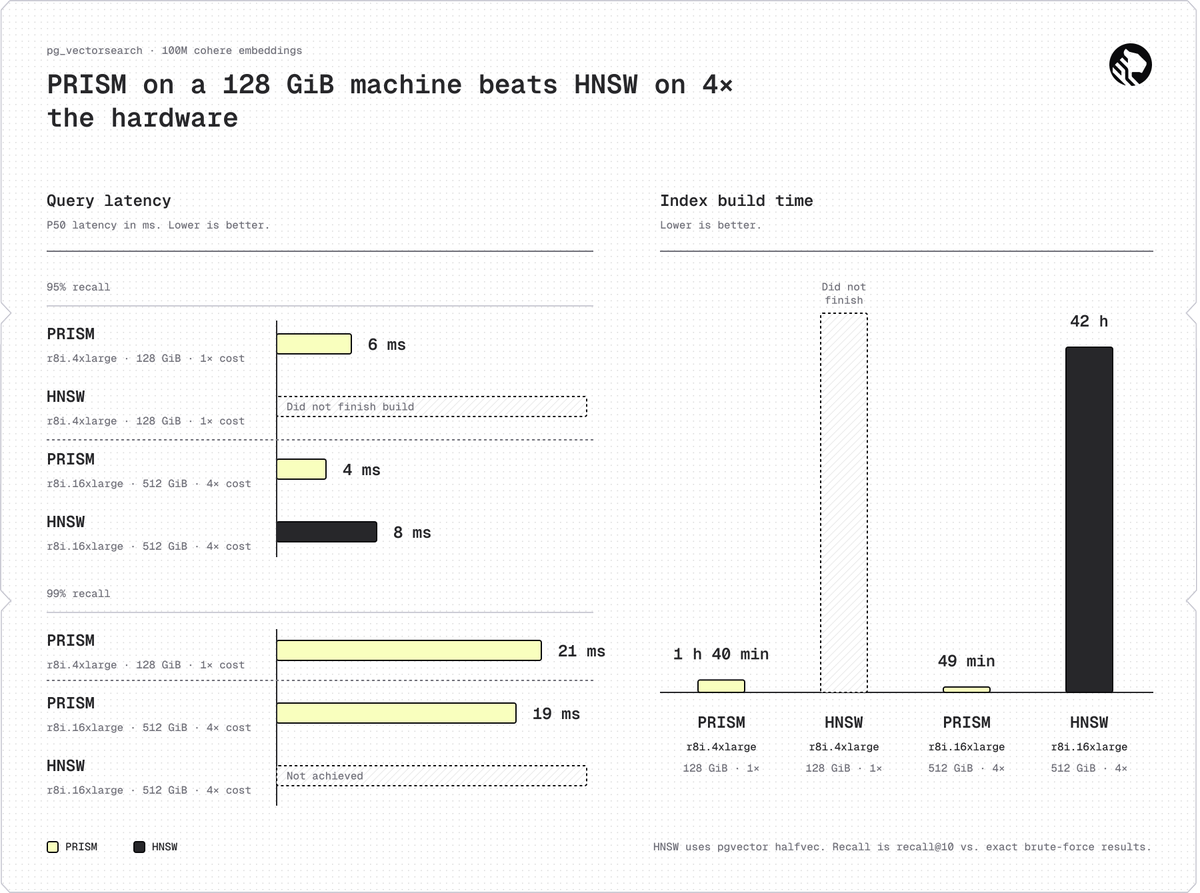
The performance improvements over HNSW are pretty remarkable. At 100 million vectors:
◆︎ Faster queries, 4× less RAM: 6 ms vs. 8 ms at 95% recall, using 128 GB vs. 512 GB RAM. HNSW couldn't even build on 128 GB.
◆︎ 7× smaller indexes: 25 GB vs. 180 GB at 100M vectors.
◆︎ 50× faster index builds: 49 minutes vs. 42 hours on identical hardware.
And at 1 million vectors, PRISM delivers 15 ms queries at 99% recall on just 2 GB RAM, versus HNSW's 392 ms on 4 GB.
What leads to these improvements? Rather than traversing an HNSW graph with random memory accesses, our new PRISM index partitions vectors based on distance, compresses them using RaBitQ, and scans them efficiently using SIMD vectorization techniques. This takes better advantage of modern CPUs and memory locality.
This is actually our second open-source vector index. We learned a lot from building DiskANN-based pgvectorscale, including some important limitations of graph-based approaches. Those lessons convinced us there was a better architectural foundation, so we started over.
pg_vectorsearch is still in alpha, with more engineering ahead. But we believe fast, scalable vector search should live alongside your relational data, without requiring a separate vector database.
Released under the permissive PostgreSQL License, just like our pg_textsearch extension for BM25 keyword search. Together, they provide the building blocks for hybrid vector + keyword search in PostgreSQL.
Feedback and contributions welcome!
Code and blog post below.
⚡️⚡️⚡️