🦔AI companies are bulk-buying rare books, scanning them through high-speed machines that cut the spines off, and shredding the originals. A service called ISBNdb facilitates orders of up to a million books and keeps buyers anonymous. Pre-2022 books are premium because they're free of AI-generated text. A federal judge ruled the practice is fair use because eliminating the original means only one copy exists at a time. Anthropic hired the former head of Google Books partnerships to obtain "all the books in the world."
My Take
This got to me. A bookseller told 404 Media that rare books with almost no surviving copies are being fed into this pipeline. Books that survived wars, fires, and centuries of handling are being shredded so an AI can learn to write a better marketing email.
ISBNdb's website literally says "'AI company destroys two million books' is not a headline that generates sympathy," and they still built an entire business around making it happen quietly. They offer NDAs as a feature. They coach clients to call it "digital preservation."
I've covered AI companies scraping the internet, torrenting libraries, and stealing music. This is worse because it's irreversible. You can re-upload a website. You can reprint a bestseller. You can't replace the last three copies of an 18th-century botanical text once someone shreds them for training data. And the judge said it's legal. So it's going to accelerate.
"We shred rare books and offer NDAs so nobody finds out" is a legitimate business model in 2026. What a timeline.
Hedgie🤗
@PompeyPedro He had many opportunities to make a pass (right footed or left out side foot etc.) to me the more egregious error was how slow he processed everything which ultimately lead to his limited options. At the very least he needed to keep the pace and force Stone to commit.
Open source powers everything in America. We must fight any and all attempts to restrict it in the age of AI.
We must never surrender to the short-sighted safetyists and hawks.
Open source is the entire reason American tech dominates across the globe. If you can't see this it is largely because it is invisible but your blindness to it is no excuse. You are protected by a smoothly running invisible shield the powers everything and that shield is open source.
It powers every major cloud. The router in your house. Your phone. The servers at your work. The NASDAQ and NY Stock Exchange. Radar systems. Just about every website you know and love. The SaaS you're reading this on right now, called X.
Restricting it in the AI era is idiotic, short-sighted and foolish at an almost mind boggling level. It is civilizational suicide.
Take Microsoft. In the early days of Linux they pushed hard against it and called open source "communism" and "cancer." Imagine if their short-sighted stupidity had won the day? Their Azure cloud now predominately runs Linux.
They would have destroyed *their own* future revenue with their foolishness and greed.
In this fight we must never surrender.
We shall fight on the beaches, we shall fight on the landing grounds, we shall fight in the fields and in the streets, we shall fight in the hills.
We shall never surrender!
the market has an answer. No subsidies, for anyone, ever.
If the developer wants to move the property, lower the price.
If the bank forecloses, they lower the price, and liquidate.
Are lower shelter prices ( affordability) a bad thing?
"After Dr. Hussam Abu Safiya’s legal team appealed his arbitrary detention, Israeli authorities transferred him on 3 June 2026 from Naqab Prison to solitary confinement in Nafha as a punitive measure.
The move comes amid harsh conditions and denial of medical treatment."
https://t.co/eSkwzUpqtI
@JaredSandler@thejrios22 And my question to you would be what do you gain by going to Mccutchen? He's clearly done being a productive mlb player.
If the team sucks then you have to prioritize development, ESPECIALLY when you have no good alternatives.
@JaredSandler@thejrios22 When the alternative is a 39yr old washed up player then the play is the kid, for today and for the future. How do you not understand this 😂
@JaredSandler@thejrios22 Hey Jared...kid is 23, barely 250 abs into his career and you're trying to pigeonhole him into a platoon? Oh BTW he's hitting .333 against lefties this year (see i can cherry pick small samples too)
Norway and the UK drilled the same North Sea.
🇳🇴Norway got $2 trillion.
🇬🇧The UK got tax cuts.
Same basin,Same era.... Completely different outcomes.
Norway captured $30 per barrel in government revenue. The UK captured $11.
That gap, compounded over 50 years of production, is the entire difference.
Norway's model was simple: tax heavily (78% marginal rate), take direct equity stakes in fields via the SDFI, own part of Equinor, and put everything surplus into a fund invested abroad.
The Government Pension Fund Global now holds over $2 trillion in assets.
That's $390,000 per Norwegian citizen about 1.5% of all listed equities on earth.
The fiscal rule: only spend the 3% annual real return. Never touch the principal.
The UK started producing earlier, at lower prices, with a lower tax rate (40%) and no saving mechanism.
North Sea revenues flowed straight into the general budget.
Economists estimate the UK missed out on roughly £400 billion compared to a Norwegian style regime.
The windfall largely financed tax cuts in the 1980s rather than a fund.
Where things stand in 2026?
Norway's petroleum sector will generate $63 bn in net cash flow this year alone feeding a fund already large enough to cover 10-15% of the national budget from returns alone.
The UK is a net energy importer.
Since 2021 it has paid countries like Norway more than £100 billion for gas.
One country treated oil as a finite resource to convert into permanent financial wealth.
The other treated it as income.
image source:eia
@stateofdeepness@MacroEdgeRes@LukeGromen Because of asymmetric payoffs. For example if they mine the SoH. Risks would be too high for commercial shipping achieving same result.
🇨🇦 isn’t collapsing. It’s splitting in two.
Young 🇨🇦 now rank 71st in happiness globally while those over 60 are still in the top 10. That gap didn’t happen by accident. Housing became the economy. Older generations built massive wealth just by holding assets, while younger 🇨🇦 are locked out unless they have high incomes or family support. Youth unemployment is pushing ~15% and nearly a million young people aren’t in work or school.
But there’s another layer underneath this. Labour supply has surged. The TFW program has expanded far beyond seasonal work into retail, service, and even parts of white-collar jobs. At the same time, higher-value roles are being offshored. More competition, fewer quality opportunities. That’s not just stagnation, that’s pressure on wages and on the future.
And yet 🇨🇦 still has everything most countries don’t. Resources, talent, world-class universities, a top-tier AI ecosystem, deep institutional capital. On paper, this should be a powerhouse economy. The problem isn’t what 🇨🇦 has. It’s how it’s being run.
If that gap gets addressed, this story flips fast. If it doesn’t, the divide only gets worse.
I spent time in Shenzhen last year and when I saw Merz come back from China saying Germans need to work more I immediately knew what broke his brain because I lived the exact same cognitive shock
my first week in Huaqiangbei I burned through 4 prototype iterations of a motor controller board for less than a thousand bucks total, back home a friend was working on something similar and spent over 12 thousand for a single revision that took almost two months to arrive
when you live that contrast in your own hands with your own project something permanently shifts in how you see the world and it goes way deeper than speed & cost
what Shenzhen actually built is a collective learning organism, imagine 20 PCB fabs 15 injection mold shops 30 component distributors and a hundred firmware freelancers all within a 2km radius, looks insanely redundant from the outside until you realize redundancy is actually information density in disguise
I watched this firsthand with an injection mold supplier I was working with, this guy had seen a hundred founders iterate similar thermal designs over 6 months so he proactively modified his tooling before I even opened my mouth, he knew what I needed before I knew what I needed, the intelligence lives in the relationships between the nodes and it compounds daily
the west thinks about manufacturing as a cost center you optimize by centralizing…
China accidentally built a distributed neural network of manufacturing intelligence where knowledge diffuses horizontally across thousands of agents faster than any single western company can process internally
so when Merz comes back and says we need to work a bit more I think he saw the problem but COMPLETELY misdiagnosed the solution, telling Germans to work harder is like telling a horse to gallop faster when the other side built a combustion engine
the gap is ARCHITECTURAL
it’s ecosystem density, you need a custom connector in Shenzhen you walk 200 meters, in Munich you send an email and wait 3 weeks
it’s iteration speed, parallel search vs sequential optimization at the system level, it’s risk tolerance, Chinese founders ship something broken on Monday fix it Tuesday ship again Wednesday while European companies are still in the approval phase for the pilot program of the feasibility study…
and Merz only saw the surface, what he missed is the tier 2 cities like Hefei Chengdu Wuhan replicating the Shenzhen model at scale right now
BYD going from irrelevant to outselling every european automaker combined in roughly 5 years, Huawei building its own 7nm chip under maximum sanctions when every analyst said it was physically impossible & behind all of that a government that treats advanced manufacturing as an existential national priority while europe debates whether AI needs another ethics committee
I think what we’re watching is the most asymmetric economic competition in modern history and most western leaders are still framing it as a productivity problem when it’s actually an ontological one
Europe & America are optimizing variables that China stopped tracking years ago meanwhile China is compounding on dimensions the west has no framework to even measure
Merz at least had the courage to name
it out loud and I respect that genuinely but working a bit more inside a broken architecture just means you arrive at the wrong destination slightly faster
Classic 1930s misdiagnosis: Western visitors saw Nazi Ruhr & Soviet Magnitogorsk humming, blamed lazy workers, prescribed heroic effort.
Hypocrisy level: max.
Our leaders *built* those rival ecosystems—Ford engineered Stalin’s Gorky plant, multinationals offshored entire supply chains to Shenzhen.
We seeded their dense manufacturing neural net, then come home demanding overtime from Europeans and Americans.
The gap isn’t effort.
It’s architecture.
Rebuild ours.
— effective education
— a tax system that rewards innovation and effort, not “time” in the game
@goldseek Liquid gold! With our own mafia to protect it from falling into the wrong hands! 😆
But yeah our politicians dont understand economics, only social programs.
Remember when the Government didn't Bank with the Fed?🤔
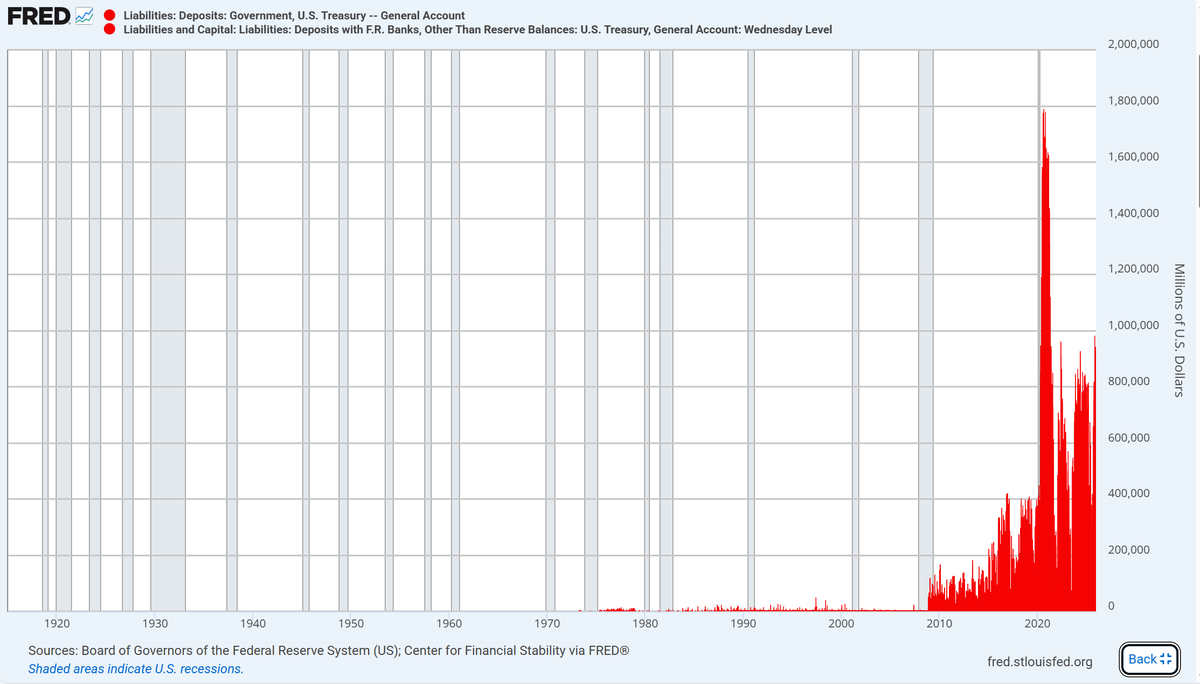
For more than 90 years - from the Liberty Loans of World War I in 1917, through the Great Depression, World War II, the Cold War, and every boom and bust in between - the U.S. Treasury handled its operating cash like a decentralized machine.
It kept the Treasury General Account (TGA) - its single bank account at the Federal Reserve District 2 in New York District #2 - at very minimal levels. In recent times maybe that was just $5–10 billion- barely a day's operating float.
Instead, it deliberately pushed hundreds of billions of tax receipts and government cash out into the banking system to thousands of smaller private banks nationwide through the Treasury Tax & Loan (TT&L) program.
Banks paid interest to the Treasury for holding those funds and used this low-cost reliable liquidity to support lending across the real economy.
The Government's cash stayed spread out, productive, and largely outside the Fed’s direct control. It was a beautifully engineered system: decentralized, market-driven, and resilient for nearly a century.
Then 2008 hit and zero interest rates arrived, and the economics of the TT&L program evaporated overnight.
Banks no longer wanted to pay (or even hold) the governments funds for free, the treasury refused the negative yields, and the 91-year-old TT&L program died quietly behind the scenes.
Today, $700–900 billion - sometimes nearing a trillion - sits idle in a single bank account at the New York Fed. Centralized. Concentrated.
We didn’t just change a cash management policy; we ended a century-long tradition of keeping the governments money distributed in the private banking system - and then silently moved it all into the heart of the Federal Reserve.
Almost no one noticed, and even fewer understand what was lost.
Chart series is "Federal Reserve's Balance sheet since 1914" and the overlapping modern-day H.4.1 series🔴of the weekly Balances of the Treasury General Account
🔗https://t.co/KkkyFqM7cr