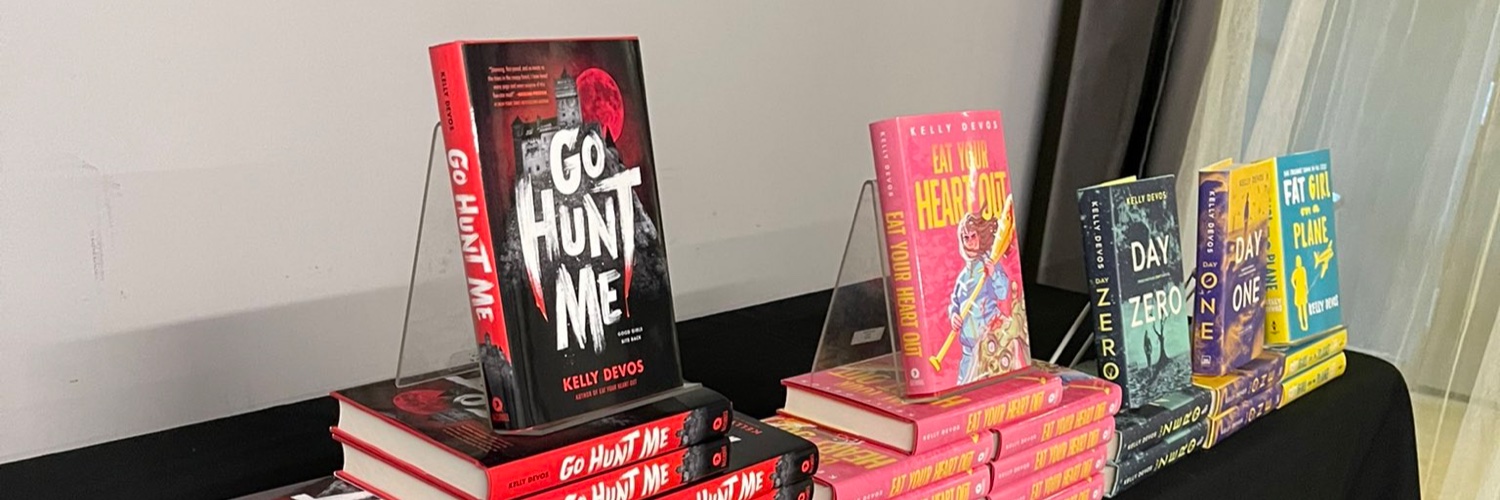
I HAVE BOOK NEWS! This book is really near and dear to my heart and I am SO thrilled it found a good home at @crookedlanebks. Thanks so much to @perez_literary :)
One point that really stayed with me is when they said that detection is not just a technical issue. It is also a social one. Our assumptions about what seems “real” can be inconsistent, biased and shaped by the culture around us.
I don’t usually post about my day job here, but this one crosses over with my fiction-writing life: AI suspicion, what “sounds AI-like” means, and why human work can get caught in the middle. I got to interview a real expert.
https://t.co/B4cOGsGCNC
🎮 Build your own video game this summer at ASU’s Game & AI Camp! Students in grades 7–10 will learn game design, coding and AI-powered creativity tools while creating interactive 2D games. June 15–26 in Tempe. Share with a future game creator! 🚀 #STEM
https://t.co/S0QfzFuVHE
Also disheartened to see accusations about books that could NOT have been generated with AI based on their timing (if a traditionally published book was pubbed in 2024 or earlier it likely could NOT have been generated with something like ChatGPT). Publishing moves SLOWLY!
Look. Just because something reads as boring or repetitive or you simply don't like it, does NOT mean AI created it. Writing is a deeply human process and I fully support that we must do our own work. But I am not happy to accuse people of using AI when I have no evidence.
There is growing interest in having AI systems work with humans rather than replacing them. The research questions are, to be honest, harder in the former case! One challenge is how do end users modulate their trust in the answers provided by LLMs? 1/
A new pre-print by @biswas_2707 and @PalodVardh12428 proposes a framework for evaluating trust--deserved and false--engendered by LLMs.
Premise: LLMs will increasingly be used in cases where the end user doesn't have the capacity to verify the result. How do we empower users to develop appropriate trust in the answers?
Traditionally, we trust the answers we can't verify based on prior guarantees--be they FAA certifications of planes or wisdom of crowds page rank certification of Google pages.
These don't quite work for broad and shallow LLMs, which are (in)famous for their jagged intelligence--being correct on Math Olympiad problems one minute while failing on simple teasers that depend on unarticulated commonsense (viz. @conitzer's substack 😋).
This paper first shows that most obvious ideas of augmenting the LLM answers with additional information--including (1) using "thinking traces" of LLMs (2) summaries of thinking traces (3) post-facto explanations--all significantly increase the false trust in end users.
It then shows that the idea of differential explanations--asking LLMs to provide explanations both supporting and opposing their answers--do a better job of modulating the end user trust. (This idea is not unlike having noisy reviewers of your #AI conference papers write both arguments in favor of, and in opposition to acceptance of your paper--with the AC then using that information to calibrate their final decision).
What does data science look like in action? #SCAI alumnus Bhavya Pandya uses predictive analytics at Envoy Air to help prevent flight delays before they happen, turning aircraft data into safer, smoother travel across a complex aviation system.
https://t.co/OxxtwjaIqQ
Trump's net worth has jumped $3-4 billion during his presidency. Meanwhile, many American families can't pay their bills because of his bad decisions. Public office is for serving the people, not yourself.
Ahh guess what?! @NurseLee4AZ just stopped by the house! If you live in district five help her get on the ballot. RT to spread the word 🤗
https://t.co/QuwI5NAYiE