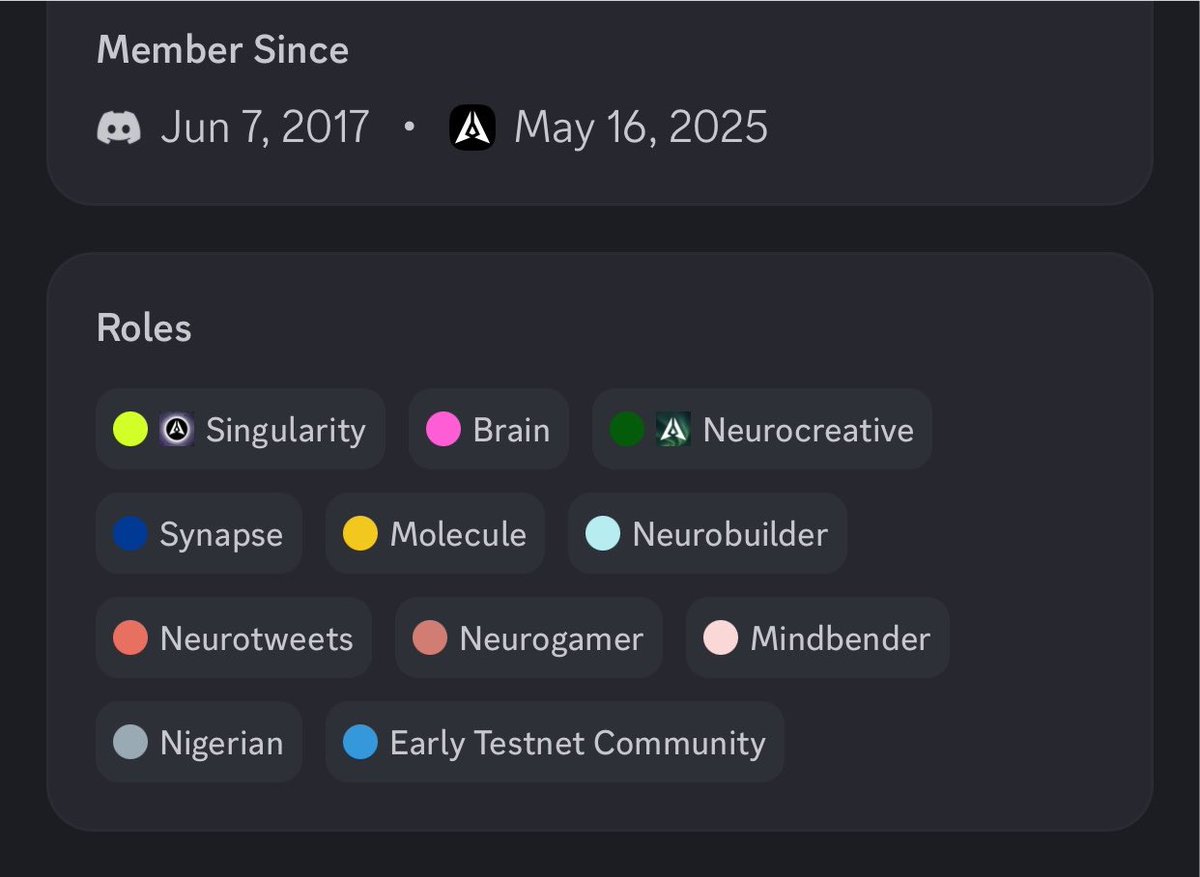
Super excited to be named singularity for the month of July @GenLayer
Reaching this milestone has been a goal I’ve worked towards for a long time and i am truly honoured to be recognised.
A special thank you to @AyomikunCFC@Elixir577@doja_web3@stargirl_hills@Dreybaba1234@sacredtoes@unstopable_111 for your constant encouragement. Your belief in me has meant more than i can put into words.
To our Community Lead, @RuzgarFlns, thank you for your leadership and for fostering a community where people are encouraged to learn, contribute and grow and i am grateful to be part of what GenLayer is building.
And to my fellow GenFrens, thank you for every conversation, every laugh, every collaboration and every bit of support along the way.
We’ve shared this journey for a long time and i don’t take any of it for granted.
Here’s to learning more, building more, and contributing even more.
@_QueenMother_1 Curiosity seems to survive rejection surprisingly often. The people who keep asking questions after the first “no” usually end up learning the most. What kept your curiosity alive during that gap?
@_QueenMother_1 I think number 2 is true. That story is way too painfully specific to be made up. Someone definitely owns that textbook now without realizing it’s worth more than the pages inside.
@_QueenMother_1 I think infrastructure debates get healthier once people stop treating trade-offs as flaws. Every architecture optimizes for something and gives something up.
@_QueenMother_1 I don’t think enough people realize how much creative energy gets wasted trying to reverse-engineer algorithms instead of actually improving the work.
@_QueenMother_1 It’s interesting how we spent years solving trustless execution before seriously asking what happens when trustless execution produces an outcome both parties reject.
@cherry_claudia_ If two builders write equally good code, but only one consistently shares their reasoning, who creates more long-term value for the community, and why?
Most NFT whitelists are decided by luck, capital, or who got there first.
I am completely tired of fighting hyper-speculative bot wars and competing against deep pockets just to get a foot in the door of a community.
Wingston is experimenting with something different.
The new FREE mint from @RallyOnChain uses GenLayer’s AI-powered infrastructure to evaluate participation and content quality rather than simply rewarding whoever has the deepest pockets.
To secure your spot on the whitelist, you actually have to earn it:
You’d need to bring out your creativity and originality on at least 3 Rally campaigns, and your entries would also need to rank top 425 on the weekly leaderboard and lastly but not least, you would have to follow @RallyOnChain to get whitelisted
What interests me is the broader idea behind it.
When AI can evaluate originality, accuracy, alignment and engagement at scale, access stops being something randomly distributed and starts becoming something earned.
That creates a completely different kind of ownership primitive. Wingston isn’t just an NFT collection; it’s a product NFT connected to a live utility ecosystem.
Holders unlock direct protocol leverage:
• Compete and get paid in RLP
• Get unrestricted and stable access to VIP token-gated campaigns
• Get to have a Rally Score boost across the protocol
GenLayer is helping turn human contribution into an on-chain signal, and that signal is what dictates your access.
Not hype. Not luck. Not capital alone.
Secure your leaderboard spot here: https://t.co/O0jFVztJwE
If AI can finally measure contribution at scale, should quality become the absolute foundation of digital ownership?
@cherry_claudia_ Ownership based purely on capital creates one set of incentives.
Ownership based on contribution creates another.
It will be interesting to see which produces stronger communities long term.
@_QueenMother_1@RallyOnChain Wingston feels less like something you “collect” and more like something you plug into. That shift from ownership to usage is what makes it interesting in my view.
People rarely talk about how brutal it is creating content as a small account with little to no engagement.
There were days I would spend hours researching, writing, editing, and posting, only to watch the tweet disappear into the timeline with barely a reaction.
When you’re starting out with less than 500 followers, the self-doubt is real. You start questioning whether the problem is your content or simply the fact that nobody is seeing it.
But I kept creating anyway.
Because the hardest part of being a smaller creator isn’t just getting ignored.
It’s realizing that even strong work can stay invisible, while weaker work gets amplified simply because the account is bigger.
That gap felt impossible to close.
So I stopped chasing vanity metrics and focused fully on improving the craft.
Then I found @RallyOnChain, and it changed how I think about influence.
Because Rally doesn’t evaluate creators based on follower count it actually evaluates the content itself.
Now, the waitlist is officially gone, and anyone can join immediately at https://t.co/1dlyruGKm9.
What makes this different is the infrastructure behind it. Submissions are evaluated through GenLayer’s AI protocol across factors like originality, accuracy, alignment, and genuine engagement.
Not popularity. Not audience size.
For the first time, creators are competing on the strength of their ideas rather than the size of their distribution.
Reach tells you who was heard. Quality tells you who had something worth hearing.
A creator with 500 genuine followers can outperform one with 50,000 if the work is clearer, sharper, and more accurate.
Quality gets rewarded, and payouts settle directly on-chain.
That feels like the version of the internet we were supposed to build.
I’m curious:
If quality permanently outweighs audience size, how many overlooked creators suddenly become impossible to ignore?
@_QueenMother_1 What I find interesting is not just access being earned, but how systems decide what a good participation mean.
Whoever defines that controls the entire value layer.
I still have 56 dead NFTs sitting on OpenSea from the last cycle.
The art is still there, but the attention is gone.
Because most NFT projects made the same mistake.
They rewarded ownership first and hoped contribution would show up later.
It never did.
The Wingston collection from @RallyOnChain flips that assumption completely.
It does not treat NFTs as assets you buy.
It treats them as outcomes of participation.
It is a FREE mint, but access is not purchased.
It is computed from what you do.
To qualify for the whitelist, you will need to:
• Join and submit at least 3 Rally campaigns
• Reach Top 425 on the weekly leaderboard
• Follow @RallyOnChain
Behind this is an AI evaluation system on GenLayer that scores contribution quality and engagement, turning activity into measurable weight inside the system.
That shift is the real story.
Because once participation becomes measurable, ownership stops being static.
Most NFTs rewarded capital.
Wingston rewards signal.
Originality becomes signal.
Consistency becomes signal.
Contribution becomes signal.
And signals decide access.
Even the utility is already live.
And Wingston holders can:
• Stake for daily RLP rewards
• Unlock VIP token-gated campaigns
• Receive a Rally Score boost across the ecosystem
This is not NFT culture trying to find utility.
This is utility defining what an NFT is.
Whitelist: https://t.co/KFKl6hp4SW…
If access is no longer bought but earned through measurable contribution, what exactly is ownership in the first place?