A DEVELOPER WALKED ON STAGE DRESSED AS A 1973 ENGINEER AND "PREDICTED" THE FUTURE OF PROGRAMMING. THE TWIST: EVERYTHING HE DESCRIBED WAS ALREADY INVENTED 40 YEARS EARLIER AND WE STILL REFUSE TO USE IT.
32 minutes from Bret Victor, doing the most quietly savage talk on our entire industry.
-> The idea that lands: we write code as step-by-step text instructions and call that "Just how programming is". He shows four better ways -- all discovered in the 60s and 70s, all abandoned.
Manipulate the data directly instead of typing blind code. Tell the machine your goal instead of every tiny step. We saw all this, then walked away.
Why? The moment you're sure you know what programming is, you stop seeing anything better. That certainty is the cage.
And now AI is dragging us back to exactly what he begged for -- you describe the goal in plain words, the machine works out the how. The future he mourned is arriving anyway.
You thought text files were just how code works. This is the talk that shows it was a choice, and maybe the wrong one.
Watch this one. It'll ruin how you see your job ↓
@ebarenholtz can we get deep insightful subjective experience reports from the twins who share some of their brain? or from anyone, after a reversible commissurotomy? Conscious awareness feels unitary, can't imagine being the result of a merger, as if the problem is temporal ordering
Is there any grounded way to know which processes in ourselves are actually conscious? Digestion, the immune system, "subconscious" neural processes; any of these could be generating subjective experiences that "we," the talking process, are not aware of. No?
@hedin__ If you're stuck going back 2014 and persuade people you're a time traveller the safest prep is to memorize the times of the first gravitational wave detections.
@seanonolennon You 'accidentally' nearly ran over a friend of mine, who was standing next to me at the time, in a crosswalk in LA in the late 90s. You'll probably never see this (and I don't think you even saw him when this happened1), but funny that this is one my two personal SOL anecdotes.
PARASITES STUPID SCIENCE FICTION
"Cat Parasite Infects Billions of People. Scientists Say We’ve Been Underestimating It"
If billions are infected, we are OK! 😅
"parasite will linger in the body for life"
Parasite sits in you doing nothing 😂😂
https://t.co/zLuLq0wMTD
A retired paper merchant with no background in science decided to string a telegraph wire across the entire Atlantic Ocean. It failed so completely that people called it a hoax and a stock scam. He spent twelve years and crossed the ocean more than thirty times proving them wrong.
His name was Cyrus Field. In 1854 he was rich and restless, staring at a globe in his living room, when the idea hit. Back then a letter from London to New York went by ship, about ten days if the weather held. Field wanted to drop a copper wire two thousand miles across a seabed no human had ever seen, and make that message land in minutes.
The experts said it couldn't be done, and they had good reasons. Nobody had ever built a wire that long. It would weigh thousands of tons, more than any ship could hold. And nobody knew if an electric signal could even survive two thousand miles underwater. When Congress voted to help pay for it, the bill scraped through the Senate by one vote.
Then came the failures. The 1857 cable snapped after three hundred miles and sank into two miles of water. In 1858 a storm nearly sank the ship hauling it, and the cable broke, and broke, and broke. Field talked his exhausted backers into one last try that summer, and it held. Queen Victoria sent the US president a 98-word note. It took about sixteen hours to crawl down the wire. New York threw a party so wild the fireworks set City Hall on fire, and Tiffany sold off chunks of leftover cable as souvenirs.
Three weeks and 732 messages later, it went dead. An engineer had forced two thousand volts through the line trying to speed it up, and cooked the insulation. The mood flipped fast. By the end of 1858 people were calling it a fraud to drive up the share price, and Field went from national hero to suspected con man.
The Civil War ate the next few years. When it ended, Field found fresh backing and a new ship: Brunel's Great Eastern, the only ship big enough to carry the whole cable at once. In 1865, with a few hundred miles to go, the cable snapped and vanished into the deep. He brushed it off. "We've learned a great deal," he said, "and next summer we'll lay the cable without a doubt."
In July 1866, he did. Then his crew steamed back out, fished up the cable lost the year before, and finished that one too. Two working lines.
The new cable carried words eighty times faster than the first one. A message between two continents went from ten days to minutes.
Betting against Cyrus Field was the rational move, and the pessimists were proven right almost every single time. But the one outcome that rewired how the whole world communicates came from the lone man who stayed optimistic and was right.
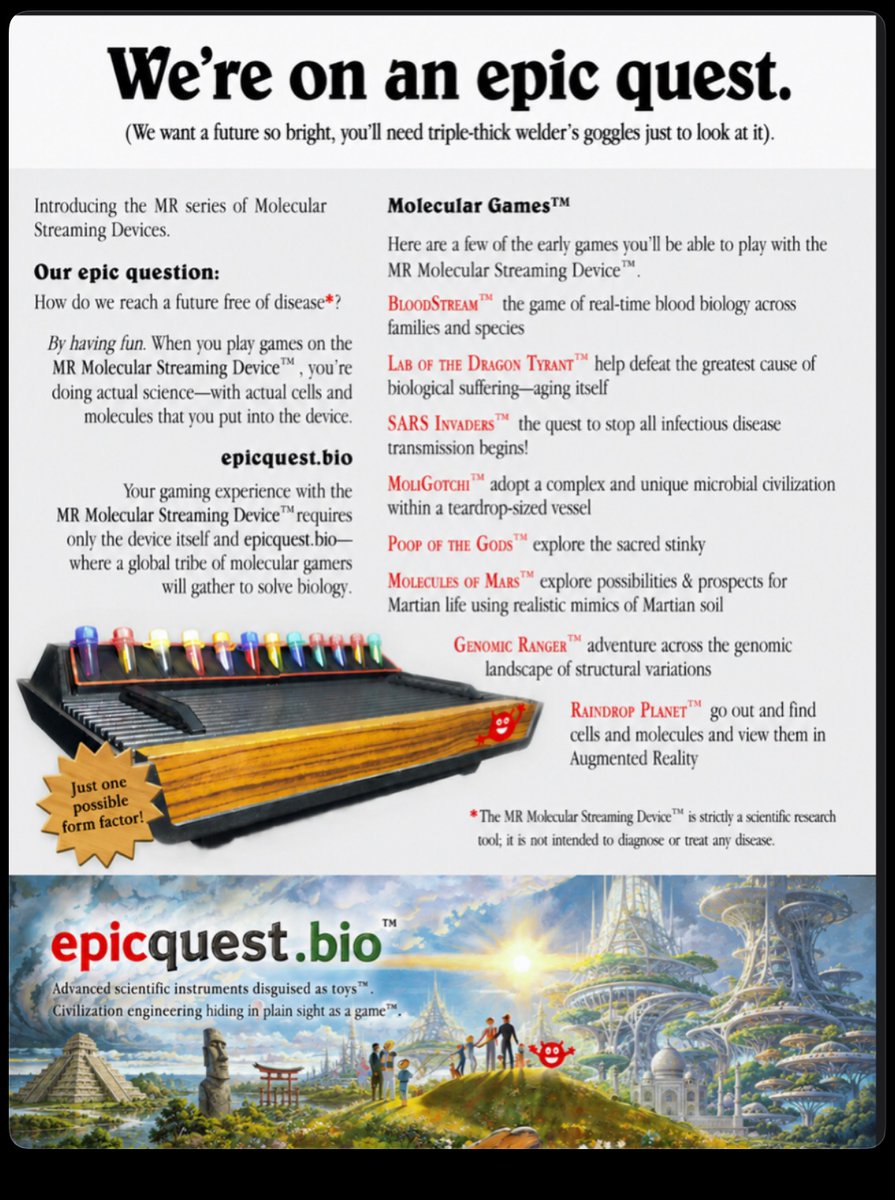
@owl_posting@sierras_account A poster we made in 2021, with one-shotted perfect AI mods to some of the copy (the website and other details changed) and to the image at bottom. We must build utility-scale molecular sensing. Cool posters btw.
I just reread Scott Alexander's Samsara and realized oh my god I am the meme irl
"Master, until now I have lived an unexamined life. Going to temple every day, meditating, taking the drugs, doing the dances. But I longed for something more. In an old library, I found a book which claimed the ancients knew of a state known as samsara, and of a mystery called the Self. That those who master these mysteries gain strange powers. Using the technique of Greed, they can attain such perfect willpower that they can work eighty hour weeks for abusive bosses without quitting. Using the technique of Lust, they can reach such perfect focus that all their thoughts for months revolve around the same person."
@markkaplan20 "It takes a great general to see the obvious." Many such cases. This is one of the reasons we need utility-scale molecular sensing. It should be trivial to answer questions like that and all 'trials' should be ongoing/participated in by everyone. What do you think?