🚀 Just launched https://t.co/1ecCJbbhwN
Your AI-powered assistant for global medical research 🌍
💡 Ask a research question → get PubMed summaries in seconds
🧠 Built for doctors, researchers & students drowning in papers
🔁 Switch between GPT-4o & Claude 3.5 for best insights
📚 Pulled live from PubMed via API
✅ 100% Free to use, PM me if you go for PRO version
No matter where you research — MedBriefs has your back.
#MedBriefs #GlobalHealth #HealthTech #MedicalResearch #PubMed #DigitalHealth #HealthcareAI #GPT4o #Claude3 #AgenticAI #EvidenceBasedMedicine #ClinicianTools #MedStudentLife #GenerativeAI #FutureOfMedicine #WHO #NIH
Medical research moves fast. Keep up with a weekly digest.
https://t.co/4RZWQnUfEm turns PubMed research into clear, AI-powered summaries with citations—delivered to your inbox.
Less time searching. More time understanding.
Sign up: https://t.co/kHiTnBoq1v
#MedEd
Researchers proved AI has deleted every reason universities exist.
Harvard University ran a controlled experiment pitting a custom AI against their own top-tier classrooms.
And the results are going to collapse the higher education bubble.
They took 194 undergraduates and split them up.
One group learned physics in one of Harvard’s best hands-on, active-learning physical classrooms. Group work. Instructor support. The premium university experience.
The other group went home and learned the exact same material with an AI tutor.
The AI didn't just win. It embarrassed the institution.
Students using the AI learned more than twice as much as the students in the elite Harvard classroom.
They scored 30% higher on the final assessment.
And they did it in less time.
Let that sink in.
A piece of software sitting on a laptop outperformed a world-class faculty in one of the most elite learning environments on Earth.
Universities have always justified their exorbitant tuition with two things: access to elite knowledge and the physical classroom experience.
This study just proved both of those moats are gone.
When software can teach you complex physics twice as well as a $60,000-a-year institution, the math of higher education breaks permanently.
The AI didn't just give the students answers. It used strict pedagogical guardrails. It guided. It questioned. It forced the students to do the cognitive work.
It offered perfect, one-to-one tutoring, personalized to the exact moment a student misunderstood a concept.
That level of attention is mathematically impossible to scale in a physical lecture hall.
For a thousand years, the university was the only place to get a premium education.
Now, it’s the bottleneck.
If AI can double your learning speed for a fraction of the cost, what exactly are students taking on decades of debt to pay for?
A 178-citation review is not stronger evidence than a 25-citation meta-analysis.
Citation count = popularity. Study design = rigor.
https://t.co/CCKsEdI3Gb now shows both: → evidence badges on every reference (Meta-Analysis / RCT / Guideline / Review) → a "Bottom line" answer up top, cited + verified
https://t.co/craI0u2eP6
In 1852 aluminium cost twice as much as gold.
Then the price fell over 99.9%. Yet it built one of the largest materials markets on earth.
What it says about AI tokens: https://t.co/5Y04wrz8mj
Medical literature search is quietly broken, and most clinicians have just accepted it. 🧵
1/ PubMed indexes 38M+ citations. But to get relevant results you basically need to be a trained librarian — MeSH codes, Boolean logic, filters. Miss the syntax, miss the study.
2/ Search in plain language and you get the opposite problem: irrelevant papers, outdated results, and the nagging sense that the one trial you needed is buried on page 9.
3/ The 2026 shift: AI that rewrites your plain-language question into optimized query logic behind the scenes — expanding synonyms, structuring the Boolean, matching how the database actually searches.
4/ The impact isn't cosmetic. Recent query-rewriting retrieval research pushed recall from ~25% → ~65%. Most of the relevant studies keyword search used to bury now surface.
5/ This is the core of what we're building at https://t.co/CCKsEdI3Gb: ask your question like you'd ask a colleague, get a cited summary grounded in PubMed — not 400 tabs to wade through.
6/ It doesn't replace clinical judgment. It gives clinicians, researchers, and students back the hours they lose to search syntax.
What's the last study you *know* you missed because the terms didn't line up? 👇
https://t.co/craI0u2eP6
Huge thanks to everyone who tried https://t.co/CCKsEdI3Gb and shared feedback 🙏
Your advice is helping improve the app and make medical research easier for others to access.
https://t.co/CCKsEdI3Gb is free to use.
Need Pro access? Message/email me — free + unlimited access.
#AI #HealthTech #PubMed
🚨‼️ BREAKING: PyPI package telnyx has been compromised by TeamPCP in yet another supply chain attack.
The malware executes immediately upon importing telnyx. It drops a valid WAV audio file and runs an executable embedded within the frames.
🧠
“Can coffee reduce Alzheimer’s risk?”
"Does intermittent fasting really increase lifespan?"
It’s a common question:
Curious what the research actually says?
Try it here 👉 https://t.co/kHiTnBnSbX
Most clinicians don’t have time to read 20 new papers a week.
So I built a newsletter that summarizes the most relevant PubMed research into a 5-minute brief.
Free. Evidence-based. No fluff.
Subscribe 👇
https://t.co/kHiTnBnSbX�
"A life spent making mistakes is not only more honorable but more useful than a life spent doing nothing." — George Bernard Shaw
https://t.co/3HF88IHf0f
PubMed doesn’t speak “normal English.”
Search:
“food supplements longevity” or “belly fat cure pills"
→ 0 results
Why? Because PubMed uses MeSH terms like:
“dietary supplements”[MeSH]
So I built a feature in https://t.co/CCKsEdI3Gb that:
• Detects casual language
• Converts it into PubMed terminology
• Explains why your search failed
Bridging everyday language ↔ scientific indexing.
👉 https://t.co/DfaGmaTYyx
https://t.co/tOGn64oGzZ goes beyond simple search.
Ask complex medical questions and get AI-powered summaries grounded in PubMed evidence, with clear citations.
Built for clinicians & researchers who need real answers, fast.
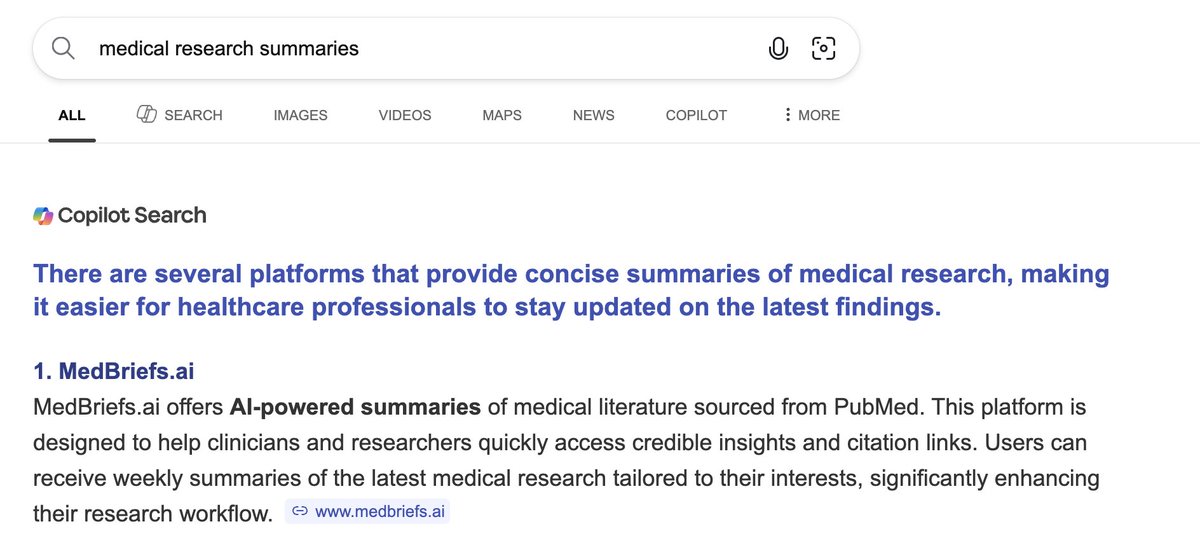
🚀 https://t.co/tOGn64pepx is now listed #1 in Microsoft Copilot Search for medical research summaries.
We also just launched a newsletter feature — get curated, AI-powered PubMed summaries delivered weekly.
Built for clinicians & researchers.
teleoperator kicking himself over not programming Asimov's Laws of Robotics...
Worth considering if we should base today's reality on the science fiction musings from the past.
Testing with humanoid robots is a very interesting new challenge. Historically robots have been confined to keep out zones with rigid walls and laser barriers, lock-out/tag-out, etc. This is the easy way to ensure people don't get hurt by very capable machines. But the more we integrate humanoid robotics into collaborative roles with humans the more we need to remove those barriers by nature of the work.