Today we’re launching Prava Pay- Cards for your AI agent.
Coffee, sneakers or subscriptions - your AI agent can now buy anything online by itself, all within the limits you set for it.
Works with OpenClaw, Hermes, Claude Code out of the box.
Introducing Hyperbox
When your laptop turns off, so does Claude. Not anymore.
Hyperbox is a dedicated cloud Mac mini preloaded with every major coding agent, super fast internet, 100% uptime, GUI + direct ssh.
Built for hyper engineers with always-on agents.
Introducing Impeccable 3.5, the best way to design in production: iterate on real UI with your AI agent, in the codebase you actually ship.
Turns out many popular design skills, including Impeccable and Anthropic's frontend-design, weren't actually very good at...design (the workflow was valuable, but the output didn't magically make LLMs like GPT great designers). We measured it across thousands of generations: 74% of pages used the cream AI-default background, 76% reached for extreme letter-spacing, 90%+ failed the contrast floor.
So we started fixing slop systematically, specific to each model. The skill now compiles rules for the exact defects each model makes, instead of shipping one generic file to everyone. The biggest jump is in GPT-5.5 and Codex.
Also new:
◆ It now knows the difference between a new project and an existing one. Existing codebase, it reads your design system and preserves your identity. Greenfield, it seeds a fresh palette from 129 hand-curated anchors so every cold start doesn't drift to the same safe colors.
◆ Live Mode is now in beta, and works at two scales. Type a direction into the new Steer bar, or speak it, and the agent reads the whole page and edits it in place. Or pick a single element, steer it with a sub-command, live-edit any copy, and accept the variant straight back to source. Insert mode scaffolds brand-new elements between the ones already there. Recovery survives HMR, hidden heroes, and dev-tool overlays.
◆ A rebuilt anti-pattern detector. Torn off jsdom and onto a real CSS cascade resolver: roughly 20x faster, dependency-free, and now small enough to run inline inside the skill, not just the CLI and extension. 14 new rules, 41 total.
◆ The skill keeps itself current, checking once a day and offering to update. Plus /impeccable init and a bare /impeccable that reads your repo and tells you the next move.
Free, open source. Claude Code, Codex, Cursor, and more.
https://t.co/Q5dmE5wB7X
What changes when agents become both a new unit of programming and an emerging new unit of human-to-machine interaction? The mission of Project Solara, a new software platform coupled with tailored hardware solutions, is to pioneer agent-first experiences that are shaped around you: your agents, your tasks, your environment, under your control. #MSBuild
We believe AI can be a dedicated research partner to help discover the next breakthrough.
Enter Co-Scientist: our latest Gemini-based multi-agent system that can generate, debate and evolve novel hypotheses for complex scientific problems 🧵
It’s hard to categorize or evaluate second-brain systems because there’s no single right answer.
But I found one useful lens every second brain should be evaluated through: the lifecycle of your data.
Collect -> Organize -> Evolve -> Use -> Govern
So I made a curated comparison of the existing second brain, AI memory, and knowledge systems, from @claudeai’s memory to @garrytan’s GBrain.
It focuses on the full lifecycle:
- how scattered context gets collected
- how it turns into durable knowledge
- how it stays fresh over time
- how people and AI tools use it in real work
- how users can inspect, correct, delete, export, and trust it
If you want AI to understand your personal context, team knowledge, and working history, this might help.
PRs welcome, especially from heavy users who’ve actually tried building and maintaining a real second brain.
https://t.co/uUbLM10Ep1
introducing momo, the CRM for AI agents.
it gives agents its own CRM, like Salseforce/Hubspot for humans.
every AI native company will need dev agents, sales agents, customer support agents, HR, legal, finance, design agents.
we're starting from customer relationships.
we hypothesize that every important decision ever made in a company all derives from understanding customer data.
even if dev agents are good at building things out in a day, if they don't have any customer signals on which features are working or where people are churning, it's no use.
@getyourmomo does the following:
1) sets up your CRM with posthog + gmail data (or other web analytics tool)
2) analyzes the features your dev agents push
3) detects power users and churning users, aggregates CS tickets
4) sets up auto outreach email workflows & collects reponses
5) builds out list of issues to fix & next steps for your dev agent
setting up custom onboarding for a few teams right now, please dm if interested :)
tokenmaxxing isn't "spend more on tokens" it's the opposite
tokenmaxxing = picking the right stat to max, then making everything else as cheap as physics allows
the drop in intelligence cost curve is your friend!
rather taste is the scarce input
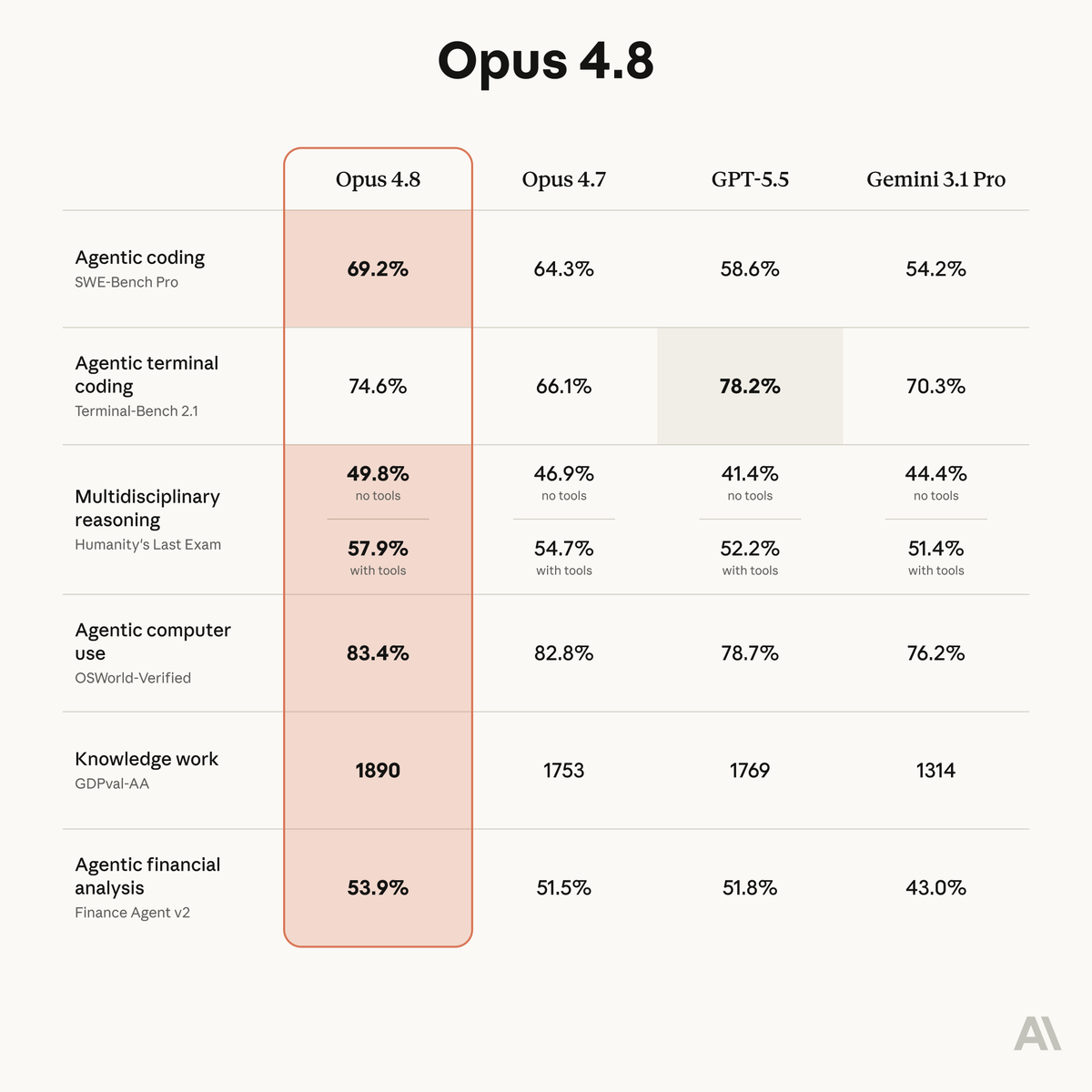
Introducing Claude Opus 4.8: it builds on Opus 4.7 with sharper judgment, more honesty about its own progress, and the ability to work independently for longer than its predecessors.
Available today at the same price.
Windows users, this one’s for you.
Computer use now works on Windows, so Codex can take action on your Windows computer.
And with Windows support for Codex in the ChatGPT mobile app, you can start, review, and steer tasks on the go while work continues on your Windows machine.
An early experience, but we’re working on more ways to keep your work moving, wherever you are.
How we prompt AI is very different in 2026 than 2022 when ChatGPT came out.
I'm teaching a new course, AI Prompting for Everyone, to help you become an AI power user — whatever your current skill level.
It covers skills that apply across ChatGPT, Gemini, Claude, and other AI tools. How to use deep research mode for well-researched reports on complex questions. How to give AI the right context, including more documents and images than most people realize you can provide. When to ask AI to think hard for several minutes on important decisions like what car to buy, what to study, or what job to take. And how to use AI to generate images, analyze data, and build simple games and websites.
I also cover intuitions about how these models work under the hood, so you know when to trust an answer and when not to.
Along the way, you'll see flying squirrels, a creativity test, some of my old family photos, and fireworks.
Join me at https://t.co/tcQc4iJAJG