I realized last night, while watching @camhigby’s livestream, that we’re dealing with people who aren’t simply ignorant of or wrong about specific history; they don’t even believe history is a thing. Here’s a segment on the USS Liberty.
The term "Palestine" until the 20th century referred to an administrative region without fixed or clear borders and with no national identity. The people who lived there before then were either regarded as Ottomans or as part of the Syrian region.
The term came from the final humiliation of the Jews by the Romans in AD 135, following the Bar Kokhba Revolt. The Romans put down the revolt and humiliated the Jews by renaming Judea, etc., "Syria Palaestina," which means "philistine Syria." Arabs and other Arabic speakers record this by naming the land of "Filastin" (ard Filastin) in their fatwas and some other writing.
While some Muslims used the term that we'd render as Palestine, and many Europeans did as a hangover from the Latin name for the region, especially given the general vacancy and irrelevance of the region to most world affairs, it was never anything more than a vague regional designation. There was no state, no province, no administrative district, even, referred to by any name that would render to "Palestine" today. There was, as noted, certainly no national or even sub-national identity, and any attempt to do so would have been shut down by seeing them as incorporated within the broader Syrian identity. The name carried roughly the same kind of specific significance as a term like the "Near East" would today.
Identifying people as "Palestinians" didn't really begin until the very end of the 19th century, and even then it was a reaction to Zionism and Jews starting to move into the region. The term was sort of mainstreamed as a political reality after the Ottoman Empire was broken up in defeat after World War I, and the region came under British control using the old Latin terminology as "British Mandate Palestine," meaning "the part of the Palestinian region under British control." That was roughly thirty years before Israel would declare independence as the sovereign nation-state of Israel as we know it today. At no point in this story is there a sovereign nation-state called Palestine or anything resembling it.
That said, the beginnings of an Arab "Palestinian" identity as oppositional to Zionism and British Mandatory control, developed from their previous 1890s beginnings to something more like a dedicated resistance identity when the Brits took over. Arabs didn't believe in British sovereignty or control over what they deemed Islamic land, either, and they were adamantly opposed to the Mandate's explicit Zionism, which was being acted upon to bring Jews into the region (even though the British were wishy-washy on this and then betrayed it during WWII, when it was arguably needed most).
The "Palestinian" identity at the time wasn't exactly national but quasi-national and born (and borne) only in resistance. It gained some crystallization as such in the mid and late 1930s after the failed Arab Revolt, significantly as a response (back-up plan) to the failure of Greater Syria to defend "Arab" interests in the region against British (and Jewish Zionist) control.
Still, it didn't acquire something approaching the identity status people might recognize today for about another decade. That had to wait until after the "Nakba" in 1948-49. This contested event occurred when five of the surrounding actual Arabian nations declared and LOST a war on the newly declared Israel. These were Egypt, Syria, (Trans)jordan, Iraq, and Lebanon.
Now, this war was the continuation of the same war being fought in the region before Israel's declaration of independence (May 15, 1948) following the late 1947 UN Partition of the region, which the proto-Israelis accepted and all the Arabs rejected. The Arabs started that war, too. Notice no state of Palestine was involved because there was no state of Palestine to be involved. Something like a "Palestinian identity" as a refusal of these developments took significant shape at the time, though.
The Arabs refer to this humiliating loss as a "catastrophe," THE catastrophe (Nakba), and rewrote history to create a "Palestinian" people who were displaced, harmed, and killed by the (defensive) military actions of the Israelis, which they see as an act of colonial aggression because they cannot admit or accept that they lost the wars, including WWI, which removed the land from Muslim control (which they believe is permanent). The "Palestinian people," whom none of these Arab states would absorb because they were more useful as a military-political weapon against Israel, came into existence as a tool to further their Islamic designs.
By the way, the UN Partition in 1947 (General Assembly Resolution 181) does not name the two states it partitioned "Israel" and "Palestine." It called them the "Jewish State" and the "Arab State." The Jews took for themselves the name "Israel" for that land, as they would. As for the "Arab State," it is not actually clear what would have been its fate. Jordan (Transjordan) viewed the Arab land by the Jordan River to naturally be part of its territory, not an independent state called "Palestine." The Syrians opposed this not particularly because they wanted the land but because they didn't want Jordanian expansion. As for Gaza, Egypt wanted administrative control but not to annex it. It is not clear what it's fate as "Arab State" would have been.
In all, in 1948-49, and following the "Nakba," these behaviors and conflicts reflected the broader pattern of inter-Arab rivalry more than anything else. The neighboring states were more focused on preventing a Jewish state and on blocking one another’s gains than on creating a viable independent Palestinian Arab state under the UN plan. The very idea of "Palestine" with a unique national identity and (fabricated) national history would have to wait.
Identity during this period (1949-1967) was still largely either "Arab" or as part of one of the Arab states, like Syrian, Jordan, or Egyptian, specifically, or just "Islamic." Movements like pan-Arabism and even pan-Syrianism were more relevant to the identity of the people today treated as "Palestinians" than was anything to do with Palestine, although the word was used. The biggest change in this period from the one before is that before this, the term "Palestinian" referred also to Jews in the region (under the Mandate), which more or less ended. Arab states also kicked out all the Jews (850,000 of them) during this time, and most of them were absorbed by Israel.
Even still, the idea of a "Palestinian nation," wasn't really invented in 1948. It didn't really gain solid identity in the global imagination as such until after the Six-Day War in 1967, which the Arabs (especially Egypt) lost badly to Israel. This second humiliation, referred to as the Naksa ("setback" or "relapse" or "defeat"), which displaced some 400,000 people* as Israel pushed threats out of its immediate vicinity by taking the lands from which they operated, changed the strategic needs of the resistance movement and fabricated a Palestinian national identity with a bogus history more or less out of thin air. That's the one defended to this day.
*These people were in large part there as a stand of active resistance against the existence of Israel as part of the aforementioned strategic refusal of any Arab states to absorb them, etc., so focusing on their displacement alone is complicated, to say the least.
The thing is, the idea to do this Palestinian national identity thing was largely due to Yasser Arafat, who was working with and getting aid and assistance from the Soviets (and arguably strategic advice in this regard, as the "Palestinian cause" strongly resembles elements of Soviet korenizatsiya programming, which has proved a useful wedge device all over the world). Moscow got involved after 1967 largely because it was only after the Six-Day War that Israel allied formally with the United States (and Western Alliance), which was the ultimate enemy of the Soviets.
Palestinian "national" identity has always therefore been a political contrivance designed to be used as a wedge and weapon against any sovereign control, especially by Jews, of any land in the broad region the Romans once declared "Syria Palaestina." A nontrivial part of this curious effort was an allied Soviet-Arab program to damage Israel and weaken American and Western interests in the Middle East (another regional designation term that isn't a nation, by the way).
That is, it's NOT REAL. It's a political contrivance meant to destabilize the region, kill and displace Jews, and fight Western interests. That's why it exists.
Since it's not real in the sense of being a genuine national identity stretching back into history in any regard, the culture that is assigned to it is also a fabrication. It is a blend of various Islamic and Arab cultural points with outright jihadist and Soviet-Communist radicalism and terrorism treated as though it's a culture. It's a culture of "resistance" and "liberation" in precisely the Communist uses of the terms. It's a "culture" in the same way "Woke" is a culture. In fact, it's basically the same thing, just Islamic and Third-Worldist Arab flavored instead of Western identity politics.
Ronald Coase's most famous paper launched law & economics and institutional economics. Yet it is still widely misunderstood.
Here's why The Problem of Social Cost is much more than the "Coase Theorem"—and what it teaches us about AI, property rights, and the real world.
https://t.co/kGQ7sBpZ3Z
Vance then goes into a rant about what he finds distasteful about the conservative movement:
"Relatedly, and finally, the institutions point. Conservative Inc. is something you hear thrown about a lot, and one of the things you have to do when you feel like you're doing very well is you don't do risky things, and so this would be a much more interesting conversation if I felt like I was behind. I'll let you say that conservatism's institutions are fundamentally broken.
So many of the people who work in the conservative orbit actively hate the people like my grandma and like that woman I met in Toledo who make this entire thing good. That is a matter of fact. There's a woman I met in my church before I converted, just when I was a kid, so an evangelical Protestant church in southwestern Ohio, and she told me once that she felt Republicans were a party of the rich.
She had been phone banking and door knocking for Republican candidates her entire life. She was almost 60 years old, door knocking and phone banking for a party that she said was the party of the rich, and if you asked her why, she said purely because I want to protect babies. That was it.
The only reason she was a Republican was that one issue. There is an entire institution in Washington, D.C. of people who hate women like that, or at the very least think that she's a simpleton, think that she's backwards in some ways. Those institutions have way too much power.
There was something, I would be shocked if it hadn't come up in the last 36 hours, but this crazy guy at the Peterson Institute, okay, I see you guys nodding, so he talked about why the protection of manufacturing jobs was effectively code for white supremacy, and we needed to throw all these working class white guys to the curb and replace them with somebody else. But let's be honest, that is a sociopathic sentiment for anybody who cares about the public affairs of this country to utter. Completely, completely insane.
Yet, there are people in this room who I know who are 10 times smarter, 10 times more capable, and 10 times more right on the issues, and yet they make, if we're lucky, 20% of what that guy makes every single year. Unless you fix that institutional problem, unless you give breathing space for the people who believe the right things and are actually fighting for the American worker, some room to breathe, some room to argue, and some room to know that if they say or do the wrong thing, they're not going to lose their job. We are never going to actually serve the dignity of the American worker."
Here's an excerpt from an unpublished JD Vance speech at the 2022 Postliberalism conference he keynoted for Adrian Vermeule, Patrick Deneen, and Sohrab Ahmari.
He genuinely believes there's some sort of donor-driven conspiracy to make Republicans support economic libertarianism and free trade:
"That's why the donors and they do have too much influence in all politics. There was a study that was done five or six years ago, and I'm going to put you the results, so don't quote me perfectly on this, but it was really interesting. And what it found is that left-wing donors, donors to democratic causes, made democratic candidates far more left-wing on social and cultural issues, made them more vocal.
And donors to Republican candidates made them far more libertarian on economic and trade issues. Shocker. Shocker, especially to the people in this room, I'm sure.
But this is why it matters. And I'm telling you guys, if we, I wrote about this in the abstract. I wrote an article in I think 2018 or 2019 about the end of the globalization gravy train.
The argument I made then is something I still believe, that the reason why there is so much influence of trade deals and trade policies that's bad for workers, and eliminating the social safety net that's bad for people like my mamaw, the reason that stuff is out there is because of the influence of financial supporters, both on the left and on the right. And I remember I wrote that article, and it was a pretty well, you know, in my view, it was a great essay. Best essay I've ever read, actually.
And, you know, I remember that there were Republican friends of mine, and there were think tanks that wouldn't even put the article on their website because it might alienate their own donors or their own supporters, okay?"
@ggreenwald 4 or 5 years ago there were crimes against Asians. Remember #stopasianhate. Turned out the perpetrators were another left wing constituency. That's when it disappeared. Glenn said nothing
@timstarr2001@LudwigNverMises I suspect that if immigrants at all levels of the skills distribution and legal and illegal alike were unambiguously economically positive you would see more cities competing for them, but you don't really see that
@timstarr2001@LudwigNverMises The facility is then entitled to emergency Medicaid in order to cover the cost of inpatient care which could be in the tens of thousands. Who pays for that? This was a big topic of discussion in New York City over the last four or five years during the migrant crisis.
@timstarr2001@LudwigNverMises As much as I like David Bier, the labor economist, he completely gets this wrong. He uses a present value of a statistical life of an immigrant, or the lifecycle model, that assumes that every new migrant is going to reflect the median
Contrast Mamdani's mealy-mouth-isms w/the bracing Manifesto: "The Communists disdain to conceal their views & aims. They openly declare that their ends can be attained only by the forcible overthrow of all existing social conditions. Let the ruling classes tremble at a Communistic revolution. The proletarians have nothing to lose but their chains. They have a world to win."
I already hated you and I hate you even more for forcing me to defend Ben Shapiro, who I've hated since you were mouthing neocon talking points on Greg Gutfeld's show in the early 2010s.
1) You antiwar Iran/China puppets always condescend to our servicemen with this "WHY DON'T YOU ENLIST" line. You think being in the military is a punishment and our soldiers are po' blaqpipo being ordered to their deaths by the white oppressor. Or maybe po' wypipo since you pretend to be pro-white while you're taking money from Qatar.
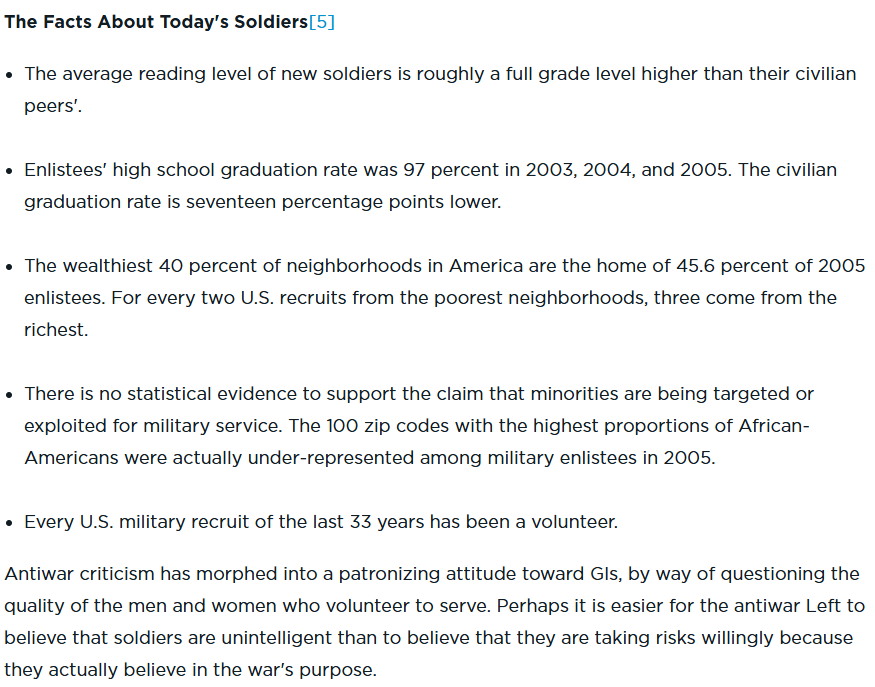
Military servicemen are smarter, stronger, and more capable than the general public. They score higher on standardized tests, graduate high school at higher rates, and come from wealthier families than the American average. You're a college dropout who went into media because you were too stupid to follow your daddy into the CIA. At least Shapiro was able to mainline enough Adderall to finish his degree.
And get this: the overwhelming majority of active servicemen AND retired veterans support the Iran war. Why? Because everyone who's served in the past 50 years has been dicked over by Iran in some fashion and they're tired of it. Both boomers who remember the Iran hostage crisis and millennials who served in Iraq want Iran taken out. You don't speak for them, Tucker. You never will.
2) The war has nothing to do with Israel and stems back to the Iran hostage crisis and their subsequent economic, political, and social manipulation of our country. If anything, Israel got the short end of the stick because we used them to crush Iran at the war's outset and Trump is now leaving Netanyahu on read. This is OUR war, a war that was 50 years overdue, and Israel is nothing more than the guy throwing us clips in the background.
3) You're personal friends with the vice president. Stop acting like you have no ability to influence the administration. Neither you nor Mark Levin supported Trump in 2016 and the Dominion lawsuit revealed that you hated Trump and were glad to see him frauded out in 2020. You're no better than him.
4) If we were alive at any other point in history, you and the rest of your tardclique would be in prison for sedition, same as every other foreign-funded "antiwar" voice that comes out of the woodwork. You're Vito Marcantonio with a vowel deficit. Go take some ayahuasca and shut the fuck up.