Best wishes from kenticisms. Like a lot of accounts I am moving away from Twitter(X), I have been running an account of the same name on Bluesky in parallel for a couple of weeks and will be posting exclusively there from the new year. Hope to see you there.
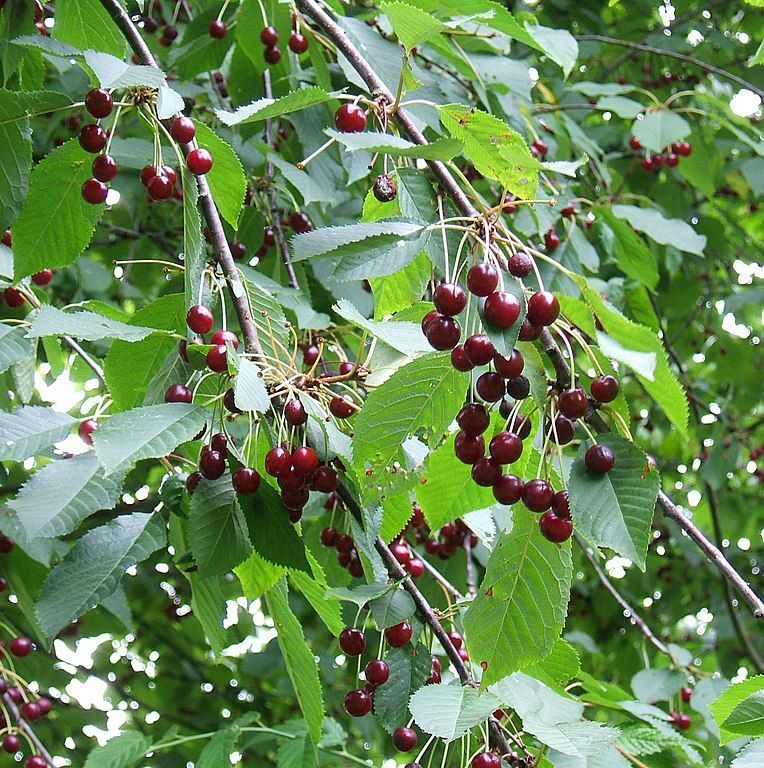
Kentish dialect dictionaries record the fruit of the wild cherry (Prunus avium) were known as MAZZARDS, sometimes also GASKINS. The heart-shaped fruit could be either red or black, sweet or bitter, with a staining juice.
(image from wikipedia)
A Dictionary of the Kentish Dialect defines MEAL as the ground wheat or any other grain before it is BOLTED [sifted]. In bolting, the bran is divided into two qualities, the coarser retains the name of BRAN, and the finer is called POLLARD.
Sander's The Dialect of Kent records MEAKERS for mice, both common house-mice or field mice.
"Ye shall soon have to shift that old foggot-stack. Too many o' they meakers be a-nesting in there, and too many of 'em a-finding their way into the cottages as well."
Halliwell's Dictionary of Archaic and Provincial Words has an entry for PORED-MILK - any milk that turns or curdles in the boiling is in Kent called pored milk, especially the first milk of a cow when she has calved.
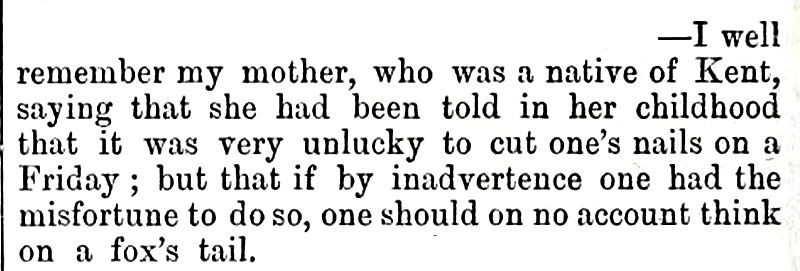
If you want to add extra danger to Friday the thirteenth you can cut your nails, whilst thinking about a fox tail! As found in Notes and Queries (1880).
Similar to the warning of the loss of ravens at the Tower of London there was a Kentish superstition that if the rooks left the rookery of an estate there would be no heir born to the family.
Whereas a ROOKERY described an argument or altercation, sometimes amongst many people.
A Dictionary of the Kentish Dialect says that SLAPPY was to make something slippery through wet and that the form sloppy, meaning wet but not slippery, was common everywhere.
It also has SLICK for slippery, obviously now in common use and GLINCE "The ice is terr'ble glincey."
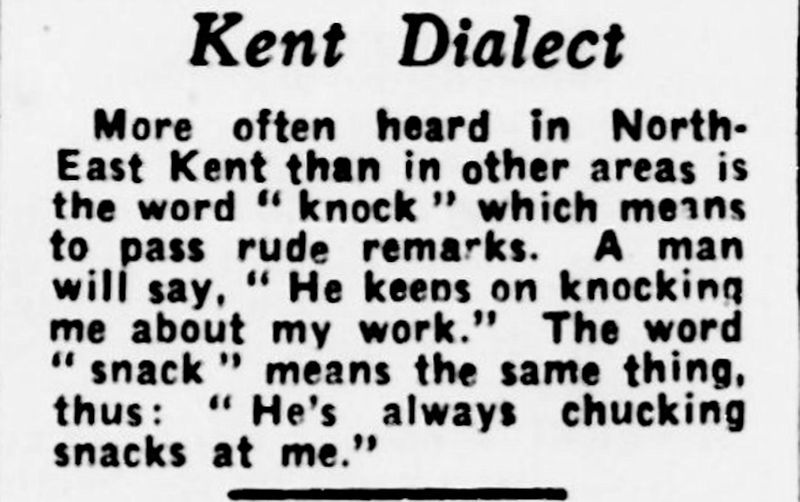
Another 1950s newspaper snippet. PANNELING was running in and out of the house, especially in rainy weather. I think that this is probably a variant of SPANDLE - to leave marks of wet feet on the floor like a dog.
Some P words attributed a Kentish origin in Halliwell's Dictionary of Archaic and Provincial Words;
PADDY - worm-eaten
PANDEL - a shrimp
PEELER - an iron crowbar
PLUM- very, exceedingly
POLT - a rat-trap that falls down; POLT could also mean saucy or audacious
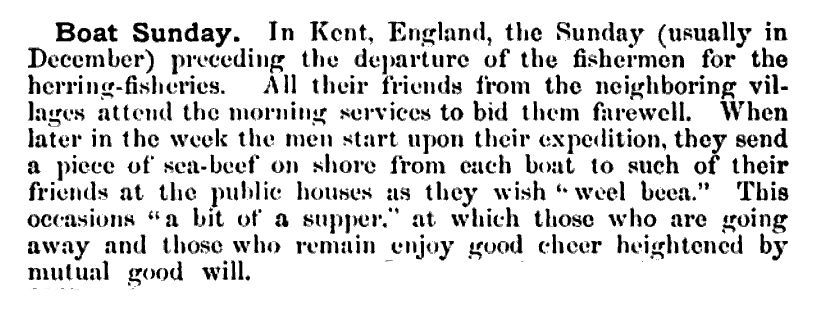
I came across this record of BOAT SUNDAY associated with herring fishery in Curiosities of Popular Customs (1925), which I'd never heard of before, I don't know if the 'sea beef' referred to here is the same as FOLKESTONE BEEF - dried dogfish.
A Dictionary of the Kentish Dialect records a Kentish pronunciation of 'asylum' as HARSLEM.
"When he got to settin' on de hob and pokin' de fire wid's fingers, dey thought 'twas purty nigh time dey had him put away to de harslem."
I think most people have heard of the tradition of playing cricket on the Goodwin Sands, but I didn't know it had started so early. In Memorials of the Goodwin Sands it says the first match was played in 1824, led by Captain Kennet Martin, Harbour Master at Ramsgate.
I've mentioned before that in Kent a large frog, or toad was known as a PADDOCK (or PUDDOCK or PUTTOCK). I found a reference in Halliwell's dictionary to a saying;
"In Kent we say to a child, your hands are as cold as a paddock"
This 1950s newspaper snippet says that BROADIES, meant to go for a walk, especially when talking to small children. I had come across this before, but it does seem an odd use of dialect, presumably a variation of 'abroad', to go out, away from home.
There was a tradition in some Kentish parishes, such as Milstead near Sittingbourne that on St Andrews day (30th) most of the inhabitants took a holiday for various amusements, one of which was a SQUIRREL HUNT. It appears to have been an excuse to commit a good deal of poaching.
A Dictionary of the Kentish Dialect defines TILT as the condition of arable land.
"He has a good tilt," or "His land is in good tilt."
A Kentish pronunciation of tilth.
OUT OF TILTER meant out of order or condition.
"He's left that farm purty much out o' tilter, I can tell ye."