Cricket fanatic, sports junkie, travel enthusiast, proud husband & dad. Passionate about history. Making every ball, run, goal, and journey count 🏏🌍📚🇨🇦🇮🇳
With this incredible goal, in extra time, Canada 🇨🇦 is heading to the final 16 for the first time in World Cup history ⚽️
Huge congrats to the entire team @CANMNT_Official— you have made all of Canada proud!
Everyone has been so impressed by Japanese fans cleaning up after themselves but most probably missed this beautiful moment at the post-game (🇳🇱2 - 2🇯🇵) press conference.
Toward the end after reporters were done asking questions, 🇯🇵head coach, Hajime Moriyasu, asked to speak one more time.
🗣️ “May I speak?”
He turned to the Dutch reporters in the room.
🗣️ “I think there are many Dutch reporters here as well, so I’d like to take this opportunity to express my gratitude to the people of the Netherlands once again.”
Moriyasu explained that when he became part of the Japan national team, Japanese football still had no professional league.
🗣️ “I was trained by a Dutch coach named Hans Ooft. It wasn’t just me. Japanese coaches in general were greatly influenced by him, which has led to the development of Japanese soccer today.”
He also mentioned another Dutch figure who shaped his career.
🗣️ “The legendary Dutch coach Wim Jansen served as the manager for J.League’s Sanfrecce Hiroshima and also as a coach for Urawa Reds, contributing to Japanese soccer.”
🗣️ “It’s not just those two. Many other coaches and players have contributed to raising the level of Japanese soccer, so I want to express my thanks. Thank you very much.”
What a masterclass in graciousness and gratitude. Imagine after a high-stakes match, instead of basking in glory and bravado (well-deserved in my opinion), the coach took to the microphone to... thank his opponents publicly and sincerely.
Japan's cultural operating system prizes harmony (wa), respect for precedent, and gratitude as a form of strength, not weakness. Japanese sports culture reflects its broader society where you'll see athletes bow to their opponents, thanking referees, and even crediting rivals or mentors.
Think of sumo wrestlers, Olympic athletes, or even bullet-train staff apologizing for a 30-second delay.
The Japanese have this concept of On (恩) - it is the sense of indebtedness to those who came before or helped you. It's what you'd expect from a culture that truly prizes continuity.
Moriyasu was acknowledging a real debt to Dutch coaches like Hans Ooft (who coached Japan in the early 90s and helped professionalize the game) and Wim Jansen. Japanese football openly credits foreign influences - Dutch "Total Football" philosophy, German organization, Brazilian flair - while building something distinctly their own. Few nations do this with such little ego.
Japan is pure class
I love this story because it reminds me that one person can make a difference.
In 1979, Jadav Payeng began planting a tree every day for 37 years — results are stunning
India has sent 96 people to America who started billion dollar companies. No one else is even close.
There's only about 5 million Indians in America. Almost one in 50,000 of them is a unicorn founder!
What a holy, special, beautiful people.
I will always fight for them.
When I saw this video, my first thought was that the earth, very often, sends us messages.
This tree, facing constant winds, is still standing, & has neither fallen nor been uprooted.
Instead it’s been shaped by it.
And developed its own unique aesthetic & identity.
We have to recognize & accept that tough times & tragedies are part of the journey.
They don’t define us, they simply give us our own unique personalities & capacities…
#MondayMotivation
The poorest way to face life is to face it with a sneer. There are many men who feel a kind of twister pride in cynicism. There are many who confine themselves to criticism of the way others do what they themselves dare not even attempt. There is no more unhealthy being, no man less worthy of respect, than he who either really holds, or feigns to hold, an attitude of sneering disbelief toward all that is great and lofty.. A cynical habit of thought and speech, a readiness to criticise work which the critic himself never tries to perform, an intellectual aloofness which will not accept contact with life’s realities: all these are marks, not as the possessor would fain to think, of superiority but of weakness.
Teddy Roosevelt
Next in who after the Ramanujan Series? Before Google was a company, he had already built an early intelligent system based on neural networks. Subhash Kak is the Ghost who bridged the gap b/w Narayana of the past & the Algos of the future. In a quiet lab in Oklahoma, he designed a Neural Network that learns in a fundamentally different way from conventional systems. He is the man who looked at 2000 yr old Sanskrit grammars & saw deep structural insights that could inspire the world's most advanced code. While Silicon Valley builds the future, Kak is 1 of the few who found ancient patterns that resonate with modern computing. He is the titan who proved that the computer is not just a machine, it is also a mirror of the ancient mind.
While the world was still using floppy disks, Kak was trying to solve the hardest problem in tech: How to make a machine understand Meaning, not just Math. In the early 90s, Kak developed an early AI-based search engine concept called LASSI (Language Analysis and Synthetic Search Inference). Unlike the early keyword-based search engines (like AltaVista), LASSI used Neural Networks & Associative Memory to go beyond simple word matching. It was an important early attempt at semantic search, a forerunner of the kind of contextual understanding we use today.
In fact, he redesigned key aspects of how computers could learn. He introduced the Kak Neural Network (a type of instantaneous learning network). While most AI today requires massive training (LLMs take months), Kak’s approach explored the idea of rapid, 1 shot learning... modeling how a human child can learn a word after hearing it just once.
He was 1 of the early researchers to propose ideas in Quantum Neural Computing, merging concepts from quantum physics with neural architectures.
Kak is a Ghost (for his AI contribution) because his work is too Eastern for the West & too Technical for the East. He realized that the Panini Grammar (from 2500 yrs ago) was a masterpiece of formal structure, 1 of the most sophisticated rule-based systems ever created. He spent decades at Oklahoma State University, working in a silo that sounds like science fiction, translating the ritual logic of the Vedas into the language of Machine Learning.
He solved important qs in the Chronology of Indian Science, using Archaeo-astronomy (tracking the position of stars mentioned in old texts) to push the timeline of ancient Indian mathematics & astronomy much earlier than previously thought.
He proves that the Ramanujan Gene, the ability to see deep patterns in the universe is part of a 1000s yrs old tradition. He is the man who showed that modern AI we are so proud of has surprising philosophical & structural connections to ancient Indian logic. Because he talks about both Quantum Physics & Ancient History, the siloed academic world often does not know where to put him. He remains a Ghost because he refuses to pick just 1 side.#WhoAfterRamanujan
“Don’t leave nothing for later.
Later, the coffee gets cold.
Later, you lose interest.
Later, the day turns into night.
Later, open doors close.
Later, people grow up.
Later, people grow old.
Later, life goes by.
Later, you regret not doing something.
And you had the chance.”
@YearOfTheKraken@NBDwrites I will add Parsi and Zoroastrian to the list. We arrived empty-handed and thrived. Without India, there would be no Parsis or Zoroastrians.
Only one chance in this lifetime…
Like watching sunset at the beach from the most foreign seat in the cosmos, I couldn’t resist a cell phone video of Earthset. You can hear the shutter on the Nikon as @Astro_Christina is hammering away on 3-shot brackets and capturing those exceptional Earthset photos through the 400mm lens. @AstroVicGlover was in window 3 watching with @Astro_Jeremy next to him.
I could barely see the Moon through the docking hatch window but the iPhone was the perfect size to catch the view…this is uncropped, uncut with 8x zoom which is quite comparable to the view of the human eye. Enjoy.
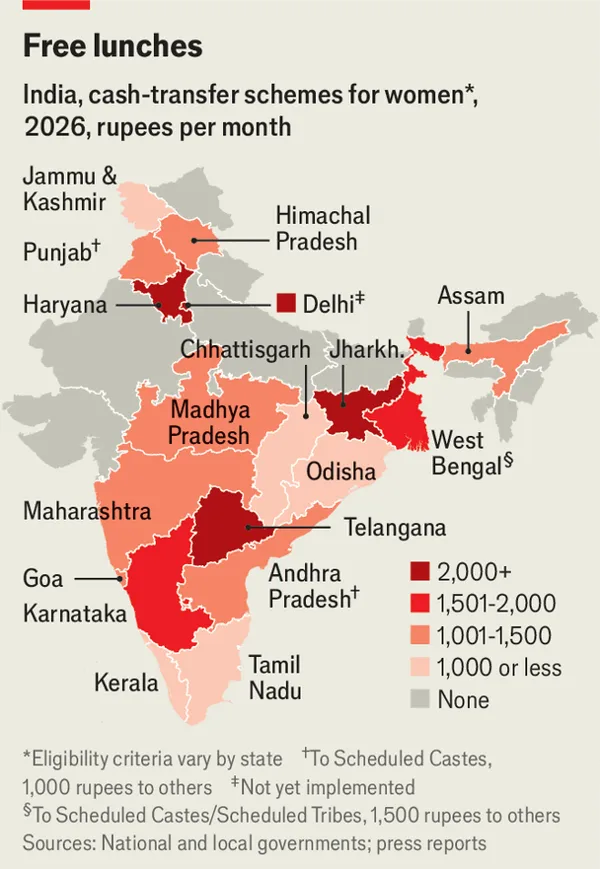
The Economist on India: "At least 16 states operate programmes for which only women are eligible...They use varying criteria, such as age, income and marital status, to choose beneficiaries. Increasingly, elections are fought over such programmes."
Important life lessons I wish I knew years ago:
1 lost money can be found, lost time is lost forever - protect what matters most
2 to learn, unlearn, relearn and then change yourself is a superpower
3 you are not your job
4 networking is about giving
5 the best teacher is your last mistake
6 good manners is as important as good education
7 do not take your good health for granted
8 be a better friend and value relationships
9 if you are waiting for a title to lead, you are not ready to lead
10 a work sponsor is more important than a mentor
11 a good story is data with a soul
12 stop worrying about what others think of you
13 if you want an easier life, work on harder problems
14 best teachers are life long students
15 imposter syndrome is real, and a good thing
16 fight against a sense of entitlement
17 half the battle is showing up
18 love and cherish your parents by giving them your time
19 success is not accidental
20 the best views are there for those who love the climb
21 lucky people work harder
22 takers may end up with more, but givers sleep better at night
23 memorizing is not learning
24 it is okay to look back, just don’t stare
25 knowing is not acting - I can > IQ
26 straight roads do not make great drivers
27 good listeners hear the unsaid (listen with your eyes)
28 be the person that you want to follow
29 do not limit your contribution to a job description
30 take care of your parents - the best gift that you can give yourself
31 customer service is not a department
32 in the long run, the optimists create the future
33 never ruin an apology with excuses
34 salary is for expenses. equity is wealth - do not rent your time
35 do not take a caring boss, joyful work or steady income for granted
36 as you get older, you love your parents more
37 challenge assumptions, starting with your own
38 we learn more from disagreements
39 best gift you can give yourself is quality time with parents
40 the older you get the less you care about what others think of you
41 be a good person but do not waste time trying to prove it
42 be comfortable with saying ‘I don’t know’ - there are no experts of tomorrow
43 being self-aware is a key to learning and growth; know yourself
44 first, invest in yourself, then help others win
45 if the answer is no, do not say maybe or yes
46 Don’t just translate, write something new and original; write for yourself - writing improves your thinking
47 It’s more important to do the right thing than to win an argument
48 do not buy your children what you never had, teach them what you never knew
49 begin with the end in mind
50 to make progress on your to-do list, you must also keep a to-don’t list
51 leave everything and everyone better than you found them
52 be kind and polite to everyone
53 Here’s how luck finds you:
—Work harder than expected
—Stay teachable
—Give without expecting a get
—Read and write more
—Show up on time
—Focus on your customers
—Develop good manners
—Be humble
—Be kind and generous
—Surround yourself with smarter people
54 bosses we remember:
—provided us a safe space to grow
—opened career doors
—defended us when we needed it
—recognized and rewarded us
—developed us as leaders
—inspired us to stretch higher
—led by example
—told us our work mattered
—forgave us when we made mistakes
55 The older you get, the more quiet you become. Life humbles you so deeply as you age. You realize how much nonsense you’ve wasted time on.
56 Hire based on high rate of learning and good judgment
57 straight lines do not make great drivers
58 stand in the middle of the road for too long and you may get hit from both sides -be decisive
59 if you do not know the answer, it is okay to say 'I don't know, but I will find out'
60 do not follow or admire mean people - be the person that you would want to follow
61 decisions you made 5-10 years ago shaped where you are today; decisions you make now will shape where you’ll be in 5-10 years