🚨 Here's the mind-blowing story of the "Godmother of AI." And everyone should know about her.
She arrived at America when she was just 15. She didn't speak English at the time.
She cleaned houses. She waited tables at Chinese restaurants. Just to keep her family going.
Then her mom got sick.
So the family had to open a dry cleaning shop. And every single weekend, she'd leave Princeton to go run the register.
No connections. No money. Nobody to fall back on.
And this woman went on to build the dataset that basically started the deep learning revolution.
We're talking about the foundation that made ChatGPT possible. Gemini. Claude. All of it traces back to her work.
Her name is Fei-Fei Li.
Microsoft has like 75 different things named Copilot.
Apps, features, platforms, a KEYBOARD KEY, an entire category of laptops, and a tool for building more Copilots.
Tried to explain what Copilot is to someone the other day. Couldn't do it.
It's literally just "the thing that helps you do the thing." Whatever the thing is.
(via @teybannerman)
🚨 BREAKING 🚨
Iran-US have announced ceasefire. But here is very weird take on what I have been thinking...
Pakistan's PM picks up the phone. Calls Trump. Calls Iran. Proposes a two-week pause. Both sides agree, literally 90 minutes before the deadline to bomb an entire country's power grid. (at least thats what we know)
And I can't stop wondering: what if AGI (AI that surpasses human intelligence) was in the room?
Like, genuinely. What would have happened?
An AGI advising the US side would have had access to every war in history, every negotiation transcript, every game theory paper ever written. It would have modeled ten thousand scenarios before advising. It would have known exactly what Iran's breaking point was what Pakistan's leverage looked like and what oil prices would do the second a ceasefire was announced.
And it probably would have recommended something perfectly logical.
But would it have called Shehbaz Sharif and said "brother, I need you to tweet something in the next hour"? Would it have understood that a Pakistani field marshal's personal credibility with Iranian generals matters more than any satellite data? Would it have felt the room and known that this specific moment, not yesterday, not tomorrow, was the moment to push?
I don't think so.
Because the thing that stopped a war tonight wasn't intelligence. It was relationships. Gut feeling. A sense of "if I ask right now, he'll say yes."
That's not a data problem. That's a human problem.
I'm bullish on AI. I build with it every day. But tonight made me realize something uncomfortable.
The hardest problems don't need more intelligence. They need the kind of trust that no model can generate.
And maybe that's fine. Maybe that's the point.
How to NEVER run out of Claude Tokens. (A Rant From Someone Who Learned the Hard Way)
I wasted thousands of tokens before I figured out what was actually happening. And, I'm a little mad nobody told me sooner.
Here's the thing nobody explains when you sign up for Claude: it doesn't care how many messages you send. It cares how many tokens you burn. And most of us are burning them like we've got an infinite supply.
I didn't. So I learned. And now I'm going to save you the pain.
1. Stop sending "no that's not what I meant" messages.
Every time you send a correction, Claude doesn't just read your new message. It re-reads everything. Every single message from the top. Your chat is not a conversation. It's a growing document that gets more expensive with every line. By message 30, you're paying 31 times what message 1 cost you. Thirty-one times. SO JUST EDIT THE ORIGINAL MESSAGE!
2. Kill the chat before it kills your budget.
I used to have these monster chats. Hundred-plus messages. I thought I was being productive. I was actually lighting money on fire. Someone on LinkedIn tracked this. 98.5% of their tokens were spent on Claude re-reading old history. Only 1.5% went to the actual output. Let that sink in. Every 15 to 20 messages, ask Claude to summarize the conversation. Copy it. Open a new chat. Paste it as your starting point. Fresh context. Clean slate. Fraction of the cost.
3. Ask everything at once.
I know it feels natural to go one question at a time. "Summarize this." Then "list the key points." Then "write me a headline."
Three questions means three full context loads. You just tripled your cost for no reason. Put all three in one message. Claude actually gives better answers this way because it sees the full picture upfront. You save tokens AND get better output. There is no downside.
4. Stop re-uploading the same files.
If you're pasting the same PDF into five different chats, you're paying to process that document five times. Use Projects. Upload once. Every conversation inside that project references the cached version. Done.
If you work with contracts, style guides, briefs, anything you reference repeatedly, this is probably the single biggest waste in your workflow right now.
5. Teach Claude who you are. Once.
Every time you start a chat with "Act as a senior marketing strategist who writes in a casual tone with short paragraphs," that's tokens. Every. Single. Time. Go to Settings. Memory and User Preferences. Save your role, your style, your defaults. Claude remembers it permanently. You never type that intro again.
6. Use the cheap model for cheap tasks.
You do not need Opus to fix your grammar. You do not need Sonnet to brainstorm a list of names. Haiku exists. It's fast, it's cheap, and it handles 80% of the stuff most people throw at the expensive models.
Save your heavy hitters for work that actually demands them. This frees up 50 to 70 percent of your budget. I'm not exaggerating.
So Artemis II launched two days ago. Four astronauts on a free return trajectory around the Moon - first crewed mission beyond low Earth orbit since Apollo 17 in 1972.
Victor Glover became the first person of color, Christina Koch the first woman, and Jeremy Hansen the first non-U.S. citizen to travel that far from Earth. They'll pass roughly 4,700 miles beyond the Moon. Furthest humans have ever gone.
But here's what actually caught my eye: AI was the "fifth" crew member.
Before Orion ever left the ground, Lockheed Martin used an AI system called SIAT (built by NEC) to stress-test the spacecraft. During thermal vacuum testing, it chewed through data from nearly 150,000 sensors and built a model of Orion's normal operations using over 22 billion logical relationships - in four hours. No human team could have worked
through that manually.
Orion has a camera onboard using machine vision to figure out where the spacecraft is by looking at the Moon, Earth, and stars. Not the primary navigation - but it kicks in if they lose contact with ground control completely. But still. A machine that locates itself in deep space by stargazing. Apollo had nothing like that.
All four astronauts are wearing wristbands tracking sleep, movement, and stress in real time. NASA's collecting this because nobody's ever actually studied what happens to human cognition and teamwork during a lunar mission. That's the real Mars prep - figuring out what breaks down in people before we commit to a seven-month trip.
Here's what I find genuinely interesting about this moment: we spent most of 2024 and 2025 arguing about whether AI would take our jobs or write better emails. While that discourse was happening, NASA was wiring AI into the spine of the most ambitious crewed space mission in half a century. Not as a chatbot. As the navigation system. As the anomaly detector. As the thing keeping four humans alive 4,700 miles past the Moon.
The gap between how most people use AI and what AI is actually capable of doing at the frontier is getting absurd. We're using it to summarize Slack threads. NASA is using it to navigate between celestial bodies.
That's the real story of this moment. Not "AI vs. humans." AI literally carrying humans further from Earth than anyone has ever gone.
Everyone who is not utilising this is an idiot
Most Claude Code users treat the .claude folder like a black box.
They know it exists. They have seen it in their project root.
But they have never opened it.
That is a massive missed opportunity.
The .claude folder is the control center for how Claude behaves in your project.
It holds your instructions, custom slash commands, permission rules, and session memory.
Once you understand what lives where, you can configure Claude to behave exactly how your team needs it.
Holy sh*t... Anthropic just accidentally dropped entire Claude Code source code 😬
What this means for non technical people:
>People can now read how Claude Code works internally, including how it talks to Claude, how tools are structured, what prompts it uses behind the scenes, etc.
>It's not a security breach of user data or Claude's AI model weights. It's the code for the CLI tool specifically.
>It's embarrassing but fairly common. Shipping source maps in production packages is a well-known mistake that happens to many companies.
What it doesn't mean: Nobody "hacked" Anthropic. No user conversations or personal data were exposed. The AI model itself wasn't leaked. It's closer to someone leaving an internal document on a public shelf by accident.
This is insane
The iPhone 17 Pro can now run a 400 BILLION parameter AI model. That is insane because normally you need 200GB of RAM to do that.
BUT THE IPHONE ONLY HAS 12GB - Then how is it possible?
The developer streamed weights directly from the SSD = a custom Metal GPU pipeline in Objective-C.
It is slow (0.6 tokens per second) but it works. We are watching on-device AI hit a turning point right now.
someone just put Claude Code on an Apple Watch and I've been staring at it for five minutes straight.
a full terminal. on your wrist. autocomplete commands on a screen smaller than a post-it note.
and honestly? this is the moment I realized we're cooked. not because AI is scary. because some absolute menace looked at a watch and said "yeah I can ship code from this" and then ACTUALLY DID IT.
we used to argue about whether AI would replace developers. meanwhile this guy is debugging from his forearm at the grocery store.
10/10 setup. unhinged behavior. exactly the energy this industry needs.
This is insane.
Someone just ran a 397 BILLION parameter model on a MacBook Pro with 48GB of RAM.
That is not supposed to work. Models this size need hundreds of GBs of VRAM.
Flash-Moe streams the 209GB model directly from SSD through a custom Metal pipeline. No Python. No frameworks. Just C, Objective-C, and hand-tuned GPU shaders.
4.4 tokens per second. Production quality. Tool calling works.
The kicker? Built in 24 hours by an AI plus human pair.
An engineer got tired of job hunting. So he used Claude Code to do it.
Here's how lawyers can steal the same playbook.
This guy is an engineer. He was sick of the apply-and-pray cycle. So he did what engineers do. He built something.
He made a system using Claude Code. Four AI agents working together.
>One finds jobs across 20+ sites.
>One scores every job on 10 filters like role fit, pay, company health, seniority match.
>One builds a custom resume for each job that actually passes.
>And the last one fills out the application form and hits submit. Automatically.
516 jobs scanned. 450 rejected with clear reasons. 66 applications sent.
Now here's why this matters to you if you're a law student, a junior advocate, or someone trying to get into a firm.
The legal job market is the same circus. You're sending the same CV to 40 firms. You're writing cover letters nobody reads. You're refreshing LinkedIn like it owes you money. Half the listings on job boards are already filled.
So let's build the same system. But for law.
You don't need to be an engineer to set this up. You need Claude Code, a clear list of what you want, and a weekend.
Your 10 filters for legal jobs:
1. practice area fit.
2. firm size and culture.
3. location and court jurisdiction.
4. stipend or salary reality check.
5. does the senior advocate or partner actually mentor or just delegate.
6. firm's reputation in the legal community.
7. growth path, can you actually become a partner or are you permanent junior.
8. case volume, are you learning or just filing.
9. does the role match your bar enrollment status.
10. timeline, is this urgent or stale.
The engineer who built this said something that stuck with me. The system he built to find the job was the best proof he deserved one.
Same applies here. If you can set up an automated pipeline to find, evaluate, and apply to legal positions, you're already showing more initiative and systems thinking than 95% of applicants.
This is actually brilliant.
Sebastian Raschka just dropped an LLM Architecture Gallery.
It is a visual reference collecting architecture figures from The Big LLM Architecture Comparison - covering Llama 3, DeepSeek V3/R1, Gemma 3, Qwen3, Mistral, and dozens more.
Each model gets a fact sheet:
- Scale (params)
- Decoder type (dense vs MoE)
- Attention mechanism
- Key architectural details
Basically a cheat sheet for understanding how modern LLMs actually work under the hood.
You can even get it as a physical poster (14570 x 12490 pixels)
https://t.co/tCp6cP3QF7
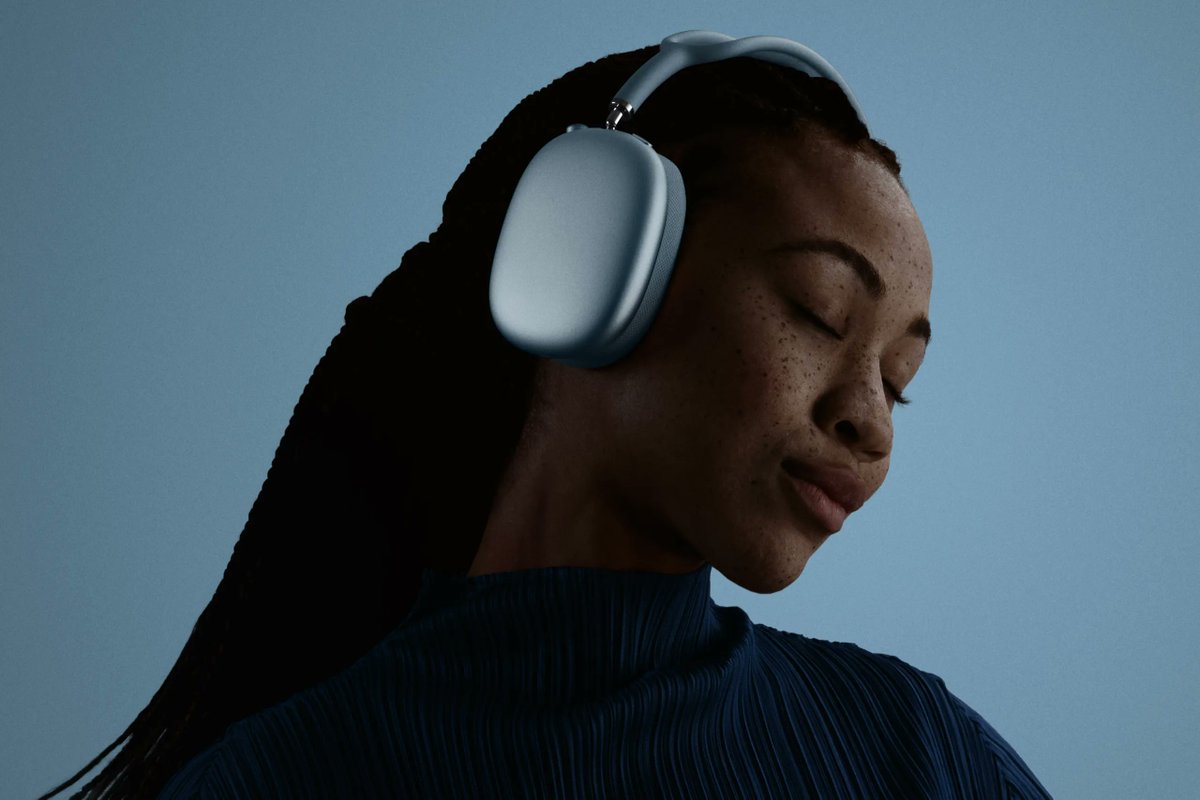
Apple just dropped AirPods Max 2. No event. No hype cycle. Just a press release.
But if you look past the audio specs, something interesting is happening.
These headphones now run Live Translation through Apple Intelligence.
Someone speaks to you in Japanese, you hear English. Real time. No phone screen needed.
They also shipped Adaptive Audio, where the headphones read your environment and decide how much noise to block. Conversation Awareness detects when you start talking and adjusts automatically.
Most companies are selling AI. Apple is hiding it. And I think that's the smarter bet long term.
Dario Amodei just went public with something big.
Anthropic has been quietly deploying Claude to the Pentagon and intelligence community for years.
Now the DoD is demanding they remove safeguards around two things:
1. Mass domestic surveillance
2. Fully autonomous weapons
Amodei's response: "We cannot in good conscience accede to their request."
This is wild. The DoD is threatening to designate Anthropic a "supply chain risk" - a label for US adversaries, never applied to an American company.
The kicker: these two exceptions aren't even barriers to current operations. They're about what Anthropic WON'T build, not what they won't let the DoD use.
Mass surveillance + AI that selects targets without humans? That's not defense. That's something else entirely.
ht @anthropic
This is wild.
Someone built a working rocket for $96.
Not a model rocket. A guided missile that actually recalculates its trajectory mid-flight using a $5 sensor.
The MPU6050 (gyro + accelerometer) tells the flight computer where it is, and the rocket adjusts its fins in real-time to stay on course.
Total bill of materials: $96.
The project is open source on GitHub. ESP32 flight computer, 3D-printed body, folding fins. It actually flies.
The barrier to aerospace is collapsing fast.
https://t.co/0a3Il2eHkG
An AI facial recognition error ruined this grandmother's life.
Angela Lipps spent nearly 6 months in jail.
She lost her home. Her car. Her dog.
All because AI said she was a bank fraud suspect.
She's never been to North Dakota. Never flown on an airplane.
Here's what happened:
Fargo police were investigating bank fraud. They had surveillance video of a woman using a fake military ID to withdraw thousands.
They ran the video through facial recognition.
AI matched the woman to Angela Lipps.
But it was wrong.
The real culprit? Still out there.
Lipps was arrested at gunpoint while babysitting her grandkids. Held for 4 months without bail as a fugitive.
She only got out because records proved she was in Tennessee the whole time.
This is what happens when we let AI make life-or-death decisions without human oversight.
No apology. No compensation yet.
She's still fighting to get her life back.
Can YOUR machine run AI locally? There is a site for that. https://t.co/JmdFEADOER analyzes your GPU, CPU, and RAM to show you exactly which models will work. From 0.5GB models on a Raspberry Pi to 512GB monsters. https://t.co/qV7w2PBF5k
A 60-year-old developer posted on Hacker News:
I'm ready to retire. But Claude Code is giving me that same energy and drive I had back in the ASP and VB6 days. It kept me up nights trying to absorb it all. Now I'm chasing the midnight hour again.
The thread is filled with devs 40, 50, 60+ saying the same thing: AI coding tools brought back the spark they thought was gone forever.
One commenter put it perfectly:
I thought those days were gone forever. I was so shocked when I found out that I could experience that feeling again.
This is the story nobody's talking about. Not the job displacement fear - the rediscovery.
AI didn't just change coding. It brought people back to loving coding.
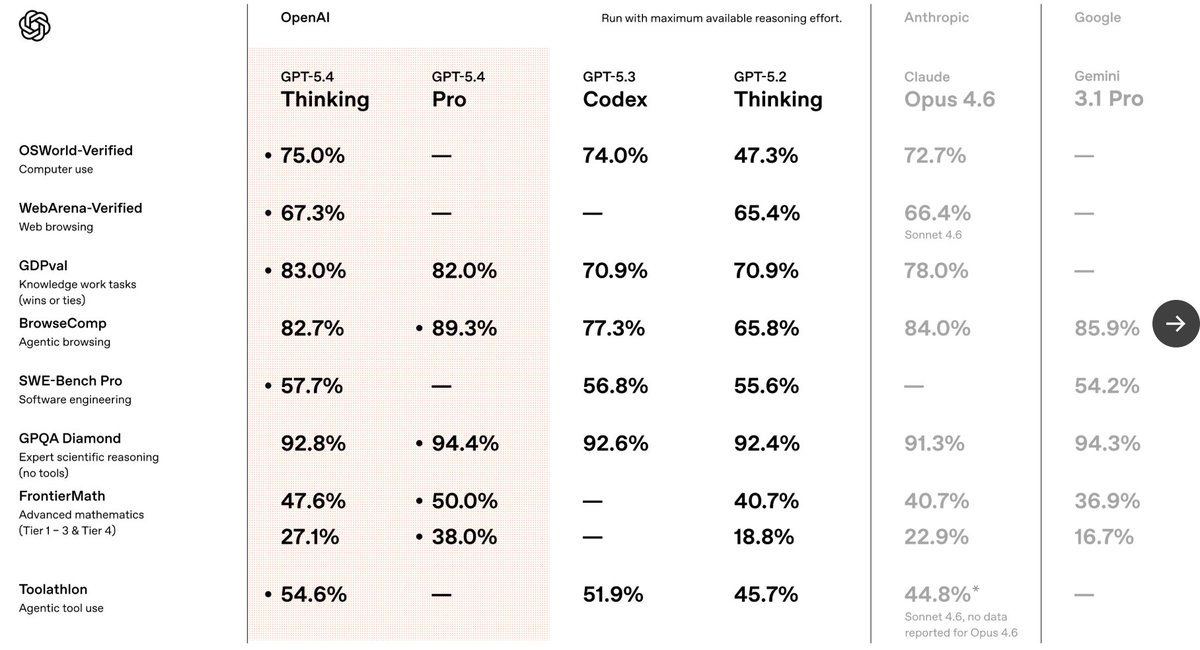
OpenAI just dropped GPT-5.4.
And it's a big one.
The new model can now use computers natively - meaning it can actually operate your computer, click around, and handle complex workflows without constant hand-holding.
On tasks that would normally require a junior analyst (spreadsheets, presentations, the works), GPT-5.4 matched or exceeded human professionals in 83% of tests. Up from 70.9% with GPT-5.2.
It also beats human performance on OSWorld (desktop tasks) at 75% vs 72.4%.
And hallucinations? Down 33% compared to GPT-5.2.
The model is available in ChatGPT, the API, and Codex.
If you build agents or automation tools, this is worth a look.