Beam is now available across platforms, with open weights under the Apache 2.0 license - in collaboration with an ecosystem of 40+ partners.
We're releasing:
- Weights, tokenizer, and reference implementation
- BF16, FP8 and NVFP4 weights and a DFlash2 drafter
- The open source harness we built and trained Beam on: Mirror CLI
Weights and model card on Hugging Face: https://t.co/tPqWpk9RXL
Today, we’re introducing Beam, Reflection’s first model.
A year ago, we set out to build a frontier open model before we had much of the team or infrastructure required to do it.
Since then, Reflection has grown 10x. We assembled an extraordinary technical team of researchers and engineers I feel privileged to call my colleagues, alongside a world-class group across recruiting, business, policy, operations, and the rest of the company whose work made all of this possible.
At the same time, we built the science, data, software, and infrastructure behind the model itself. In July, we started pretraining Beam and weeks later, we had a 500B-parameter model at the frontier of Western open intelligence—particularly strong at agentic coding, with remarkable reasoning efficiency.
What makes me proudest, though, is our team. The relentless focus, speed of execution and the willingness to own and solve whatever problem was in front of us. And, most importantly, the commitment of this team to our mission.
Beam is our first milestone toward our mission of building open intelligence and making it accessible to everyone.
We’ll release Beam’s weights, model card, and tech report later this month.
And we’re already training the next, larger model.
Over the past year, we built the team and the engine to propel us to the frontier and that’s what makes me so excited about what comes next.
We are introducing Beam today, a 500b open model that excels in coding, agentic, and scientific workloads.
Beam is very token-efficient, pre-trained from scratch, and scaled with the largest RL run documented openly we are aware of.
Getting here was challenging, rewarding, and personal.
I immigrated to the USA during childhood when my parents got jobs as scientists at PNNL, a national lab located in a rural town in Washington state.
Growing up, I developed an interest in physics because it was grounded in simple principles, was foundational, and had long-term impact.
Physics was the foundational science of the 20th century. The first general computer (ENIAC), the transistor, GPS, and much of modern technology had its roots in physics.
In 2016, during my graduate studies, I noticed the birth of a new foundational science - Artificial Intelligence.
AlphaGo, the superintelligent Go agent developed by DeepMind, had come out and made me feel what was about to come.
A neural network, trained to imitate human players, and then improve itself through trial and error, mastered the most intellectually challenging board game in the world.
What surprised me about AlphaGo is how it was conceptually simple, general, and scalable. The system could in principle improve itself forever, it was just a function of compute.
This is when I became “AGI pilled” as they say.
I switched from physics to AI because I thought this would become the root node science of the 21st century, much like physics was the root node science of the 20th century.
I believe that working on foundational science is not enough on its own. Foundational science must also remain open and widely accessible.
We remember Newton for his contributions to physics, but he was also an alchemist.
Alchemy was done in secret, because the artificial production of gold was deemed lucrative but also dangerous with the potential do destroy entire economies. Newton even wrote his alchemy notebooks in cypher.
On the other hand, Principia was published in the Philosophical Transactions of the Royal Society, the knowledge was made widely available, passed down for generations in what we now call Newton’s laws.
The computer, transistor, GPS were possible to build because physics as a science was open. Openness creates an ecosystem of innovation.
The notion of openness, which is a core tenet of scientific discovery, has also become a guiding principle for how foundational technology gets built and distributed.
The internet was built on open protocols. The most widely used operating systems are open. The field of cybersecurity exists because strong encryption protocols were made open in the 1990s.
Open also means safer. The best defence is a distributed one. Commonly used open source software is robust and battle-tested because it is inspected and patched by a community of developers.
AI is different but also similar to software in many ways, though with a much larger surface area of vulnerabilities. It is impossible for a small group of safety researchers working in secrecy to remediate all of the potential issues regardless of their intentions. It is like entrusting a handful of white blood cells to protect your body.
AI is both foundational as a science and a technology, and the safest way that also ensures the benefits of AI are distributed evenly is by making it open.
I’m excited for what developers and scientists build and learn from this model, and for Beam to play a small part in ensuring that AI is made widely accessible, safe, and beneficial to all.
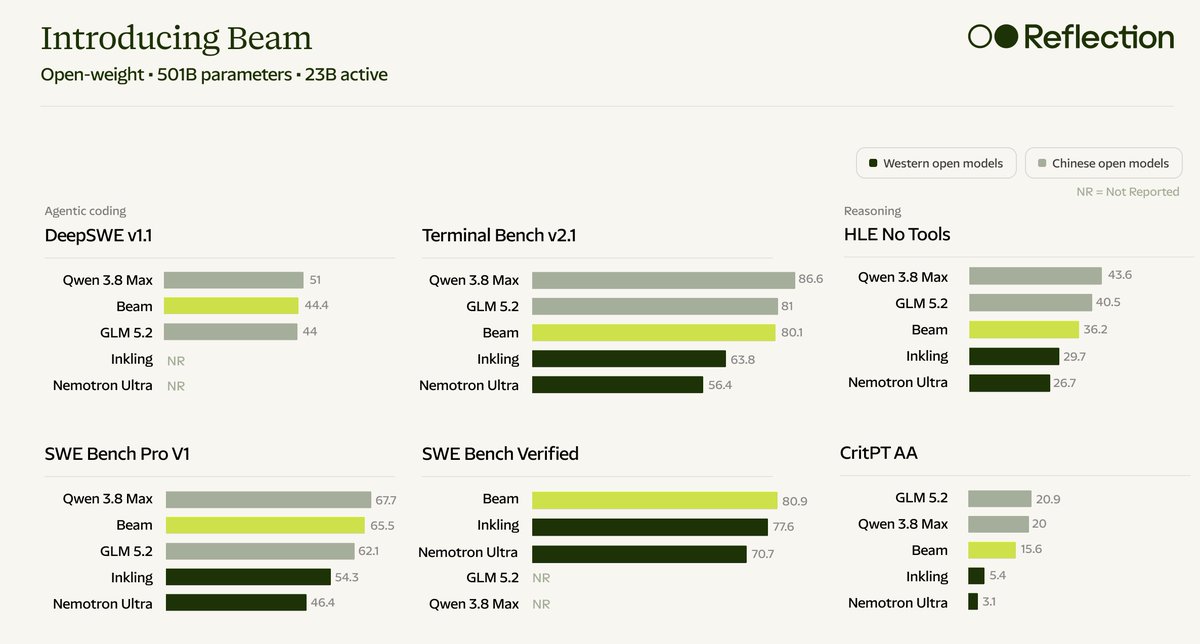
Introducing Beam: a highly efficient agentic open model with 501B total parameters and 23B active.
- Frontier reasoning efficiency
- Advances the Western open frontier on coding & agentic tasks
- Trained end-to-end from scratch
Full weights release this month.
Learn more about Beam: https://t.co/c3Qx2cpM8G
@SRSchmidgall Hi! Any chance your group needs REs/SWEs? I have experience working with AI research scientists on data curation for LLMs, an infra background and a strong desire to contribute in the field of AI for health.
@Dorialexander Why pre-hide info and rely on the generator to simulate instead of giving it the full input and having it reformat into a q&a pair? Won’t that introduce a lot of incorrect examples? Or is getting both correct and incorrect data the goal?
@Dorialexander > Training here is not simply done on raw data: it relies on clever arrangement with selective destruction or masking of original sources, in effect integrating learning strategies into the data itself.
How would we mimic this to pre-train language models? Any examples?