A mother asked her OB how she had never heard of the most common congenital infection in America. He told her women would not want to worry about one more thing.
That instinct has a name in medicine. Benevolent deception. The decision that a competent adult is better off not knowing something, made for her, without her.
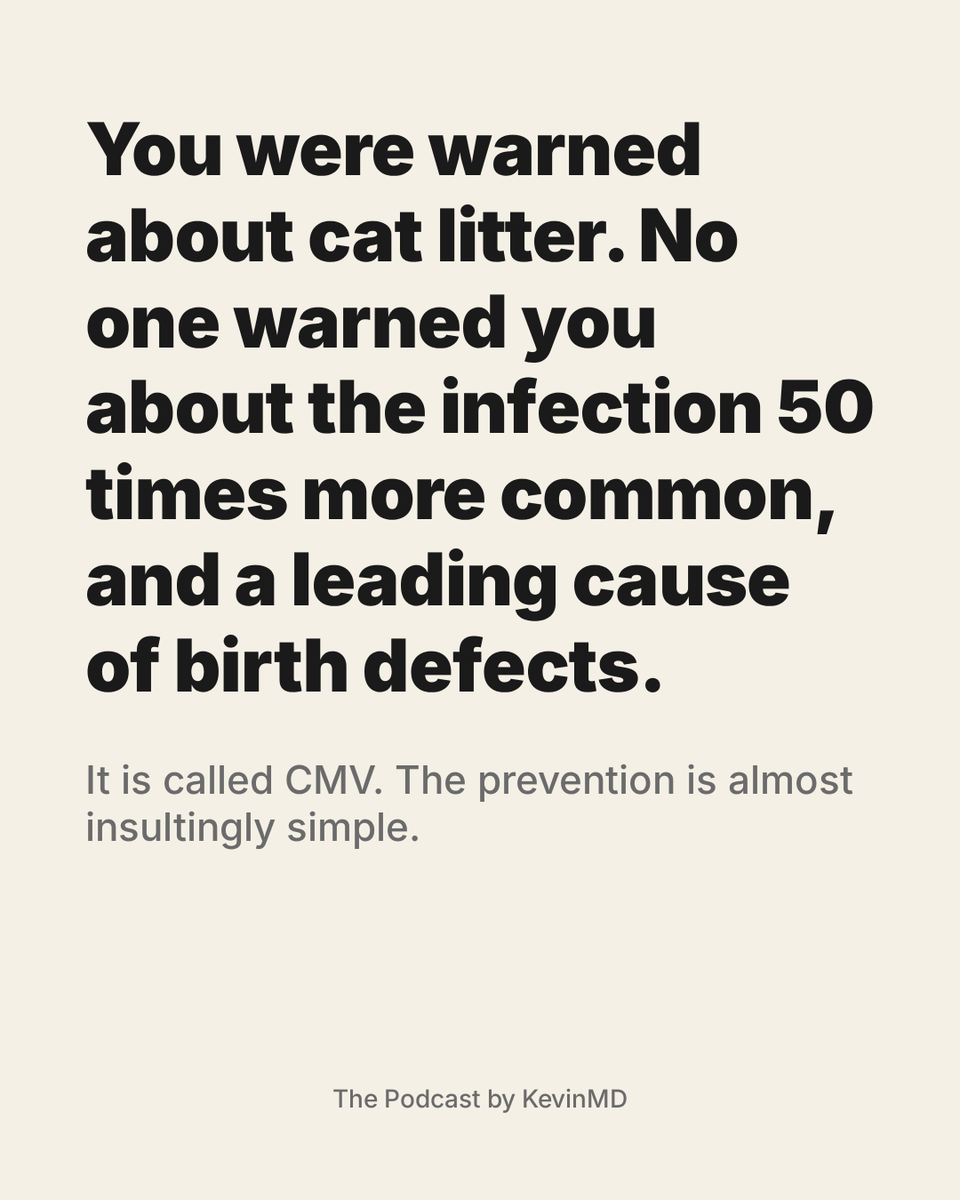
The infection is CMV, cytomegalovirus. It is a leading cause of birth defects in the United States. It affects one in two hundred babies. Toxoplasmosis, the cat-litter warning every pregnant woman receives, affects one in ten thousand. We warn about the rare one and stay quiet about the common one.
In study after study, ninety percent of women have never heard of CMV. The major obstetrics body still does not recommend routinely discussing it, reasoning that the prevention steps are impractical. Those steps: do not share a toddler's spoon or toothbrush during pregnancy, do not finish their food, kiss them on the head instead of the lips.
When the same women are surveyed, ninety percent say they would want to know.
Here is why the silence has a cost beyond the abstract. CMV in a newborn can be treated, but only inside a narrow window. The diagnosis has to be made in the first month of life, and the antiviral has to start in that same month, or it no longer counts as congenital infection. Miss the window and a treatable cause of progressive hearing loss and brain injury simply goes untreated. By the available estimates, fewer than one in ten babies born with CMV is ever diagnosed at all.
So the chain runs like this. Mothers are not told. Symptomatic newborns are not flagged. The treatment window closes. And it traces back to a decision that a competent adult did not need a piece of information.
Writer Megan Nix, whose daughter was born with congenital CMV, is not arguing for screening every pregnant woman. She agrees with not doing that. Her argument is narrower and harder to dismiss. It is unethical to withhold information from an adult who has said, clearly and repeatedly, that she wants it. The fix is not a new test. It is a conversation that already should be happening.
Listen to the full conversation on The Podcast by KevinMD. Link in the replies.
What is one thing your clinicians never told you that you wish they had?
#CMV #ThePodcastbyKevinMD
A bestselling cardiologist just took apart the longevity industry by name, and he started with the supplement in your kitchen.
Eric Topol, MD has spent his career in medical research. His new book "Super Agers" carries over 1,800 citations. He is about as far from a supplement influencer as it gets, which is exactly what makes his takedown land.
His targets:
The $100-a-month green-powder supplement that claims to be the only one with data behind it. Look closer and the studies are tiny and run by the company itself. No independent evidence it changes any health outcome.
The whole-body MRI marketed as early detection. No data that it helps. Plenty of harm: incidental nodules in healthy people, leading to biopsies, complications, and months of anxiety.
The longevity clinics charging $250,000 for plasmapheresis, stem cells, and hyperbaric chambers. An unregulated category, because supplements and these services get no FDA oversight.
His point on conflict of interest is the sharpest part: if someone is selling supplements or owns a longevity company, they cannot be an objective source on what works. A profit motive and honest advice do not mix.
He is just as hard on the protein craze. The one-gram-per-pound target pushed in other longevity books is not supported by the data. Past a modest bump for older adults, very high animal-protein intake promotes inflammation, the opposite of what you want.
And the punchline most people miss: what actually extends healthy years is nearly free. A mostly plant-based Mediterranean diet, regular sleep, walking, ten-dollar resistance bands. He cites a study of 105,000 people over 30 years where the ones who reached 70 disease-free ate exactly that way.
His rule of thumb, in seven words: when it starts to cost a lot of money, that should be a red flag.
What is the one longevity product you spent real money on before you knew whether it worked?
Listen to the full conversation on The Podcast by KevinMD. Link in the replies.
#Longevity #ThePodcastbyKevinMD
For decades, medicine treated irritable bowel syndrome as a stress disease. Mark Pimentel, MD, a gastroenterologist, says about 60 percent of it is something else entirely.
It's small intestinal bacterial overgrowth, or SIBO. The wrong bacteria colonize the small intestine, which is normally relatively clean, and start fermenting your food up to 63 times faster than normal. That is why the classic tell is bloating ten minutes after a meal.
The part most people have never heard: it often starts with food poisoning. Campylobacter, the most common cause of food poisoning in the US, triggers lasting IBS in roughly one in five people who get it. The infection leaves the body producing antibodies against the nerves of its own gut, which slows everything down and lets the bacteria move in.
For years the standard response was to treat the symptoms. A laxative for constipation. An antidiarrheal for diarrhea. Pimentel's argument is that this is backwards.
He describes patients who arrive having had three normal colonoscopies and still no answer, sent for one more test and then another, because the reflex is to keep ruling things out rather than confirm a positive diagnosis. Meanwhile the simplest tell goes unexamined: bloating ten minutes after a meal, the thing many people stopped mentioning years ago because they were told it was anxiety.
There is a breath test that can identify the overgrowth, now even at home, and a non-absorbed antibiotic, rifaximin, that clears it in a two-week course. A patient who responds and feels normal often does not need another colonoscopy, another celiac panel, another year of guessing.
His line is the one worth saving: we shouldn't be treating symptoms in IBS, we should be treating the cause. And he thinks the field is finally getting there, with new diagnostics and treatments in the pipeline that may eventually stop the condition at its source.
Listen to the full conversation on The Podcast by KevinMD. Link in the replies.
If you have IBS, has anyone ever tested you for SIBO, or was it only ever explained as stress?
#IBS #ThePodcastbyKevinMD
These are sold at gas stations and vape shops. They are labeled as energy and focus aids. And many of them contain compounds that act on the same receptors as opioids.
That is legal, by the way. The FDA chose not to regulate them.
Muhamad Aly Rifai, MD, a psychiatrist, internist, and addiction medicine specialist, treats people who became physically dependent on what they thought was an energy shot. Kratom and 7-OH (7-hydroxymitragynine) act on the opioid receptors. About 10 states have now banned 7-OH. The federal government has not.
Once someone is dependent, getting them off is not a weekend taper. He describes patients who need buprenorphine maintenance for a long stretch to come off a product they bought next to the lottery tickets. Poison control calls tied to these products are climbing.
Here is the gap that drives it. Only 19 percent of Americans even recognize the word kratom. People will doubt a prescription their own physician wrote and then trust a shiny bottle a convenience store clerk recommended, a product with zero clinical trials behind it. We fear addiction and romanticize the next natural alternative at the same time.
There is also a quieter regulatory mess underneath it. Some of these compounds sit in the same gray zone as cannabis, legal in some states, banned in others, scheduled one way federally and another way locally. The general public sees a labeled bottle on a shelf in a store and reasonably assumes someone signed off on it. No one did.
The fix he wants is not complicated. Clinicians should be asking every patient what over the counter products they take, because the estimate is that 30 to 40 percent are using something unregulated they never mention, sometimes with real drug interactions.
And his answer on whether any of it is worth recommending was one line: there is no unicorn supplement. Other than caffeine, nothing on that shelf does what it claims.
Listen to the full conversation on The Podcast by KevinMD. Link in the replies.
#AddictionMedicine #ThePodcastbyKevinMD
A man kept showing up drunk with a 0.3 or 0.4 blood alcohol level. He had not had a drink. It took five years and the right doctor to figure out why.
His name is Joe, and his wife, nurse researcher Barbara Cordell, spent those years watching him stumble, slur, and lose coordination on days he had not touched alcohol.
The mechanism is the strange part. Gut microbes fall out of balance, the fermenters everyone carries start growing unchecked, and they turn ordinary carbohydrates into more ethanol than the body can clear. The condition is called auto-brewery syndrome. It is rare, but likely underdiagnosed.
For years nobody believed it was possible. An emergency room found alcohol in his blood and concluded he was a secret alcoholic. Other physicians, friends and colleagues in medicine, said they had simply never heard of such a thing. The injustice was not the diagnosis. It was being called a liar by the people who were supposed to help.
One gastroenterologist read the case literature and ran an inpatient carbohydrate challenge. In a controlled room, with nothing to drink, the team watched his blood alcohol climb. They believed him because they saw it happen.
The fix followed the mechanism. Because the fermenting organisms feed on sugar and starch, a strict low-carbohydrate diet starves them, and that diet plus treatment resolved it. He is healthier now than before he got sick. The known risk factors track the same logic: long-term antibiotic use that disrupts the microbiome, and a high-carb Western diet that feeds it. Cordell has since connected with around a thousand people worldwide who suspect they have the same thing.
The bookmark-worthy takeaway for any clinician: when a patient insists they have these episodes and they are not drinking, that is worth taking seriously, not dismissing.
Listen to the full conversation on The Podcast by KevinMD. Link in the replies.
Search "The Podcast by KevinMD" wherever you listen to podcasts
What is the most surprising true diagnosis you have ever watched get dismissed because it sounded impossible? #AutoBrewerySyndrome #ThePodcastbyKevinMD
The health care system stopped calling you a patient and started calling you a client. That one word rewrote who it owes a duty to.
Nicholas Rosenlicht, MD, a psychiatrist and author of My Brother's Keeper, learned this firsthand. He was on a team negotiating insurance contracts for a community mental health center, and they were told they could not use the word patient. They had to say client.
It sounds like semantics. It is not.
A patient is someone society has agreed to protect. For as long as medicine has existed, the sick have been granted rights and special protections, because we recognized they need care. A client gets none of that. A client has only what is negotiated in the contract, and in health care those contracts are written by corporations with no input from doctors or patients.
Now hold that against how businesses actually work. A corporation's fiduciary duty runs to its shareholders and its board, not to its customers. A physician's fiduciary duty runs to the patient. That is the entire difference, and it is not an accident of vocabulary. Reclassify the person in the room from patient to client and you have quietly moved them out of the category the duty protects.
The same move gets made to physicians. "Provider" does to the doctor what "client" does to the patient: it makes the relationship interchangeable, a cookie-cutter service you can swap out, and it strips the autonomy that used to come with the title. Disempowerment by vocabulary, in both directions.
There is a reason mental health adopted "client" faster than any other field. The stigma around psychiatric illness makes "patient" feel heavy, even frightening, so a softer word feels kind. Rosenlicht argues it does the opposite. It sanitizes the relationship while quietly solidifying the stigma, and it lets a business model take over the room.
A business can be a client. A business can never be a patient. The word only fits a suffering human being who wants relief, and swapping it away is how you stop treating them like one.
We already have laws against the corporate practice of medicine in every state. They are simply not being enforced. Corporations build shell structures, hold the purse strings, and practice medicine in everything but name, while health care remains the largest lobbying force in the country.
His takeaway for anyone making a health decision: follow the money.
Listen to the full conversation on The Podcast by KevinMD. Link in the replies.
What is the first moment you stopped feeling like a patient and started feeling like a transaction?
#HealthcareReform #ThePodcastbyKevinMD
A healthy 19 year old lost 40 pounds and could barely think. Every doctor said it was anxiety. She diagnosed herself off a video, asked to be tested, and was told she probably did not have it because she had never vomited.
The test came back through the roof.
This is one of the most common reasoning failures in medicine: ruling out a diagnosis because the patient does not present the "textbook" way. Celiac disease does not require vomiting. It can show up as migraines, weight loss, brain fog, and malabsorption. Kamiah Gibson had all of it. She was a healthy 19 year old who got suddenly, severely sick, and the most available explanation, for months, was that an anxious young woman was imagining her own symptoms.
She had to advocate against her own doctors to get the blood test that finally confirmed it. A biopsy sealed it. She had been right from the start.
Notice how the diagnosis was delivered: over the phone, with the instruction to "eat gluten-free," two days before a three-week trip across the country. No counseling on cross-contamination, no plan, no follow-up scheduled. She was sick the entire trip and does not remember parts of it. The miss did not end at the diagnosis. It extended into how the diagnosis was handed over.
The part that should stay with us: she had been pre-med. After months of not being believed, she changed course to become a mental health therapist for people with chronic illness, because she knew firsthand what it does to a person to be sick and disbelieved at the same time. The disbelief did not just delay her care. It rerouted her life.
Kamiah Gibson is now a graduate student in social work. Her story is a clean case study in why "it's probably anxiety" is one of the most expensive sentences a clinician can say, and in how often the patient in the room has already done the diagnostic work everyone else is still refusing to start.
Listen to the full conversation on The Podcast by KevinMD. Link in the replies.
What is the diagnosis you have seen anchored away too early because the patient did not present the textbook way? #MedicalGaslighting #ThePodcastbyKevinMD
There are 400 leg amputations every day in America, and a huge share of them trace back to one disease most people have never heard named: peripheral artery disease.
It hides for years. The early signs get filed under normal aging.
You used to walk a mile with no problem. Now your calf cramps and you have to stop. A wound on your foot won't heal. Your foot aches at night until you dangle it off the bed to bring the blood back. Each of those is a circulation warning, and each one gets shrugged off.
Xzabia Caliste, MD is a vascular surgeon in Albany who grew up watching two relatives with diabetes and high blood pressure lose their legs one amputation at a time. Their circulation was never assessed. They never saw a vascular surgeon. That history is why she pushes so hard on this now.
The mechanism worth saving: peripheral artery disease grows out of diabetes, high blood pressure, high cholesterol, and smoking. Catch and control those, get a circulation check when the warning signs show up, and a large fraction of these amputations never happen. Much of it is treatable with stents and balloons before it ever reaches surgery.
Most people picture a vascular referral as a guarantee of major surgery. It isn't. The same things done in heart arteries get done in leg arteries, just bigger: drug-coated balloons, plaque modification, stents. Surgery is the last resort, not the first move.
The screening point is the one clinicians keep missing. There is no separate test the public is asking for. The screening already exists, and it is the management of those four conditions in primary care. The disease is downstream of things we already track. The failure is letting the warning signs get filed under aging instead of triggering a circulation check.
Eight out of 10 Americans don't even know what a vascular surgeon does. A third don't know vascular surgeons treat carotid, aneurysmal, and peripheral arterial disease at all. That gap is a big part of why this disease stays silent until someone is losing a foot.
Listen to the full conversation on The Podcast by KevinMD. Link in the replies.
If you're over 60, what would it take for you to ask your doctor for a circulation check?
#PeripheralArteryDisease #ThePodcastbyKevinMD
A second member of the care team had already said it was terminal and recommended hospice.
The oncologist overruled that. He told a woman with stage four cancer in both lungs, with her daughters in the room, that a miracle drug would have her feeling like her old self again in six to eight weeks.
This is not a story about a bad doctor. It is a story about what happens when medicine treats death as a failure to be avoided rather than a fact to be told.
She trusted him completely. So she spent her last weeks sick, hospitalized to drain lungs that could not breathe, chasing a recovery that was never coming. A grandchild had been born ten days before her diagnosis. She wanted to meet that baby. She wanted to see the beach one last time. She got neither.
Two months after diagnosis, a rural ER doctor in New Hampshire took one look at her and said her death was imminent. She died a day and a half later, on hospice.
Patient advocate Althea Halchuck, EJD, wrote about it. The article was shared four thousand times in two weeks, far past her usual reach, and nurses and oncology staff wrote to her describing the same thing on their own units.
Here is the part worth sitting with. The oncologist almost certainly thought he was being kind. But a culture that treats death as a failure to be avoided turns honest prognosis into something that feels like giving up, and the optimistic lie becomes the path of least resistance. The kindness and the harm came from the same instinct.
Her argument is simple and hard to refute: patients are not asking for a crystal ball. They are asking whether they have a month, whether they will see another Christmas. An honest prognosis, a rough timeline, and earlier hospice would have given her the one thing the false hope took: time. Palliative care and hospice are largely free under Medicare and badly underused.
Listen to the full conversation on The Podcast by KevinMD. Link in the replies.
What would it take for honest prognosis to become the default in your field instead of the exception?
#EndOfLife #ThePodcastbyKevinMD
The Department of Transportation just affirmed food allergy as a disability under the Air Carrier Access Act. Then it restricted pre-board protection to peanut and tree-nut allergies only.
That is a structural error.
The ruling extrapolated from the specific characteristics of prior plaintiffs (peanut and tree-nut allergies) rather than the legal category they fell under (food allergy as disability). It creates a hierarchy within a single disability category that no other disability category faces.
Then the airlines started disregarding even the narrow scope.
Southwest has been denying pre-board to passengers with peanut and tree-nut allergies despite the ruling explicitly protecting them. Frontier still serves peanuts. A Southwest captain threw a passenger off a flight for asking to pre-board with a pistachio allergy, which is a tree-nut allergy and protected under the ruling. JetBlue's published policy is to notify the row in front and the row behind the allergic passenger. The execution is left to whichever crew is working that day.
The numbers: a Northwestern survey of 4,704 passengers flying with food allergies. 98 percent report anxiety. 70 percent were promised accommodations that never came through. Roughly 32 million Americans live with food allergies.
The marginal cost of letting all food-allergic passengers pre-board to wipe down their seat is roughly zero. The marginal cost of NOT letting them is one episode like this, multiplied by every flight, every day.
The medical-equipment argument is the one airlines have not answered. Oxygen tanks and defibrillators are on every commercial aircraft for foreseeable in-flight emergencies. Epinephrine auto-injectors are not standard. The FAA reauthorization decision is the next pressure point.
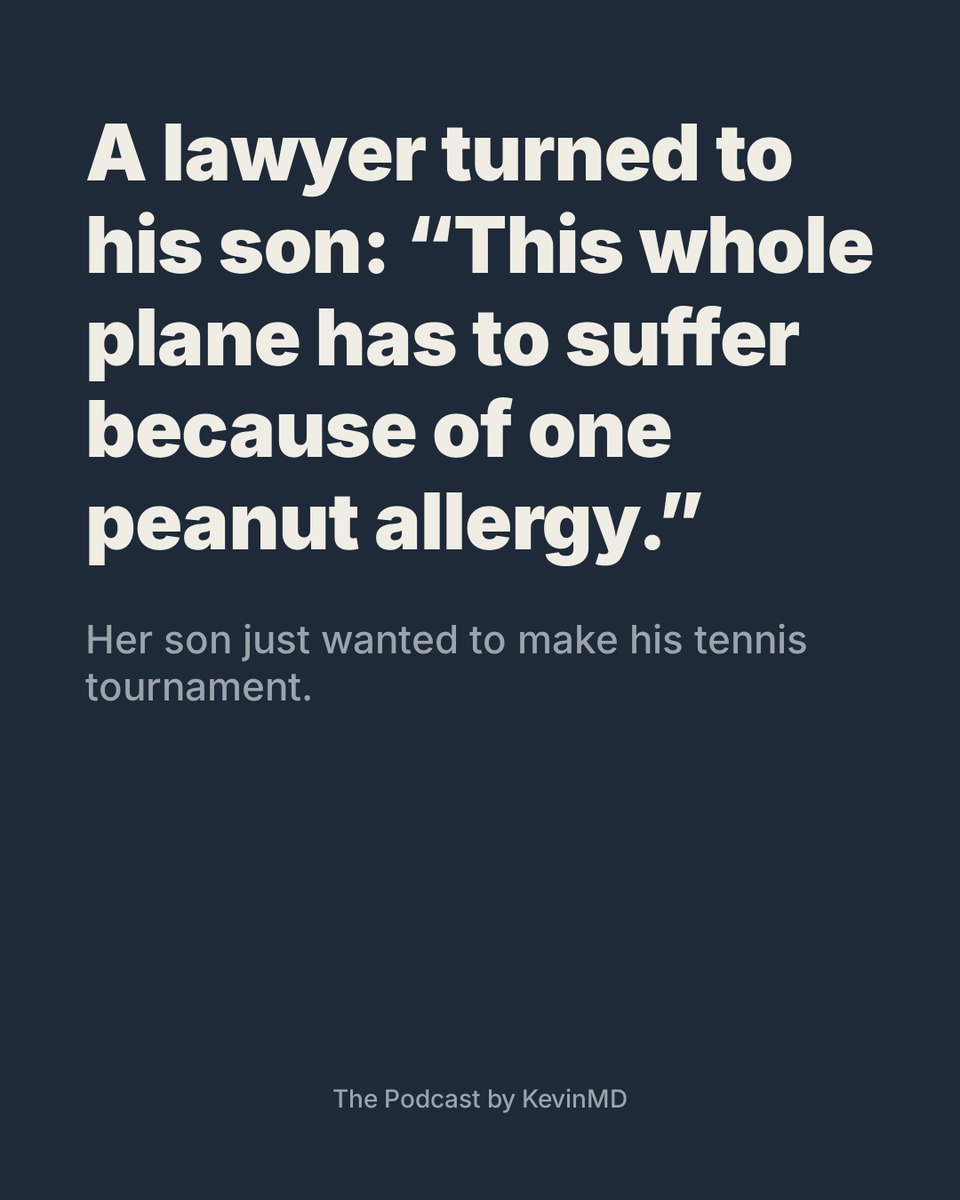
Leanne Mandelbaum, who brought the original 2019 complaint that first established food allergy as a disability under federal law, lays out the cinematic scene that drove her advocacy: her son Josh on a JetBlue flight, a passenger in the next row saying out loud to his own child that the whole plane was suffering because of "one fricking jerk of a child with a peanut allergy," and a different flight attendant quietly offering to wait until landing to eat her own peanut butter sandwich.
Her closing line about Josh after exposure and an auto-injector: "I have seen my son completely lose the light in his eyes. The light came back."
Listen to the full conversation on The Podcast by KevinMD. Link in the replies.
What is the single change to airline disability-accommodation policy that would move pre-boarding from cabin-crew discretion to documented workflow step?
#FoodAllergy #ThePodcastbyKevinMD