The real fear with giving an AI agent actual access is not that it becomes a villain. It is that it makes a fast, expensive mistake while you are not looking, and you only notice afterward.
That is why Latch clicked for me. It changes the order you do things in.
Normally you launch an agent and just hope it acts right.
With Latch, you write the rulebook first. You put the agent behind a checkpoint and decide exactly what it is allowed to do, which places it can reach, what it is banned from, and how many actions it gets in a minute before it is cut off. Anything outside those rules just gets refused.
One part I really like is that you can test all of it before going live.
You send practice requests through your filters and watch what passes and what gets stopped. If a rule blocks something, it halts right there and tells you which rule did it and why.
I have tried this on a real agent. Reading worked fine, every attempt to change or delete something got blocked instantly.
You get permissions you can actually set, test, and confirm, instead of just crossing your fingers.
@rialo_africa@0x_alextine
I saw someone ask if we would be able to lend $10k to an AI agent?
Not because it sounds intelligent.
I would only consider it if the agent could prove who it is, show the rules controlling it and leave a record of every action it takes.
That is the missing piece in a lot of AI finance today. An agent may be excellent at analysing markets or managing payments, but giving it a wallet key with unlimited access is like hiring a new employee and handing them the master key on day one.
The safer model is simple.
Give the agent a clear identity. Set a daily spending limit. Decide which apps it can use. Block anything outside those rules. Require every approved action to produce proof.
Latch brings that kind of control into the Rialo stack. The agent can still work quickly, but authority is not based on who holds the key. It depends on whether the identity, context and policy all match before the transaction happens.
That changes the question from “Do I trust this AI?” to “Can this AI operate outside the limits I set?”
If the answer is no, then lending to software stops sounding reckless and starts looking like programmable risk management.
The real sign that blockchain has gone mainstream will not be more people talking about blockchain.
It will be people using it without noticing.
Nobody thinks about TCP/IP before sending a message. No one also checks how GPS works before opening Maps. The technology stays in the background while the product does its job.
Blockchain still asks users and developers to think too much about the plumbing. Bridges, oracles, indexers, automation bots, extra servers and custom integrations can turn one simple idea into a pile of moving parts.
And that is why the direction @RialoHQ is taking feels important.
A contract should be able to read trusted web data, react when something happens, protect private information and complete the next action without a dev stitching together five different services.
Think about flight delay insurance, the app checks the flight, confirms the delay and sends the payout automatically. Then the traveller does not need to understand wallets, data feeds or settlement systems. They only see that the product worked.
That is the level blockchain has to reach.
The biggest win will not be making everyone understand onchain infrastructure.
It will be making that infrastructure quiet, reliable and almost invisible.
@rialo_africa@0x_alextine
The modular versus monolithic debate that consumed blockchain design for years is quietly becoming the wrong question to be asking, & the reason is simple enough once you see it.
That debate mattered when raw capability was scarce, when execution speed, data scaling & cross-chain were genuine bottlenecks & how you arranged the architecture basically set your performance ceiling.
But capability has gotten cheap, components are standardizing, & once everyone has access to roughly the same underlying pieces, the shape of the architecture stops being what separates the winners.
Think about a factory for a second, moving the warehouse into the same building as the production line shortens the walk & bumps efficiency slightly, but the factory still works the same way.
Now let the production line pull live data from the warehouse to schedule itself, & suddenly the two amplify each other, smarter warehouse means tighter production, tighter production means smoother warehouse.
That is the distinction @RialoHQ keeps pointing at, integration is not cramming more modules into one box, it is building components that make each other more valuable the more they interact.
The real competition ahead is not who has more pieces, it is who has more combinations that reinforce each other.
The sharpest question in web3 UX right now is whether a normal user should even know they are using a blockchain, & the honest answer is more layered than the usual yes or no.
Think about how you use the internet, almost nobody understands how HTTPS or SSL certificates actually work, yet everyone trusts the sites they use daily, & on the rare occasion it matters you can click the padlock & inspect the certificate yourself. That is the model blockchain should be copying.
When someone buys a ticket, trades a game item or gets a package delivered, they should not have to think about which chain recorded it or how much gas it burned, they just want it fast & reliable.
But the moment ownership gets disputed or a transaction is questioned, the immutable record should be sitting right there for anyone to independently confirm.
Hide the complexity, never hide the ability to verify. That is the line @RialoHQ is walking with familiar web2 logins & flows on the surface while the chain quietly guarantees trust underneath.
The best infrastructure rarely asks for your attention during normal use, & is always there the instant verification actually matters.
@rialo_africa@0x_alextine
One of the most interesting thing about @RialoHQ is not its consensus, it is the question almost nobody in crypto wants to answer out loud, which is who eats the loss when an external fact turns out to be wrong.
The whole industry has built a strange economy around admitting it needs the normal internet, oracle feeds, keepers, indexers, webhook relays, bridge-adjacent glue, & some of that genuinely buys you guarantees while plenty of it is just a surcharge for wrapping an ordinary dependency in crypto-shaped infrastructure with a token & a dashboard attached.
Native api calls do not make web2 data magically true, what they do is make the dependency visible inside the app instead of laundering it through another network pretending to be decentralized.
That matters because every api response a contract treats as binding is a liability event waiting to happen, a bad price, a bad credit score, a wrong shipment status, & the moment that value triggers settlement, somebody owns the damage.
The real edge is helping apps decide which outside facts can bind state, under what quorum, fallback, and with what recourse. If that works, pipes that only move data get cheaper & accountable correctness becomes the thing worth paying for.
@rialo_africa@0x_alextine
The part of compliance nobody really wants to admit is that the entire kyc & aml stack is just a giant pipeline for collecting & storing sensitive personal data, your passport scan, address proof, bank statements, selfies, sitting on some compliance vendor's server waiting to be the subject of next year's breach notification.
The actual question being asked, is this person eligible to transact, gets a yes or no answer, but the way the industry currently arrives at that answer involves shipping every supporting document upstream as a permanent liability.
Zero-knowledge proofs flip that whole setup, you can mathematically prove the requirement is satisfied without ever exposing the data behind the proof, & @RialoHQ is one of the few chains structurally positioned to make this practical at protocol level rather than a bolt-on.
A user proves they are over eighteen without revealing their birthday, proves they live in an approved jurisdiction without revealing their address, proves they cleared sanctions screening without revealing the screening data itself.
Compliance ends up stronger because the verification is cryptographic instead of trust-based, & the breach risk shrinks because the data nobody collected is the data nobody can lose.
@rialo_africa@0x_alextine
Here is a category of application that genuinely cannot be built on a transparent ledger no matter how much you want it to, anything involving hidden information where one player knowing the other's state breaks the whole game.
Onchain poker has been "almost shipping" for six years, sealed-bid auctions keep collapsing into front-running, hidden-strategy games leak the strategy because the chain itself is a public broadcaster.
Every attempt to fix this ends up with a centralized server in the loop pretending to be a referee, which defeats the whole point.
The @RialoHQ approach via confidential execution enclaves runs the hidden state inside hardware that the public chain literally cannot see into, then publishes a cryptographic proof back to the main ledger that the game logic was followed exactly.
Cards stay hidden until reveal, bids stay sealed until close, strategy stays opaque until the move is made, & everyone watching can still mathematically verify nobody cheated.
An entire category of apps that has been theoretical since the genesis block becomes shippable, & the privacy is not coming from trust in an operator, it is coming from the silicon itself enforcing the rules at a layer the network cannot bypass.
The detail from yesterday's @RialoHQ Shark Tank that I keep coming back to is the economic model both RialOS & Rialo Saving Jar are using, where staking yield from the protocol pays the gas for every user transaction, so deposits, withdrawals, payroll streams & rebalances all execute at zero cost to the person actually doing them.
Crypto has spent eight years trying to abstract away gas with meta-transactions, paymaster contracts, account abstraction wallets, sponsor relayers, & every single one of those still required somebody offchain to bankroll the cost & decide who deserves the subsidy.
Routing native staking yield directly into a gas pool removes that operator entirely, the chain itself is funding the user experience out of its own protocol revenue, which is structurally a different category of solution than what other networks have shipped.
Aeternum Tesseract is doing a smaller version of the same trick, routing half a percent of locked assets into a treasury that covers future claim gas. The pattern under all three projects is the same realization, the infrastructure should pay for itself out of its own activity, & the user should never see a fee for showing up.
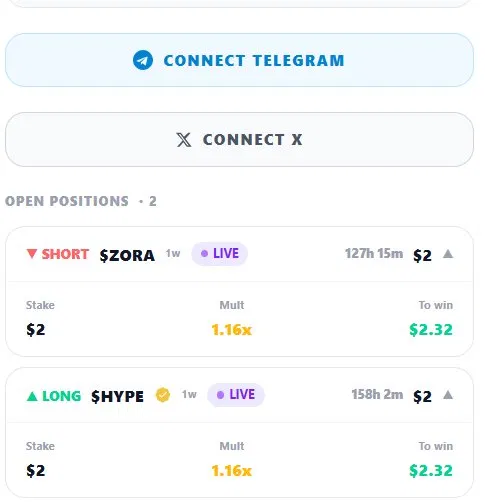
Opened a $ZORA short & a $HYPE long on @FUDmarkets mainnet just to test both directions at once.
Execution was fast, both entries filled clean with zero lag & switching between positions to track them is smooth.
Solid flow overall, two things would level it up though, deeper PnL analytics & a proper dashboard for filled positions instead of having to click the wallet address up top to see them.
Took an angle on @GenLayer I haven't seen broken down well anywhere: the GenVM vs the EVM, side by side.
The short version is that the EVM is a calculator built for certainty, while the GenVM is a thinking engine built for everything else.
Python at the top instead of Solidity. WebAssembly sandbox in the middle. A native LLM bridge underneath. Two execution modes running in parallel so AI can live onchain without breaking consensus.
Explainer below 👇
Web3 mostly leans heavy on the serious stuff. Tokens. Identity. Ownership etc.
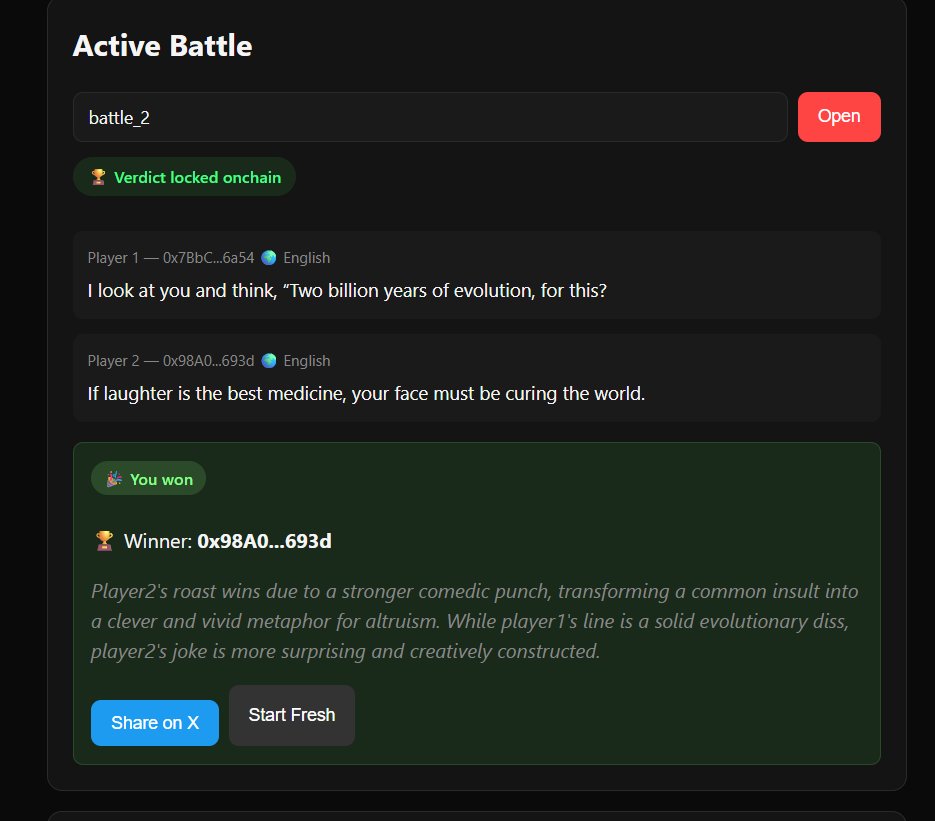
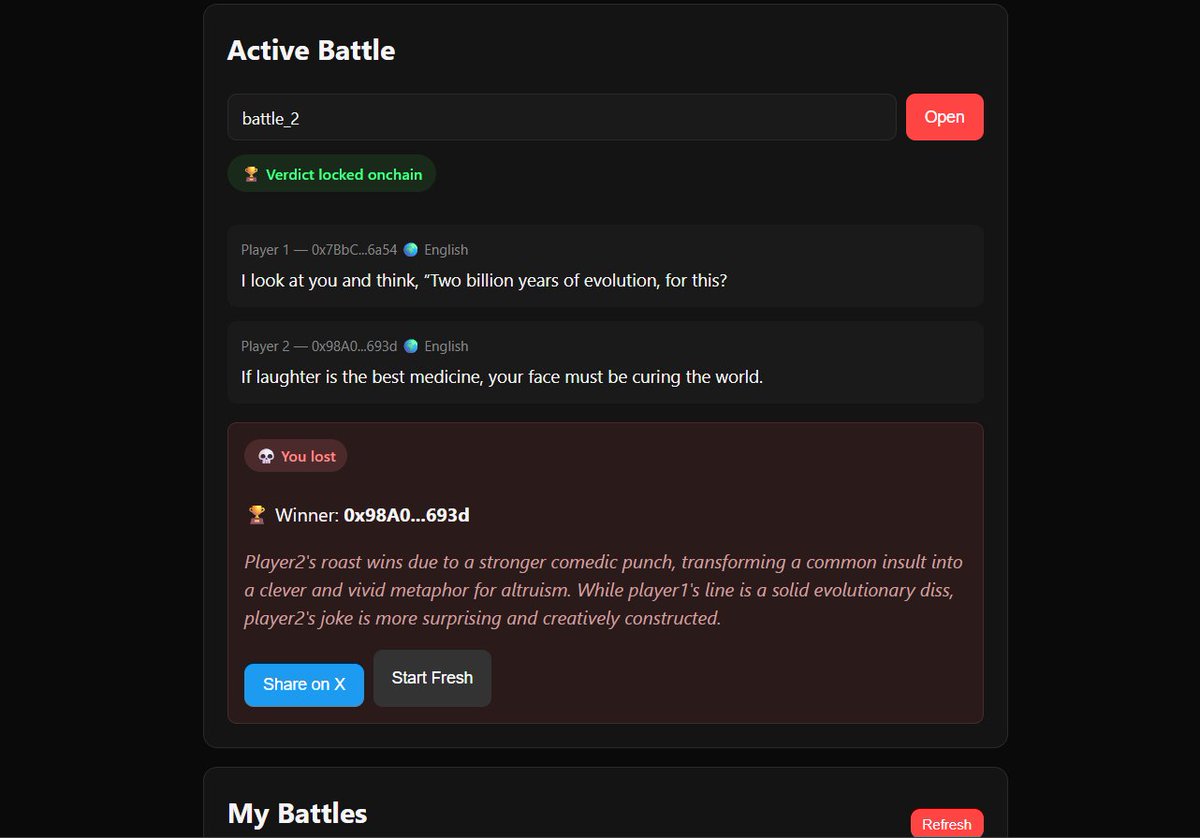
RoastChain is the opposite. You throw a roast or yab in any language, someone jibes back, @GenLayer validators argue in their own languages over whose was sharper, & the verdict locks onchain forever.
v1.5 just shipped with a full arcade-style revamp.
Tournaments where players earn coming next.
how sharp-tongued are you?
https://t.co/eRLPFJCuCp
DTCC announced on May 4th that it will begin tokenizing real-world securities in July with a full platform launch in October, pulling in over 50 firms including BlackRock, Goldman Sachs & JPMorgan & that announcement is more significant than it reads on the surface because DTCC custodies over $100+ trillion in assets & processes $4.7 quadrillion in annual transactions, which means this is literally the backbone of American capital markets deciding that on-chain settlement is the next phase.
The timing makes the question of verifiable execution infrastructure genuinely urgent in a way it hasn't been before, because the gap everyone keeps treating as secondary isn't about whether assets can be tokenized, that part is actually the easier problem to solve, it's about what happens after those assets live onchain when the financial data that's supposed to be feeding the smart contracts governing them still comes from intermediaries & servicers who have long-standing relationships with borrowers & personal financial reasons to avoid declaring defaults.
A smart contract enforces whatever rules you program into it perfectly & without bias, but it has absolutely no way to verify whether the information driving those rules is actually true before it acts on it & the idea of sitting $100+ trillion in tokenized assets on top of that unresolved blind spot is exactly the structural gap that @RialoHQ's determination layer is built to close.
@rialo_africa@0x_alextine
Recently shipped RoastChain V1 on @GenLayer Bradbury.
It's a multilingual AI roast (or what we call 'yabbing' in nigerian-pidgin) battles judged onchain.
Two players drop roasts in any language. The diverse LLMs across GenLayer's validator network evaluate each one in its original language & lock the verdict onchain via Optimistic Democracy consensus. Permanent. Tested it with English vs Nigerian Pidgin & the AI nailed the cultural references in less than 90s.
So if you got beef with someone, hope on roastchain and yab each other while genlayer smart/intelligent contract decides who yabbed the other better😃
At some point you could even put your money ($Gen) where your mouth is.
HOW TO PLAY:
1. Connect MetaMask on Bradbury (you'll need GEN testnet tokens for gas)
2. Drop a roast in any language → click Start New Battle → share the battle ID with anyone
3. Your opponent pastes that ID → counter-roasts → clicks Join Battle
4. Either of you clicks Judge → validators reach consensus → verdict locks onchain forever
Building this exposed something interesting. My first version used run_nondet_unsafe with strict JSON equality.
Pidgin vs Pidgin kept timing out because diverse models would weight humor differently & never reach consensus so i Switched to gl.eq_principle.prompt_comparative & it converged because validators no longer needed identical outputs, just coherent judgments.
WHAT'S NEXT: A fresh UI/UX revamp is queued for v1.5. Beyond that I'm sketching bracket-style tournaments where players stake $GEN into a pot & the winner claims it, plus 1v1 wagered duels where two players stake against each other & the AI verdict releases the pot. Onchain comedic stakes feels like the kind of subjective primitive that only works on a chain that can actually judge subjectivity.
Try it: https://t.co/EAfzy8A8aJ
Repo: https://t.co/qJvPUKtQF2
If you've been watching @mawariXR closely you already know that yesterday's article from @luismawari about the Techno Satoyama & the 5 layers of the ecosystem felt very intentional, like someone laying out everything the community needed to understand before something big landed.
Then the @mawariXR X account followed up with 3 math equations that the whole community quickly worked out to point to today's date & the energy inside the community right now is the kind you only really feel when something genuinely long-awaited is finally about to become real.
What makes this moment hit differently for me personally is that this mainnet has been years in the making & @mawariXR didn't rush it the way most projects do & they spent that time actually building 5 real layers from physical compute infrastructure all the way through to original content & that's a dream ecosystem architecture most projects only talk about in whitepapers.
Whether TGE comes alongside mainnet today or follows shortly after is yet to be confirmed but what matters is that all 180,000 nodes are firing, real XR experiences are already being streamed live in Tokyo & the foundation underneath all of it is genuinely solid & today feels like the moment it all starts to open up publicly.
May the 4th be with us🤲
The timing of this article dropping yesterday is hard to ignore because just days ago the US Treasury published a new proposed rule under the GENIUS Act requiring every stablecoin issuer to have full AML & sanctions compliance programs running & this demo is showing exactly what that looks like when it's built properly into the chain rather than stitched on top of it.
The way compliance works in most stablecoin systems today is that the transaction goes through first & then an offchain system somewhere tries to flag violations after the fact, which means there's always a gap between what actually happened & when the policy enforcement catches up to it.
What @RialoHQ is showing here is that the compliance check & the execution are literally the same moment, the system calls a live policy engine during the transaction itself, verifies the sender & receiver in real time & either lets it through or stops it completely before anything moves.
Regulators writing the rulebook for 2026 are essentially describing infrastructure that's already being built right here.
Something that i think deserves more attention than it's currently getting is how fast the @SeismicSys ecosystem is actually filling up with real products serving real people, because when you zoom out & look at it all together it paints a very different picture from what most crypto infrastructure projects look like at this stage.
@getprism_money is letting digital nomads & remote workers across Vietnam, Philippines & Thailand spend locally with QR codes without needing a local bank account, & that's running on Seismic underneath.
@DashXHQ is handling US to India cross-border payments, letting businesses accept USDC & settle directly into Indian bank accounts within hours & that's running on Seismic too. @brookwellapp is handling rent payments & payroll for people who get paid in crypto but live in the real world, also on Seismic.
All these different products are solving completely different financial problems for different groups of people & they all independently chose the same private infrastructure layer to build on top of.
In my opinion, it's definitely not a coincidence or just some narrative rather it's builders making practical decisions about what their users actually need & what they keep landing on is that financial data needs to be private by default, verifiable when required & protected at the infrastructure level.
The $0.01 per transaction fee model means this scales toward the kind of volume real fintech generates daily, & with virtual account support across 30+ countries settling through one coherent private layer, the picture being assembled here quietly is genuinely something the traditional finance world has been trying to build for decades through five different vendors & twice the complexity.
All i can say at this point is that the ecosystem is no doubt compounding at an incredible scale.
The single biggest weakness in crypto systems today isn't some crazy hack or a market crash, it's the fact that one person, one server or device is usually holding the complete key to everything & the second that entity gets compromised or acts funny, the whole thing falls apart with it.
Threshold cryptography was built to solve this from scratch by splitting control across multiple people so that a minimum number of them have to come together before any action gets authorized & DKG pushes it even further by cutting out the trusted "dealer" completely, meaning the group generates the shared secret together with zero trust placed in any single party the whole time.
@RialoHQ just published a full interactive breakdown of this with a simulation you can actually walk through yourself on Rialo Learn & the space genuinely needed this level of education a long time ago.
As usual @RialoHQ Shark Tank event took place this week & I want to talk about all 3 projects that were presented because each one deserves more than a one-liner.
Stelo Finance is building a DeFi super app & the thing that actually stood out to me isn't the feature list, it's the fact that they've thought about retention from day one, lending interest revenue sharing & paid educational content built into the model means the platform has a reason to keep users engaged beyond just the novelty of it being new, & that's a level of product thinking a lot of early DeFi projects completely skip.
The Rialo Builder Showcase is the kind of infrastructure project that doesn't get enough credit, forty projects already listed, independent developer submissions, search & filtering, GitHub links, data stats, & you can browse the whole thing without logging in at all, which in Web3 is genuinely rare & genuinely matters because most discovery tools quietly gatekeep the people they're supposed to be helping.
Then Royale Casino, one wallet connection covering your entire gaming experience, testnet running on mock tokens so you can actually feel the full product without any real financial exposure, RNG optimization & social battle features already on the roadmap.
3 very different projects, but all 3 are being built on @RialoHQ & all are further along than most people probably realize.