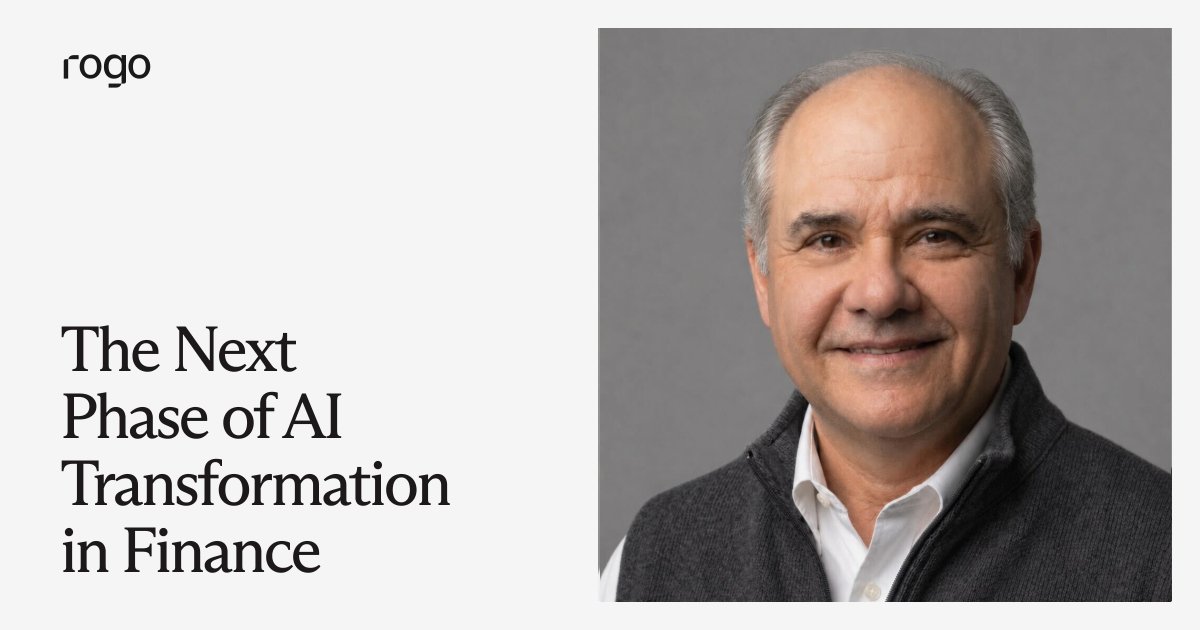
CIO, Rogo | AI for Financial Markets | Board Member | Senior Partner Emeritus, McKinsey | Venture Investor | Father of Four. All views expressed are my own.
As I wrote this, I saw X go into meltdown over tokens.
You've seen the headlines: “Uber blows yearly AI budget in just one quarter.” “Meta employee burns 281 billion tokens in April.”
But, the problem isn't spending. Spending works. Since 2023, the top quartile of our AI spenders doubled their revenue. The bottom quartile? Flat.
It's blind spending. We don’t know which spend worked.
A sales team has qualified leads. A support team has resolved conversations. These are units you can measure against. All a token tells you is the meter ran, not whether the work was worth it or not.
Finance says, “half the budget,” engineering says, “double it” and you don’t know who’s right because there is no shared language of value. There’s no attribution, and no attribution means no allocation.
For example, right now, all work, no matter the size or shape, defaults to frontier models. But meeting summaries and calendar updates don’t require GPT-5.5 Pro.
In isolation this seems trivial, but re-route just 10% of a $10M AI bill from frontier to GPT-4 level intelligence you’ve saved nearly one million dollars. This sounds like a made-up stat — it’s not. It truly is that much cheaper.
This is the future of finance: not blindly rubber-stamping or rejecting AI spend, but allocating it with the same rigor companies apply to headcount.
@rahulrekhi@chamath@rahulrekhi has it right. If there were a single best model, the radar plots would look like concentric polygons, each enveloping the next one.
Kevin Buehler is joining Rogo's leadership team as Chief Innovation Officer after 32 years at McKinsey advising the world's largest financial institutions.
Read more about Kevin's arrival and our recent launch of Felix:
https://t.co/aEmUhs923k
Junior Bankers Sick of Grunt Work Build $2 Billion AI Tool to Do the Job
Rogo, started by young bankers around a kitchen table in 2021, just won a multibillion-dollar valuation
Congratulations to John Willett, Gabriel Stengel and Tumas Rackaitis, co-founders, on the Rogo Series D led by Kleiner Perkins and on this Bloomberg feature article by Todd Gillespie.
A short excerpt:
“In a cramped Manhattan apartment in late 2021, three young investment bankers often toiled into the wee morning hours, crunching away on spreadsheets and rearranging logos on slide decks, while one of their roommates was taking a risk.
Gabriel Stengel had just quit his job at Lazard Inc. to team up with fellow Princeton University computer science graduate John Willett, a former JPMorganChase banker, so the pair could work fulltime around Stengel’s kitchen table on something else: coding an artificial intelligence tool that would take over that dealmaking drudgery.
'A lot of the analytical work is done by a 21-year-old in tools from 40 years ago at 2 a.m.,' Stengel, 27, said in an interview at the Park Avenue headquarters of their venture, Rogo Technologies. Such thoughts nagged at him in his early career: 'Why do I have to use Excel? Why do I have to present it in PowerPoint?'
Rogo, which they founded with computer scientist Tumas Rackaitis, 26, just notched a $2 billion valuation in a fundraising round. That’s up from $750 million three months ago. The new $160 million series D round was led by Kleiner Perkins, with additional money coming from existing backers including Sequoia Capital, Thrive Capital, Khosla Ventures and JPMorganChase & Co.’s Growth Equity Partners, Rogo said Wednesday.”
@conorgrennan@jpmorgan@McKinsey How does a global bank become AI-first? I am delighted to share my interview with Derek Waldron, Chief Analytics Officer at JPMorganChase.
Derek and I have known each other for 18 years and first intersected on AI in 2016. In our conversation, we cover several topics
Two companies I’ve worked with, @jpmorgan and @McKinsey, are way ahead on AI.
This conversation (https://t.co/wKyEUoz45q) between JPMorgan’s Chief Analytics Officer Derek Waldron and McKinsey Senior Partner @KevinBuehler nails what it actually takes to build an AI-first culture.
Waldron: “We don’t try to quantify hours saved. We focus on domains where transformation has the biggest impact.”
Exactly. Saved hours mean nothing if they’re not redeployed. Leadership sets the benchmarks, but employees must find value in their own workflows.
And this line is gold: “Value from gen AI won’t come just from giving people tools.”
Tools aren’t transformation. Behavior is.
The more people use these models, the faster they understand their limits—and their power.
That’s the AI Mindset in action.
@ashVaswani Congratulations, Ashish, to you and the whole team at Essential AI.
I am impressed by the three excellent foundational AI papers you have released in the last three months!
See all three papers at https://t.co/jNvCmsEAYX
Check out our latest research on data. We're releasing 24T tokens of richly labelled web data. We found it very useful for our internal data curation efforts.
Excited to see what you build using Essential-Web v1.0!
I have been a bit of a skeptic when it comes to Microsoft incorporation of #ChatGPT. I was not sure if it will have a big impact on Google. But @KevinBuehler changed my whole framework of viewing the situation. #Microsoft has only ~3% of the global search…https://t.co/pM64VDBSAq
What is generative AI? Our latest McKinsey explainer answers that question and helps you become more knowledgeable about OpenAI’s ChatGPT, Google’s LaMDA, OpenAI’s DALL*E 2, Stability AI’s Stable Diffusion, GitHub Copilot and much, much more. https://t.co/2rQ6LOCXz1
My resolution for 2023 and beyond (with a little help from ChatGPT): ascend two of these 12 mountains each year for the next five years.
Check out my first LinkedIn article:
Mountains to climb https://t.co/RtZUiwXTjl via @LinkedIn
ChatGPT’s remarkable, but still imperfect, performance comes from a combination of (1) reinforcement learning from human feedback (RLHF) with surprisingly modest data sets (tens of thousands of human-labeled examples) and (2) large language models (GPTs) using enormous data sets.
I’m running for Governor to turn around New York.
Our state is totally broken. Rising crime, sky-high taxes, closed schools, corrupt politicians.
I've spent my career turning around failing organizations. Let's get this done.
https://t.co/RwPrwvR3Aw