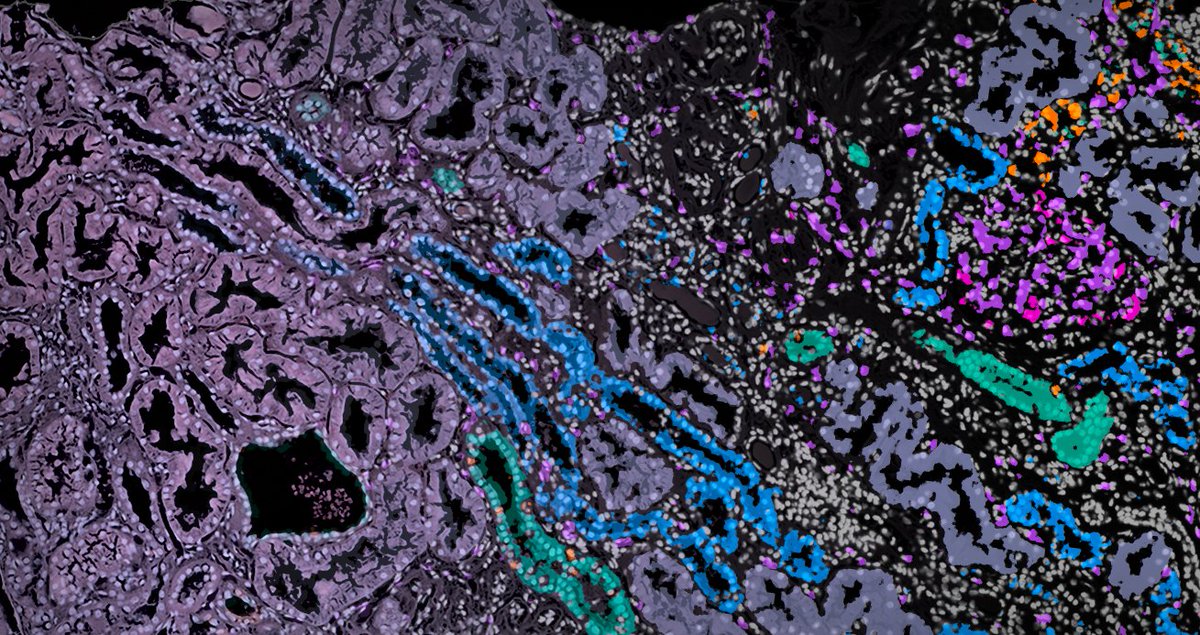
1/5 Very happy to share our work on flexible, multiscale cell type assignment for subcellular spatial transcriptomics, now in @Nature
https://t.co/ycqRLMpo9R
1/5 Very happy to share our work on flexible, multiscale cell type assignment for subcellular spatial transcriptomics, now in @Nature
https://t.co/ycqRLMpo9R
When a team at @NDMOxford wanted to know more about cells they were studying as part of research in to kidney disease, they found perfect partners in @OxUniMaths & @mpicbg.
Read about @BetterKidneys@haharrington@kfbenjamin & colleagues' collaboration:
https://t.co/IXy4QFTK3y
5/5 We're super excited about TopACT's ability to leverage the unparalleled resolution of next-generation spatial omics platforms.
Check out the article for more, including additional experiments on synthetic benchmark data and the mouse brain.
@OxUniMaths
2/5 This is joint work with the amazing Aneesha Bhandari, @haharrington, @BetterKidneys and many more.
We introduce TopACT, a method for automatic cell type annotation in next-generation spatial transcriptomics data which sidesteps the need for predefined cell boundaries.
4/5 In #StereoSeq data, TopACT precisely pinpoints rare immune cells in space.
We then use multiparameter persistent homology, a newly emerging method in topological data analysis, to generate and validate a hypothesis on immune cell organisation in lupus.
Arguably one of the least utilised but most powerful features of persistent homology (PH) is functoriality. Large swathes of data come pre-divided into distinguished, disjoint subsets (a priori/via clustering). A functorial PH pipeline lets us analyse how these subsets interact!
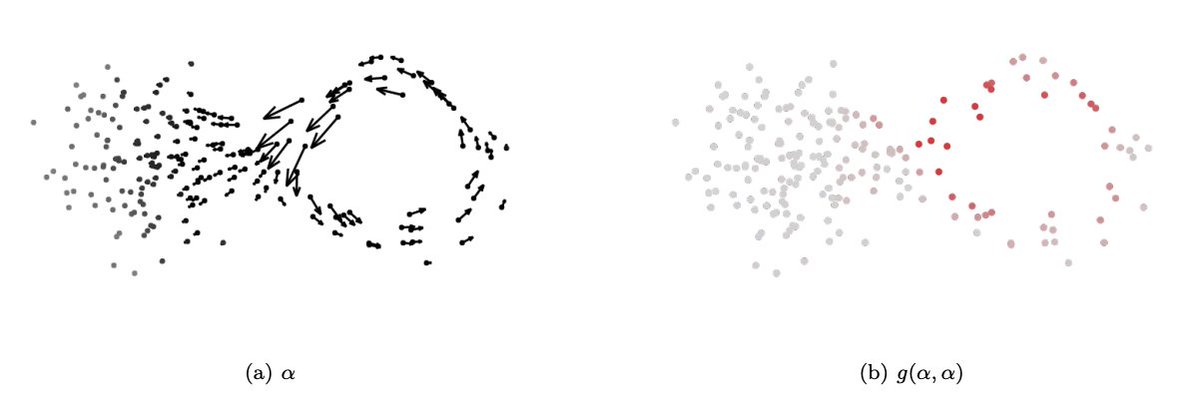
Really pleased to finally share my preprint: Diffusion Geometry
(1/4) Diffusion geometry defines Riemannian geometry for data and probability spaces!
https://t.co/hwldYZZCdF
This is going to be super interesting!
Hear about how mathematical topology can shed light on actual mecahnisms going on in our immune cells!
Sign up for this free online webinar as part of our @uclchimera programme .
Fri 26 April, 10-11am
I had a great time presenting our research on spatial transcriptomics and topological data analysis today! Incredibly honoured to have been chosen as a medallist #STEM4Brit
Today the first sets of winners for the STEM for Britain 4th March 2024, @Mathematics, Gold/First Place, Daniel Gardham -University of Surrey, Silver/Second Place, Katherine Benjamin -University of Oxford, Bronze/Third Place, Francisco De Melo Virssimo – London School of Economic