🚨: What If Everything You See Is Only a Tiny Fraction of Reality?
You think the night sky is endless, filled with countless stars and galaxies? Think again. What you see is only a tiny corner of the universe. Beyond the reach of our eyes, telescopes, and even the fastest light, lies a realm we may never touch—the non-observable universe.
Scientists tell us that the universe is expanding faster than light itself. That means there are places so far away that their light will never reach us. Imagine billions of galaxies, each with billions of stars, floating in silence, forever hidden from our view. What’s out there? Could there be worlds like ours, or entirely strange realities we can’t even imagine?
Even more mysterious, our universe might be just one bubble in a vast multiverse, with endless “other universes” beyond. The more we learn, the more we realize how tiny and fleeting our place in the cosmos really is.
The universe we see is just the tip of an iceberg. Beyond it lies the unknown, a hidden ocean of stars, galaxies, and cosmic secrets. And some of these secrets may remain forever out of reach.
Are you ready to imagine what’s out there… where even light itself is trapped?
The Butterfly Nebula: A Dying Star’s Fiery MasterpieceIn a dazzling display of cosmic artistry, the Hubble Space Telescope has returned to NGC 6302, famously known as the Butterfly Nebula, capturing it in an unprecedented full spectrum — from near-ultraviolet to near-infrared. The result is a stunning technicolor vision of chaos and beauty, revealing the violent mechanics sculpting its radiant “wings.”One of the most striking new discoveries is a glowing S-shaped pattern traced by near-infrared emission from singly ionized iron. This signature marks the central star system’s most recent ejections — powerful outbursts of superheated gas racing outward at far higher speeds than the older material around them. These are the freshest scars from a star in its dramatic death throes.Over the past couple of thousand years, the star (or stars) at the heart of the nebula has repeatedly shed its outer layers. The spectacular butterfly wings are regions of gas heated to an astonishing more than 36,000 degrees Fahrenheit (about 20,000°C), hurtling through space at over 600,000 miles per hour — fast enough to cover the distance from Earth to the Moon in under 24 minutes.Located between 2,500 and 3,800 light-years away in the constellation Scorpius, NGC 6302 offers a front-row seat to the final act of a Sun-like star’s life. As it sheds its atmosphere and exposes its incredibly hot core, it creates one of the most intricate and energetic planetary nebulae in our galaxy.This latest multi-wavelength view from Hubble peels back another layer of mystery, showing how dying stars don’t go quietly — they paint the cosmos with glowing iron, shock waves, and ethereal wings of fire.Image Credit: NASA, ESA, Joel Kastner (RIT)
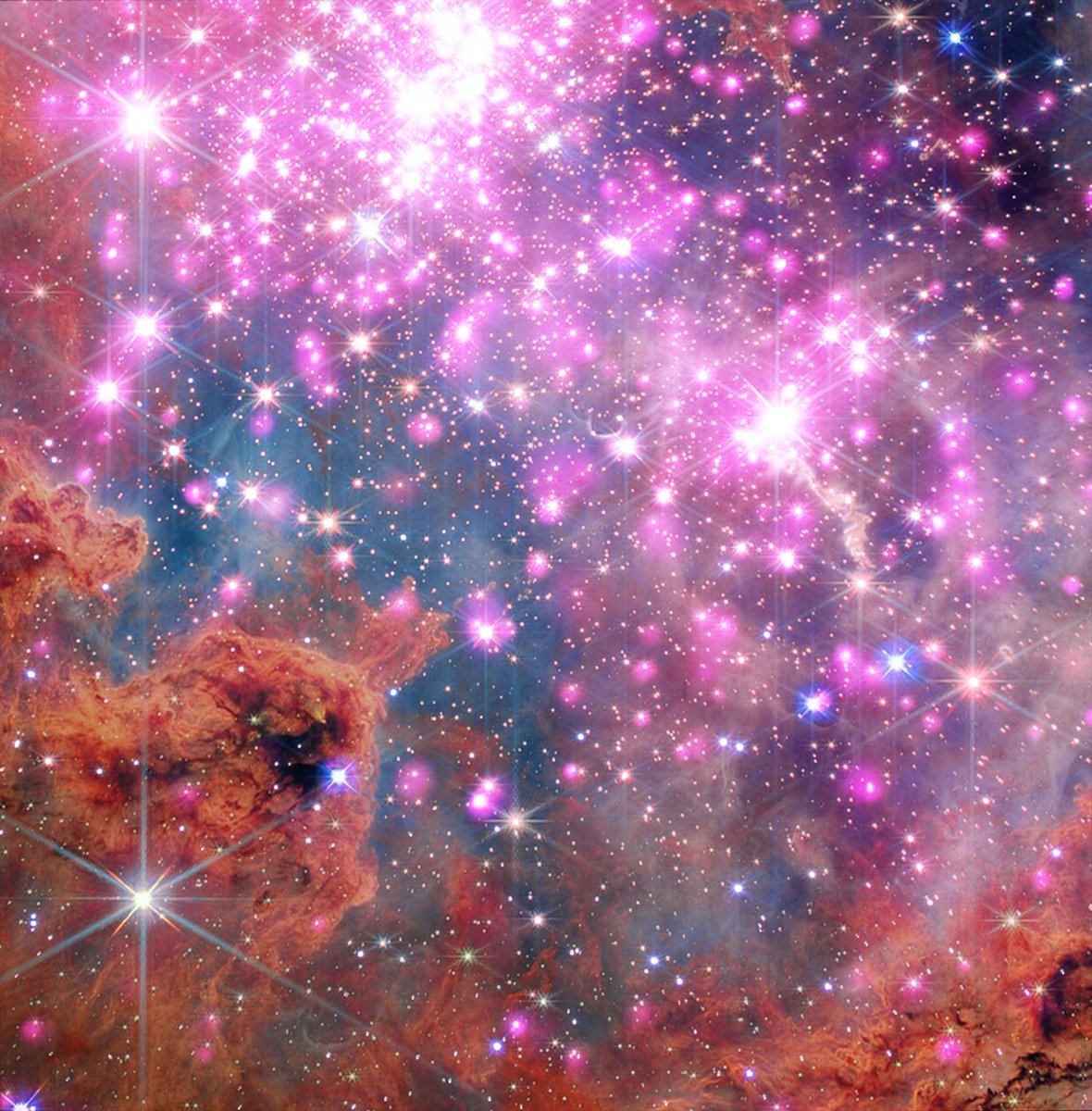
Westerlund 2 is a young cluster of thousands of stars located about 20,000 light-years from Earth. This close-up image, roughly 12 light-years across, combines observations from NASA's Chandra X-ray Observatory & @NASAWebb.��