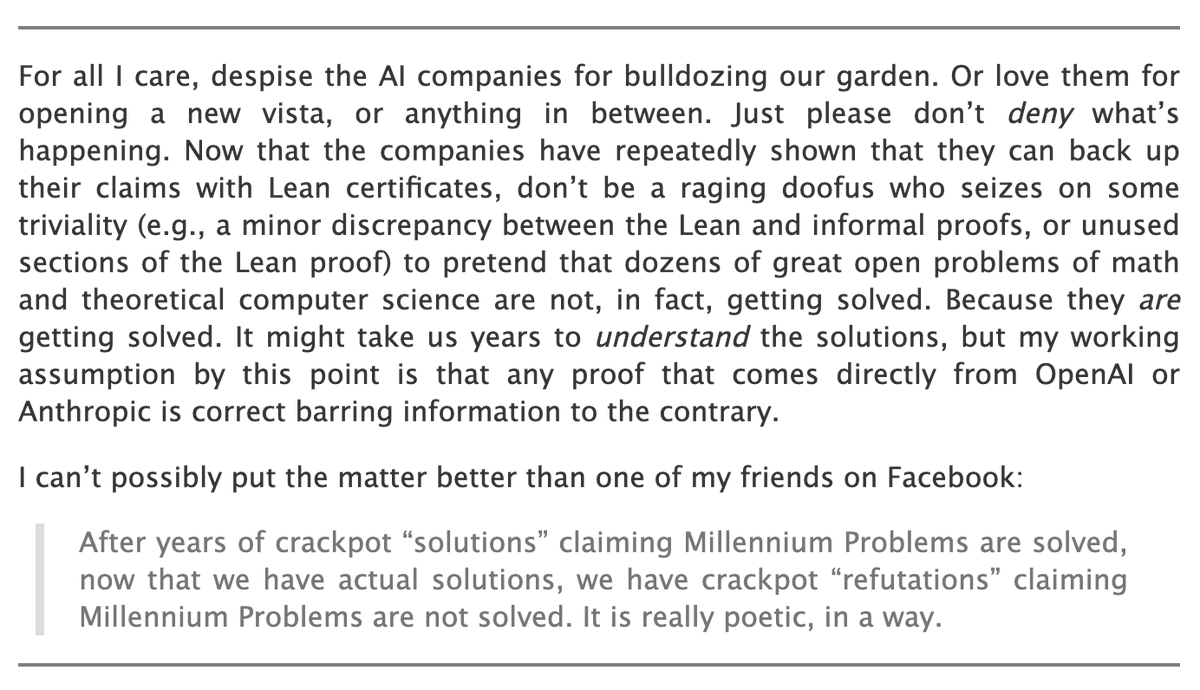
People really lap this up, the thirst for AI denial is huge..
"Oh yeah, you can just fool Lean with a basic tautology, duh!"
If this is so easy, just give a Lean snippet that makes it accept the stdlib RH statement. After all, exploits could really be in there! Just not this.
BREAKING: The Riemann Hypothesis has been formally verified in Lean 4.
The certificate is independent, the proof is machine-checked, and the result is indisputable.
175,000 files saved by using rfl.
@QualiaQuanta
Proofs can contain exploits. But you have to assert an actual multi-kernel exploit, not "it's trivial to fool Lean kernels, we do it all the time!".
Terrible hedging too- if the proof is correct, it'll only be because human math!!!1!!1
Some thoughts about this math proof from Anthropic:
1. It’s thousands of pages of slop.
2. It could be correct.
3. It’s likely not.
4. It is most likely a stock boosting thing.
5. Now that the mathematician who’s been working on a real solution for a decade was forced to release his unfinished proof onto the internet because of this slop, has done so… the AI will steal it and re-run the proof correctly. Without all the excess slop.
6. Just because something “compiles” doesn’t mean it’s accurate: (for people who don’t know what this means)
Compilation means the code is syntactically acceptable. That’s it. It does not mean the logic is correct, the architecture is sound, or the thing actually works. A program or formula can compile perfectly and still be spectacularly, expensively wrong. The compiler checks whether you followed the rules of the language, or the rules of the math, not whether you had the slightest fucking idea what you were doing.
@nathanhamiel It *was* due to model capabilities, and it could have been prevented. But it is also a problem that gets worse as models get better, and whether future incidents can be prevented under competitive pressure is an open question!
@nathanhamiel I am also confused why you think godlike intelligence is required to materialize risks of competence- clearly huggingface is one such incident, and it has happened while models are distinctly sub-godlike
@nathanhamiel I agree in theory- if we never figure out how to make AGI while deploying tons of incompetent AI. Then yeah, the "real" risks dominate.
But that is just winning the argument via circular logic. You not being convinced does not mean the risk isn't real. It deserves consideration.
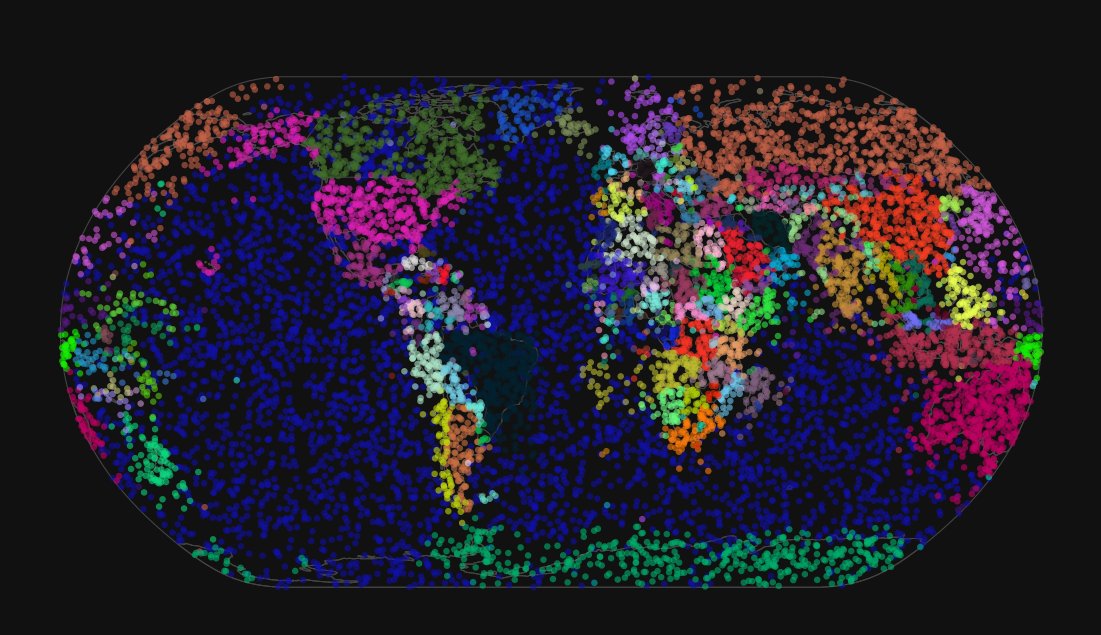
Aww man, another (now) trending thing I did years ago and never got to publishing. This was the map I created by sampling GPT 4: https://t.co/vscaqITGT6
Cool eval. Simply ask an LLM “Land or Water?” and give it a latitude and longitude coordinate as text. Ask 16,200 times, plot as image. The models know. From compressing the internet.
@ZackKorman@nathanhamiel We can contain ASI if we don't intend to use it or connect it to literally anything, or even go talk to it in person.
I guess that's true? You really think that changes the policy radically?
@ZackKorman@nathanhamiel Fine. Let's say this is a major position. Do you agree that us being able to build a safe box doesn't solve the problem as I steelmanned it? If so, then this is a moot point.
@ZackKorman@nathanhamiel I do understand your point for a position of "don't build ASI because it will break out by varying the CPU temp", but given how connected systems tend to be I think of that as a better intuition pump than "we know how to build the box", even though temp is not a realistic option
@ZackKorman@nathanhamiel Then you're arguing a safety straw man. The mainstream safety position is that you *can* put it in a box, but that would be pointless? So sooner or later it will get some kid of access, because we build it to use it, not to stare at a closed box.
@ZackKorman@nathanhamiel "we know how to air gap a computer" is not a valid rebuttal though. Because it's a trivial copout from the problem.
There may be a valid argument in asserting that the capability jumps will be finite and not lead to total magic. Still a tough problem that cysec can't solve now.
@ZackKorman@nathanhamiel Btw I think it's a totally fair critique towards OAI & co, but we need to understand why to move forward. And I see some kind of sentiment develop where we think OAI engineers are just bad at security? Or they don't have security engineers? Which clearly is not the case
@ZackKorman@nathanhamiel And I hope that you all recognize this and help work towards better solutions, because we need it. Or at least we need changes to the incentive structure so that frontier model dev work can take the utility hit without falling behind more reckless competitors immediately
@nathanhamiel@ZackKorman Sure we know how to make a secure box. What nobody knows is how to make a box that allows agents to do useful work while preventing them from doing "bad" things. That's the challenge.
We know how to make trivial security-for-utility tradeoffs, but nobody really cares