One of India’s most successful tech billionaires is making his first big bet after stepping down from the food delivery empire he led for 18 years https://t.co/poBo8Y9gnS
Eternal founder Deepinder Goyal says their new wellness device, Temple, that is designed to measure cerebral blood flow, could hit the market within a year.
The Indian tech billionaire tells Bloomberg's Haslinda Amin it all began as a science project https://t.co/XryrcoRUZh
The Temple team has made a breakthrough.
We have discovered (literally discovered) a biomarker, only readable on the temple region, and nowhere else, that measures the real-time cost of you being alive.
We are calling it Entropy™.
It's a live number on Temple's home screen, updating every second, on an index from 1 to 250.
1 is the deepest rest we've ever recorded. We've only seen fit, experienced meditators touch it, for fleeting moments deep in practice. 250 is the highest we've seen in elite athletes at the peak of their output and flow.
Everything moves Entropy. Sleep, stress, a sprint, coffee, a meal, a cold plunge, meditation, strength training... everything moves your metabolism, your cost of being alive. And Entropy tracks it, live.
Heart Rate doesn’t come even close to this level of precision in calculating the cost of being alive. We benchmarked Entropy and Heart Rate against a standard metabolic cart (calorimeter). Over a hundred cardio sessions, Entropy tracked the calorimeter's curve at r=0.93 and p <0.001. Heart Rate managed a meagre r=0.55.
Here's why Entropy should matter to you –
Your Entropy Maxima is the highest your body can reach when you push it hard. A high peak is the signature of a capable body, one that can rise to meet effort and recover from it. As we age, that ceiling naturally falls, so this is the number to push upwards.
Your Entropy Minima is the lowest your body settles to at rest. Across the animal world, a lower cost of being alive at rest tends to go with a longer life. Your Entropy Minima is the number to bring down, every single day.
Living with Entropy is magical. It teaches you so much about yourself, that no other metric ever has. We are looking forward to you trying out Temple. But not before it’s perfect.
Apply for early access at https://t.co/XxGR9Hpq58
Follow @temple for updates.
Hello everyone, here are the highlights from Eternal's last quarter –
- Eternal’s Q4FY26 Consolidated Adjusted Revenue grew 64% YoY (like-for-like) to 17,680 crore
- B2C NOV grew 54% YoY (4% QoQ) to INR 26,880 crore
- Consolidated Adjusted EBITDA increased 160% YoY to INR 429 crore while increasing 18% QoQ (vs INR 364 crore in Q3FY26)
- Blinkit NOV growth remains strong at 95.4% YoY (8.2% QoQ)
- Food Delivery NOV growth at 18.8% YoY (-0.9% QoQ) - continues to improve for the third quarter in a row, inching closer to our long-term expectation of 20%+ YoY
- Going-out NOV grew 42% YoY for the full year FY26
- Hyperpure’s overall Adjusted EBITDA margin improving to 0.5% resulting in absolute Adjusted EBITDA profit of INR 5 crore
- 109 million Indians completed transactions worth over $10 billion through Blinkit, District, and Zomato in FY26
- Delivery Partner Welfare: ~₹200 crore in government benefits unlocked in FY26; expanding to 1 lakh gig & contract workers by FY27
- Greening India: 1M saplings distributed to 3,000 farmers across 6 states; 600K+ planted over ~5,000 acres (free of cost)
- EV Adoption: EV delivery partners grew from 52K (Mar 2025) to 100K+ (Mar 2026)
- Plastic Waste: 15,000 MT recycled in FY26; 60,000+ MT recycled since inception (100% plastic neutral initiative)
- Feeding India: 1.4 lakh+ children fed daily across 2,300+ centres in 150+ cities
That’s all for now. To our customers, delivery partners, business partners, policymakers, and team members: your support is what moves us forward.
If there’s anything we can do better, we are always listening. Please feel free to share any questions or feedback at [email protected]
Full report here – https://t.co/r88GCLeggt
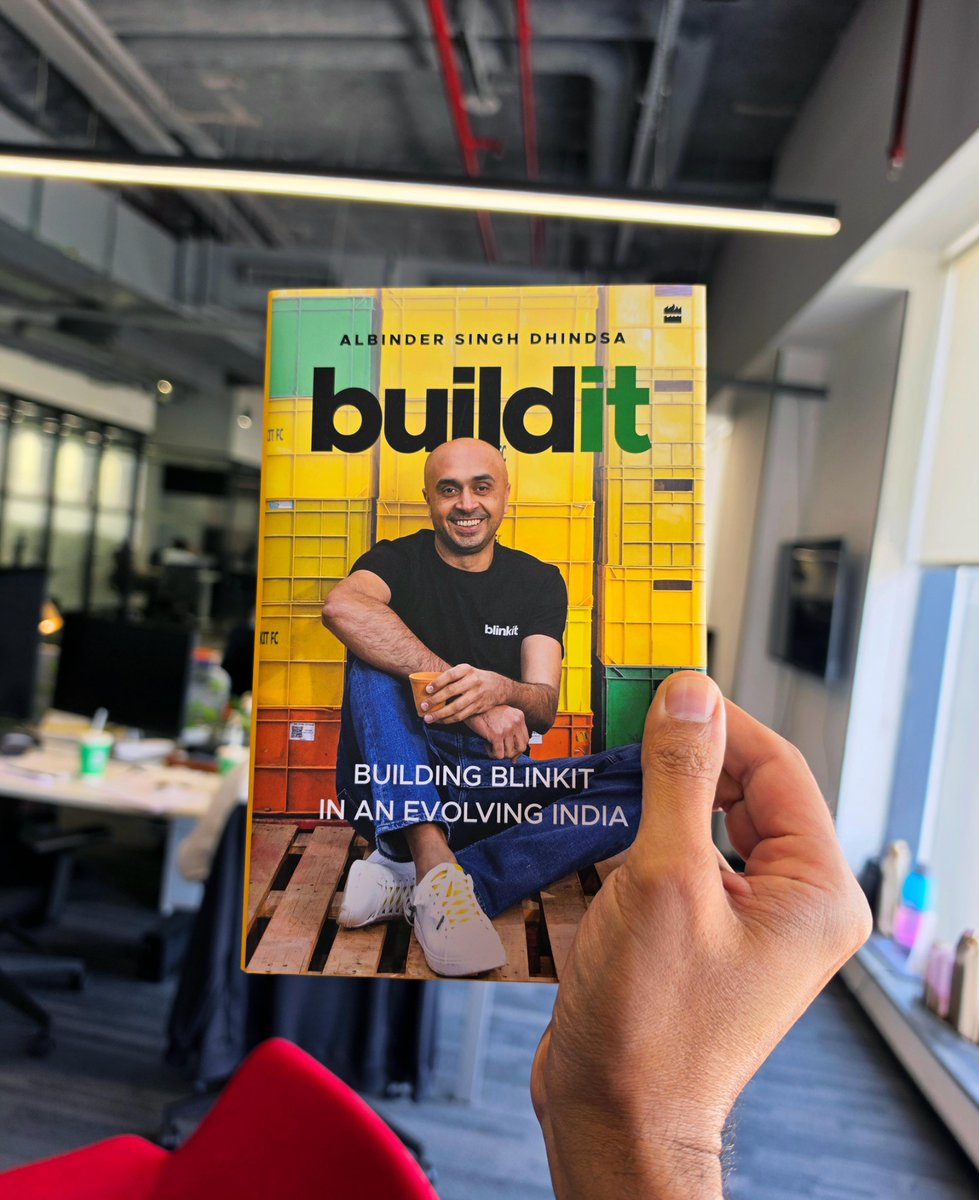
A book about Blinkit, now on Blinkit.
I have no idea how @albinder finds time for writing books alongside all that he has to do, but this is an excellent read about the challenges of starting up, building, breaking, and rebuilding for retail in India.
A few hundred signed copies available on Blinkit.
Yesterday, a small prototype aircraft of a brand new design from LAT Aerospace crashed into a wheat field near Saifai during a ground roll test. Strong winds caused loss of control, and immediate crash.
We’ve reached out to the farmer whose crop was damaged and have already ensured full compensation for their loss.
We’re early in development. Crashes are part of building aircraft. We’ll learn from this, tighten our test protocols, and keep going.
We just completed a successful flight for our tech demonstrator, Lat One v0.2.
Lat Aerospace is building ultra-short takeoff and landing aircraft using blown wing technology. Think fixed-wing performance with near-helicopter access.
A couple of months ago, v0.1 achieved uSTOL but crashed shortly after. That was expected. v0.2 was about completing the full mission, and it did. The blown wing concept worked in reality. Closed-loop control got validated. We'd predicted a cruise speed of 30-32 m/s and cruised comfortably at 33. No thermal issues despite a burning afternoon. The quick-detach wings held through aggressive turns. Was in the air for over 6 minutes. Smooth touchdown, and ready to fly again.
But the thing that makes me the happiest isn't any of that. It's that our CFD studies, aerodynamic models, SIL simulations, and flight logs all match, almost perfectly. That's what real engineering looks like. I am so proud of our team.
A long way to go, and we are getting there.
@lataerospace@surobhidas
If you used to work at Zomato, whether you chose to move on, or I was the one who asked you to leave, this is for you.
I know that for many of you, Zomato didn't have the environment, or the leadership you needed at the time. But I know for sure, that you loved being at Zomato, and it is quite possible that you never felt like home anywhere else since you left.
We have over four hundred people at Eternal today in their second or third stints. Many of them are doing their best work now. Maybe because they've grown, but also because the company has grown. We are more organised, a little less chaotic, and hopefully, I've learned a few things along the way too.
If you haven't reached out because you think the door is closed, or because you think I'm holding onto the past, I'm not. I want you back.
There is so much to build at Eternal. We are today, a family of companies. Zomato, Blinkit Quick-Commerce, Blinkit Ambulances, District, Hyperpure, Nugget, and Feeding India. We need people who already know what good looks like here, and who care enough to fight for it. There is no better person for that than someone who has been here, left, grown, and wants to come back.
You might say that Eternal is not going to be the same, because I am not the CEO anymore. But ask yourself a question. Did titles ever matter at Eternal? I am still very much here, and I'd love for you to be a part of this next phase of Eternal.
If you feel like you have unfinished business here, please don't overthink it. Write to me at [email protected]. The Gurgaon pollution is still a bug, but being at Eternal is the feature. Let's talk and find a role that fits your life as it is today.
Last one on this topic, and I have been holding this in myself for a while.
For centuries, class divides kept the labor of the poor invisible to the rich. Factory workers toiled behind walls, farmers in distant fields, domestic help in backrooms. The wealthy consumed the fruits of that labor without ever seeing the faces or the fatigue behind it. No direct encounter, no personal guilt.
The gig economy shattered that invisibility, at unprecedented scale.
Suddenly, the poor aren't hidden away. They're at your doorstep: the delivery partner handing over your ₹1000+ biryani, late-night groceries, or quick-commerce essentials. You see them in the rain, heat, traffic, often on borrowed bikes, working 8–10 hours for earnings that give them sustenance. You see their exhaustion, their polite smile masking frustration with life in general.
This is the first time in history at this scale that the working class and consuming class interact face-to-face, transaction after transaction. And that discomfort with our own selves is why we are uncomfortable about the gig economy. We want these people to look our part, so that the guilt we feel while taking orders from them feels less.
We aren't just debating economics. We are confronting guilt. That ₹800 order might equal their entire day's earnings after fuel, bike rent, and app cuts. We tip awkwardly, or avoid eye contact, because the inequality is no longer abstract. It's personal.
Pre-gig era, the rich could enjoy luxury without moral discomfort. Labor was out of sight. Now, every doorbell ring is a reminder of systemic inequality. That's why debates explode. It's not just policy. It's emotional reckoning. Some defend the system (“they choose it”), others demand change (“this isn't progress, its exploitation”).
And here’s the uncomfortable twist: the unsaid ask of clumsy ‘solutions’ isn’t dignity. It is about returning to invisibility.
Ban gig work and you don’t solve inequality. You remove livelihoods. These jobs don’t magically reappear as formal, protected employment the next day. They disappear, or they get pushed back into the informal economy where there are even fewer protections and even less accountability. Over-regulate it until the model breaks, and you achieve the same outcome through paperwork instead of slogans: the work evaporates, prices rise, demand collapses, and the people we claim to protect are the first to lose income.
And then what happens?
The rich get their old comfort back. Convenience returns without faces. Guilt dissolves. We go back to clean abstractions and moral posturing from a distance. The poor don’t become safer, they become invisible again: back in cash economies, back in backrooms, back in shadows where regulation rarely reaches and dignity isn’t even debated.
The gig economy just exposed the reality of inequality to the people who previously had the luxury of not seeing it. The doorbell is not the problem. The question is what we do after opening the door.
Visibility is the price of progress. We can either use this discomfort to build something better (which we keep doing continuously as delivery partners are our backbone), or we can ban and over-regulate our way back into ignorance. One of those choices improves lives. The other simply helps the consuming class feel virtuous in the dark.
One more thing. Our 10 minute delivery promise is enabled by the density of stores around your homes. It’s not enabled by asking delivery partners to drive fast. Delivery partners don’t even have a timer on their app to indicate what was the original time promised to the customer.
After you place your order on Blinkit, it is picked and packed within 2.5 minutes. And then the rider drives an average of under 2kms in about 8 minutes. That's an average of 15kmph.
I understand why everybody thinks why 10 minutes must be risking lives, because it is indeed hard to imagine the sheer complexity of the system design which enables quick deliveries.
Also, if you've ever wanted to know why millions of Indians voluntarily take up platform work and sometimes even prefer it to regular jobs, JUST ASK any rider partner when you get your next food or grocery order.
You will be humbled by how rational and honest they will be with you.
Having said that, no system is perfect, and we are all for making it better than today. However, it is far from what it is being portrayed on social media by people who don't understand how our system works and why.
If I were outside the system, I would also believe that gig workers are being exploited, but that's not true.
Agree. And literally everyone who has a job wants to get paid more. Everyone thinks they deserve better. At the end of the day, market forces decide how much does someone get paid.
Companies reliant on gig economy compete very brutally with each other. Demand is more than the supply, which results in gig incomes being more than what many formal entry level jobs in India pay.
Agree.
I repeat – gig workers is one of the largest organised job creation engines in India. And we provide insurance, fair, timely and predictable wages.
Gig doesn’t need more regulation, it needs less regulation. It will bring more people into the fold, who will be able to earn some money, upskill themselves and later join India’s organised workforce. Not to mention, consistently send their kids to school - which will fundamentally change the fabric of our nation one generation later.
I am all for peaceful protests against anything and everything. But violent protests and stopping others who want to work from working is not okay (proof attached).
Here’s what we know – a number of these protestors were not even our delivery partners. They were agents of political interests, piggybacking on the narrative to gain political mileage.
So many people keep asking me about Continue. What is it? What are you up to? Here you go...
Continue started as a research effort two years ago, with the belief that if the human body is a system, it should also have its leverage points. The simple levers that, when adjusted, could fundamentally alter how we age and live.
Along with a team of initially skeptical researchers, we've been investigating a penny-drop insight about human aging. Something that's been hiding in plain sight for eternity. But more on that in a few weeks. We are at the tail-end of the research on this hypothesis, which if true, could fundamentally change our understanding of biology and aging.
But today isn't about that. It's bigger than that.
Today, we are expanding Continue Research to include a $25 million fund (entirely personally backed) to support researchers across the world who dare to ask simpler questions than anyone else. Who believe biology might be far simpler than we've made it.
For over a decade, I have believed that most of the world’s problems stem from our short human lifespans. Continue Research’s goal is to extend healthy human function long enough that humans stop making short-term decisions.
Read more about Continue’s purpose at – https://t.co/2jbRl1CHvq
This will be a multi-decadal journey. Our goal here is to become a small catalyst in humanity's journey of conscious evolution. To lead us into the Post-Darwin era.
Researchers, please look us up and apply for funding/grants at – https://t.co/3bbtOyXEPf
———
PS: Continue is not a part of Eternal
For years, there’s been something about Zomato that made me uneasy.
We made eating out and ordering in easier than ever, but we never really helped people truly eat better. Yes, you could find a salad or a smoothie bowl, but the truth is, if you wanted to eat genuinely nourishing food, Zomato didn’t make it easy.
That weighed on me, because when we say our mission is “better food for more people”, the “better” has to mean something deeper.
Today, we’ve taken one of the biggest steps in fixing that blind spot. We’re launching Healthy Mode on Zomato.
Every dish in this mode now comes with a Healthy Score—from Low to Super—based on what really counts for your health: protein, complex carbs, fibre, and micronutrients, and not just calories. Behind the scenes it’s AI and restaurant data doing the heavy lifting, but what you’ll see is simple: a clear explanation of what makes a dish healthy, and why.
This is not your run of the mill “healthy mode” for beginners. We have kept the bar very high, that professional athletes can rely on healthy mode to find food that works for them.
This is personal for me. I’ve carried the guilt that Zomato made it easy to eat whatever you craved, but not easy to eat what your body needed. Healthy Mode is our first real step in putting that right.
It’s live in Gurgaon, and we’ll expand fast. Try it, tear it apart, tell us where it fails. Because this is just the beginning—and for the first time, I feel we’re moving meaningfully closer to truly living up to our mission: better food for more people.
Punjab is battling its worst floods in decades. Villages submerged, families displaced. In Fazilka, Tarn Taran, Gurdaspur & Hoshiarpur, Feeding India is on ground with relief kits & hope proving courage & humanity always rise above disaster.
#PunjabFloods#FeedingIndia
We're celebrating Zomato's (Eternal's) 17th birthday by launching the "Greening India" initiative! 🌳🌳
Over the next year or so, we'll plant more than 25 lakh trees on farmlands, over 10,000 acres – supplementing farmers' income while removing 15 lakh tonnes of CO₂ from the atmosphere over the next three decades.
So far, we've already partnered with 2000+ farmers for plantations on 4500+ acres land across Maharashtra, Uttar Pradesh, and Punjab.
If this succeeds, we'll make this much bigger.
Details – https://t.co/OUYc9II1kK