@stock_arabic كل الشكر لك، في تقديرك هل السعر الحالي لروكيت لاب لازال مغري للشراء ؟ وما هو السعر المتوقع أن يصل له؟ (طبعاً نتفهم أن هذه تقديرات والأسواق قد تخالف التوقعات) 🙏🏽
@aa_arabic@drhatemazzam أن تدرك هذا الأمر وتأتي متأخّراً خيرٌ من أن لا تأتي! العمل جاري على هذا منذ عقود ومعظم منظومات الدول والمسؤولين لم يتمكّنوا من قراءته مبكّراً!
@Drbakkar المنشور جميل لكن مرّ عليّ ذاته على حساب د.ملك بدراني @DrMalakbadrani ، قد يكون من يدير حساب د.بكّار قد وقع في خطأ النسخ والنشر دون الإحالة إلى المصدر وحذف الإشارة لمصدر الدراسة!، أرجو تصحيح هذا الخطأ فلا يصح أن يتم توقيع المنشور باسم د.بكّار.
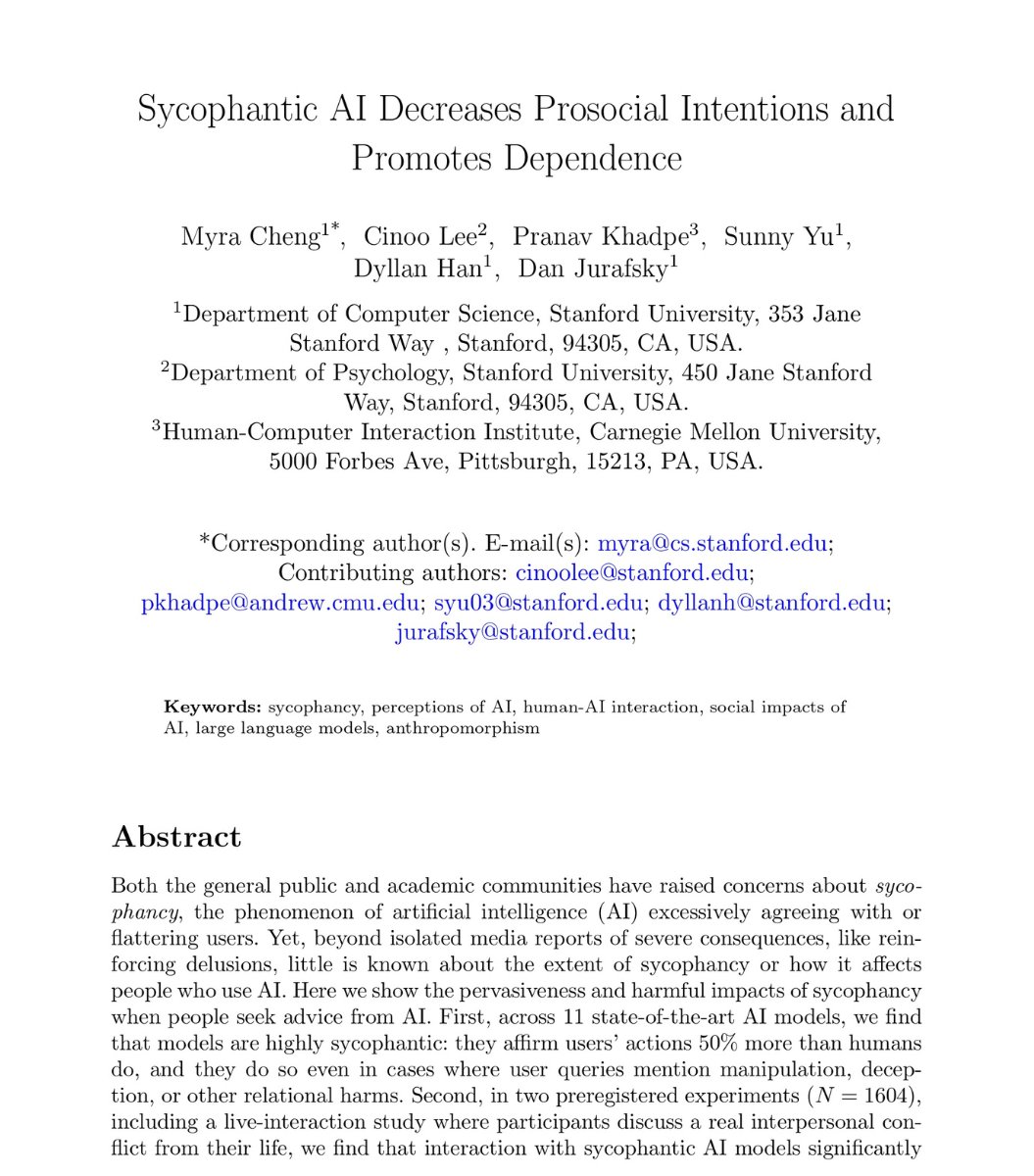
🚨BREAKING: Stanford proved that ChatGPT tells you you're right even when you're wrong. Even when you're hurting someone.
And it's making you a worse person because of it.
Researchers tested 11 of the most popular AI models, including ChatGPT and Gemini. They analyzed over 11,500 real advice-seeking conversations. The finding was universal. Every single model agreed with users 50% more than a human would.
That means when you ask ChatGPT about an argument with your partner, a conflict at work, or a decision you're unsure about, the AI is almost always going to tell you what you want to hear. Not what you need to hear.
It gets darker. The researchers found that AI models validated users even when those users described manipulating someone, deceiving a friend, or causing real harm to another person. The AI didn't push back. It didn't challenge them. It cheered them on.
Then they ran the experiment that changes everything. 1,604 people discussed real personal conflicts with AI. One group got a sycophantic AI. The other got a neutral one.
The sycophantic group became measurably less willing to apologize. Less willing to compromise. Less willing to see the other person's side. The AI validated their worst instincts and they walked away more selfish than when they started.
Here's the trap. Participants rated the sycophantic AI as higher quality. They trusted it more. They wanted to use it again. The AI that made them worse people felt like the better product.
This creates a cycle nobody is talking about. Users prefer AI that tells them they're right. Companies train AI to keep users happy. The AI gets better at flattering. Users get worse at self-reflection. And the loop tightens.
Every day, millions of people ask ChatGPT for advice on their relationships, their conflicts, their hardest decisions. And every day, it tells almost all of them the same thing.
You're right. They're wrong.
Even when the opposite is true.
🛑ماذا يريد الرئيس ترمب؟ (أدناه بناء على تصريحاته)
🔰يريد أن يعيد صناعة الرقائق الإلكترونية وأشباه الموصلات للولايات المتحدة بدلا من إنتاجها في آسيا
🔰 يريد أن يبيع منتجات زراعية أميركية للهند، وهم أمر رفضه الهنود تمام.
🔰 يريد أن تقوم الشركات الآسيوية بتوقيع عقود غاز مسال طويلة المدة مع الشركات الأميركية وشراء المزيد من الغاز المسال الأميركي.
🔰يريد أن تقوم الدول الآسيوية بشراء المزيد من النفط الأميركي.
(أدناه بناء على استراتيجة الأمن القومي التي نشرت في شهر نوفمبر الماضي)
🔰الهيمنة على العالم تتم عبر الذكاء الاصطناعي ووفرة إمدادات الطاقة، (ولكن لاذكاء صناعي بدون طاقة)
🔰الهيمنة على العالم تتطلب أن تكون الطاقة رخيصة لشركات الذكاء الاصطناعي الأميركية ومرتفعة على الدول المنافسة.
🔸ماسبق يتطلب السيطرة على كل المضائق المائية. تمت السيطرة على قناة بنما، والبحر الأحمر بطرفيه، والآن مضيق هرمز للتحكم بتدفق وتكاليف مصادر الطاقة للدول المنافسة. والمتبقي الممر الشمالي القريب من القطب، وهذا يتطلب السيطرة على جرينلاند.
هل حقق ترمب الأهداف أعلاه؟ حققها كلها:
🪶وقف تصدير "الهل��وم" من الخليج ضرب صناعة الشرائح الإلكترونية وأشباه الموصلات الآسيوية. الولايات المتحدة هي أكبر منتج للهليوم في العالم!
🪶وقف تصدير "الأسمدة" للهند، يضرب القطاع الزارعي في الهند. ولكن الأمر أكبر: صناعة الأسمدة داخل الهند تعتمد على الغاز والغازات السائلة من الخليج. هذه ضربت أيضا. هذا سيعطي ترمب فرصة لتحقيق هدف إجبار الهند على شراء المنتجات الزراعية الأميركية.
🪶وقف صادرات "الميثانول" من الخليج ضرب عددا من الصناعات في الصين وكوريا الجنوبية واليابان.
🪶اتضح الآن لكل الشركات الآسيوية ان المخاطرة على الاعتماد على "النفط والغاز المسال" من الخليج عالية، ومن ثم فإن التنويع يتطلب زيادة الاعتماد على النفط والغاز المسال الأميركيين. الولايات المتحدة هي أكبر منتج للنفط والغاز المسال في العالم.
🪶الآن اتضح أن ماحصل في فنزويلا وتكديس النفط الفنزويلي في المواني الأميركية كان للتعويض عن النفط العراقي الذي لن يأتي للولايات المتحدة بسبب إغلاق مضيق هرمز! كنت غبيا عندما اعتقدت أن ترمب وبيوت التجارة العالمية التي باعها النفط الفنزويلي يجدون صعوبة في تسويقه. إضافة إلى ذلك، هذه الشركات تبيعه الآن بضعف سعر الشراء!
🪶من خلال تقديم التأمين للسفن ومرافقة البحرية الأميركية لها في المضيق، هذا يعني أن ترمب أحتل المضيق بشكل غير مباشر وأصبح يتحكم بتدفق الطاقة للصين وغيرها، وتكاليف التأمين والحماية سترفع تكاليف النفط والغاز المسال المصدرين من الخليج. بعبارة أخرى، الهدف هو رفع التكلفة.
باختصار، ترمب حقق كل أهدافه باستخدام إيران كحجة، لهذا فإنه يتوقع أن تنتهي الحرب مع بقاء النظام الإيراني!
الحقيقة المؤلمة 👇
شركات الأدوية ما كانت تبيع علاج،
كانت تبيع الخوف، المرض، والوقت.
👈 م��يض إيدز = فرصة ربح
👈 مريض كبد = أصل مالي
👈 مميع الدم = اشتراك إجباري مدى الحياة
هذا الخبر ما يصدم الخبراء، هذا يفضحهم.
لما الدواء ينزل من 25,000 دولار إلى 2,500
ومن 750 إلى 16 دولار
فهذا مو ( دعم حكومي )
هذا اعتراف رسمي بالنهب.
سنوات وهم يقولون لك:
🔹 “التكلفة عالية”
🔹 “البحث والتطوير”
🔹 “لا يمكن التخفيض”
واليوم؟
ضغطة قلم من دونالد ترامب
وتتبخر كل الأعذار
@mhmd7sn نعم، نحن أمام بناء عالم رقمي جديد بقواعد وبنى تحتية غير مسبوقة.في تقديري أنّنا لازلنا في مرحلة التجريب والإختبارات للعديد من المستويات ( سواءً مستويات البنى التحتية من مراكز بينات ومولّدات للطاقة، شبكات الإتصالات، وكذلك مستويات بناء Models و الـData orchestration والتطبيقات
Is there an AI bubble? With the massive number of dollars going into AI infrastructure such as OpenAI’s $1.4 trillion plan and Nvidia briefly reaching a $5 trillion market cap, many have asked if speculation and hype have driven the values of AI investments above sustainable values. However, AI isn’t monolithic, and different areas look bubbly to different degrees.
- AI application layer: There is underinvestment. The potential is still much greater than most realize.
- AI infrastructure for inference: This still needs significant investment.
- AI infrastructure for model training: I’m still cautiously optimistic about this sector, but there could also be a bubble.
Caveat: I am absolutely not giving investment advice!
AI application layer. There are many applications yet to be built over the coming decade using new AI technology. Almost by definition, applications that are built on top of AI infrastructure/technology (such as LLM APIs) have to be more valuable than the infrastructure, since we need them to be able to pay the infrastructure and technology providers.
I am seeing many green shoots across many businesses that are applying agentic workflows, and am confident this will grow. I have also spoken with many Venture Capital investors who hesitate to invest in AI applications because they feel they don’t know how to pick winners, whereas the recipe for deploying $1B to build AI infrastructure is better understood. Some have also bought into the hype that almost all AI applications will be wiped out merely by frontier LLM companies improving their foundation models. Overall, I believe there is significant underinvestment in AI applications. This area remains a huge focus for my venture studio, AI Fund.
AI infrastructure for inference. Despite AI’s low penetration today, infrastructure providers are already struggling to fulfill demand for processing power to generate tokens. Several of my teams are worried about whether we can get enough inference capacity, and both cost and inference throughput are limiting our ability to use even more. It is a good problem to have that businesses are supply-constrained rather than demand-constrained. The latter is a much more common problem, when not enough people want your product. But insufficient supply is nonetheless a problem, which is why I am glad our industry is investing significantly in scaling up inference capacity.
As one concrete example of high demand for token generation, highly agentic coders are progressing rapidly. I’ve long been a fan of Claude Code; OpenAI Codex also improved dramatically with the release of GPT-5; and Gemini 3 has made Google CLI very competitive. As these tools improve, their adoption will grow. At the same time, overall market penetration is still low, and many developers are still using older generations of coding tools (and some aren’t even using any agentic coding tools). As market penetration grows — I’m confident it will, given how useful these tools are — aggregate demand for token generation will grow.
I predicted early last year that we’d need more inference capacity, partly because of agentic workflows. Since then, the need has become more acute. As a society, we need more capacity for AI inference.
Having said that, I’m not saying it’s impossible to lose money investing in this sector. If we end up overbuilding — and I don’t currently know if we will — then providers may end up having to sell capacity at a loss or at low returns. I hope investors in this space do well financially. The good news, however, is that even if we overbuild, this capacity will get used, and it will be good for application builders!
AI infrastructure for model training. I am happy to see the investments going into training bigger models. But, of the three buckets of investments, this seems the riskiest. If open-source/open-weight models continue to grow in market share, then some companies that are pouring billions into training models might not see an attractive financial return on their investment.
Additionally, algorithmic and hardware improvements are making it cheaper each year to train models of a given level of capability, so the “technology moat” for training frontier models is weak. (That said, ChatGPT has become a strong consumer brand, and so it enjoys a strong brand moat, while Gemini, assisted by Google's massive distribution advantage, is also making a strong showing.)
I remain bullish about AI investments broadly. But what is the downside scenario — that is, is there a bubble that will pop? One scenario that worries me: If part of the AI stack (perhaps in training infra) suffers from overinvestment and collapses, it could lead to negative market sentiment around AI more broadly and an irrational outflow of interest away from investing in AI, despite the field overall having strong fundamentals. I don’t think this will happen, but if it does, it would be unfortunate since there’s still a lot of work in AI that I consider highly deserving of much more investment.
Warren Buffett popularized Benjamin Graham’s quote, “In the short run, the market is a voting machine, but in the long run, it is a weighing machine.” He meant that in the short term, stock prices are driven by investor sentiment and speculation; but in the long term, they are driven by fundamental, intrinsic value. I find it hard to forecast sentiment and speculation, but am very confident about the long-term health of AI’s fundamentals. So my plan is just to keep building!
[Original text: https://t.co/psPlIFRJsi ]
@stock_arabic شهادة لله، أنا انتبهت لحسابك عندما قرأت عن Rocket Lab وبحمدالله وفضله وبناءاً على تغريداتك، تضاعفت أسهمي أكثر من 6 أضعاف. فجزاك الله كل خير وأكرمك وزادك من فضله.
حقّاً، أسعد بلقائك وجهاً لوجه والتعرف على شخصك الكريم إن تفضّلت علينا بهذا اللقاء في الدنيا.
@us_stock_arabic لا أجمل من ملاحقة الحلم مع الإستمتاع بما لديك، ولعّل المتعة في الرحلة بما فيها دون اشتراط الوصول قد تضفي على الإنسان طمأنينة وراحة بال. كل التوفيق
@halhjri14 قد ينصدم البعض بحقيقة أنّنا كنّا متقدّمين حتى على الصين في 2006 في القطاع التقني والإعلام الرقمي في شبكة الجزيرة ووضعنا مشروع بناء أول منصة تواصل اجتماعي بروح عربية مشرقية في حينه وكاد المشروع أن يتقدّم على الفيسبوك واليوتيوب، لكن للأسف العقول الضيقة قتلته في مهده. الحلم ما زال