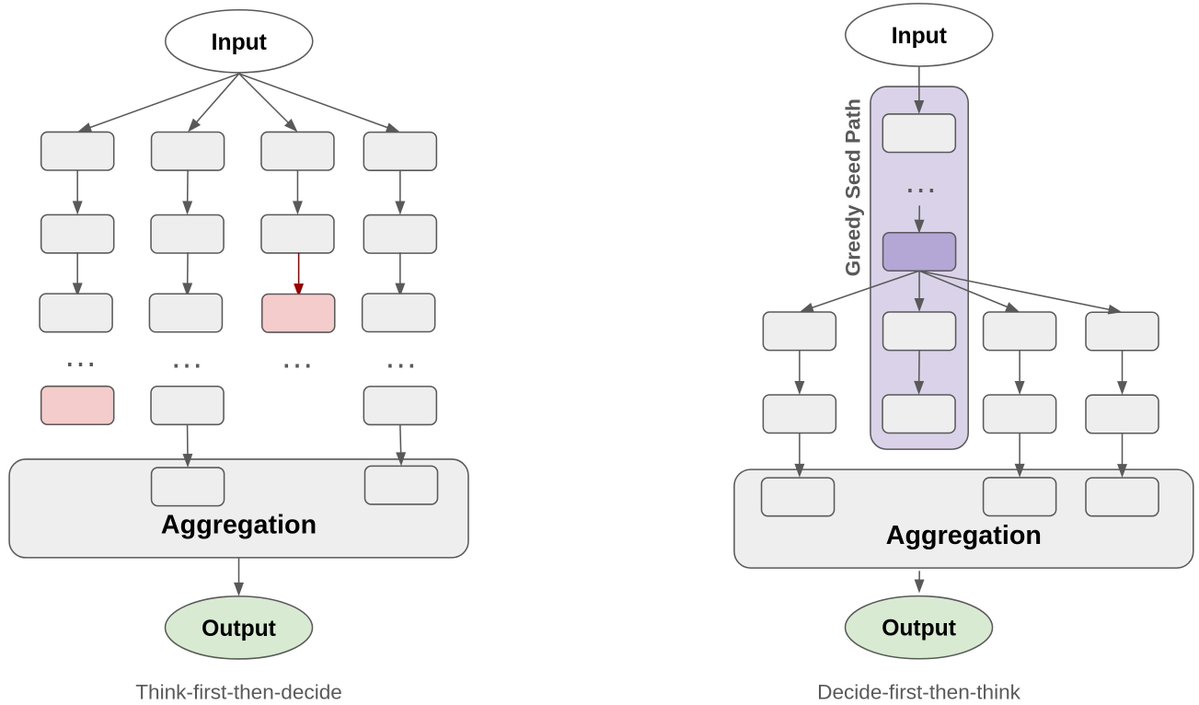
I won't be in #COLM due to a visa issue 🥲 but if you're there, go talk to @JiUngLee1 on Thursday during poster session 4 about our work: Fork-Think with Confidence: we rethink parallel sampling for efficiently scaling inference-time compute 🧵
I'll be presenting this paper from my @nvidia internship at #REALM2026 at the poster sessions from 10:30-11:30 and 15:30-16:30 in Hall H, in Sections 6 and 7 #EMNLP2026
Come by to chat about model selection in heterogeneous multi agent systems!
Paper: https://t.co/AHFcrR6wqA
I'm in Budapest for #EMNLP2026 ✈️ 🏰
Would love to meet and chat about factuality and agentic AI, training data and interpretability, creativity in/with AI, or anything else. Please say hi if you see me!☕️
Also hiring PhD students this cycle✨ Let's chat if you are looking!
I won't be in #COLM due to a visa issue 🥲 but if you're there, go talk to @JiUngLee1 on Thursday during poster session 4 about our work: Fork-Think with Confidence: we rethink parallel sampling for efficiently scaling inference-time compute 🧵
If you’re interested in looped transformers, generalization, or reasoning, I’ll be presenting this work at COLM this Wednesday! Feel free to DM or email me if you’re in SF and would like to chat or grab a coffee.
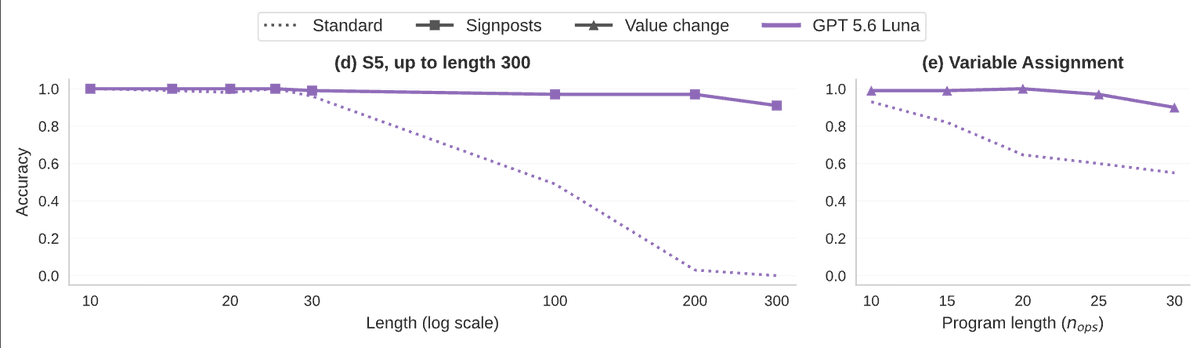
Transformer generalization theory provides simple formatting tricks for boosting small models on state tracking (here: GPT-5.6 Luna).
Come meet the authors at COLM: Grand Ballroom Poster Location: #132 on Tuesday, 4:30 PM PDT in Poster Session 2.
Better pivot tokens selection remains an open challenge. We test metrics such as entropy, but stronger criteria could bring further gains. Our results point to predetermined forking as a promising direction for efficient inference-time scaling.
Paper: https://t.co/AFNNGj7QV7
I won't be in #COLM due to a visa issue 🥲 but if you're there, go talk to @JiUngLee1 on Thursday during poster session 4 about our work: Fork-Think with Confidence: we rethink parallel sampling for efficiently scaling inference-time compute 🧵
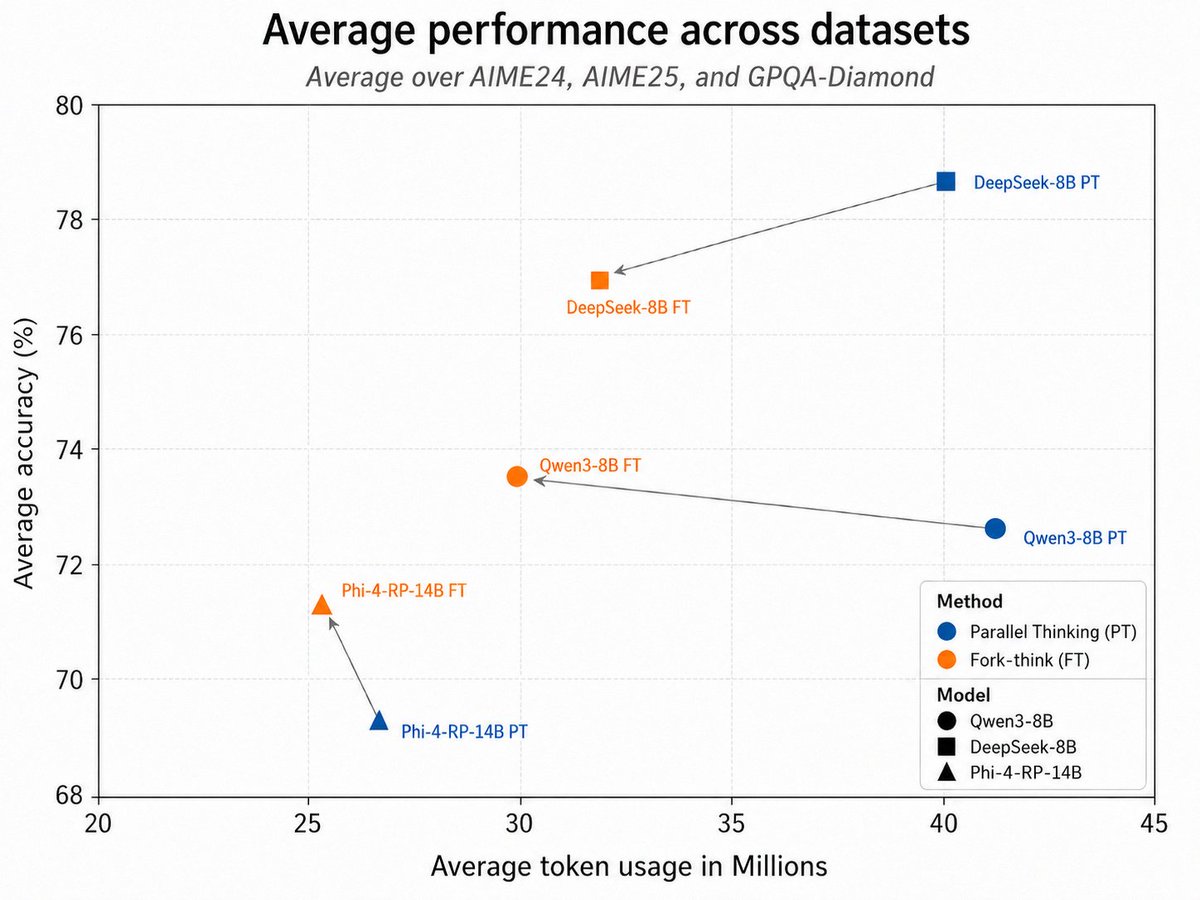
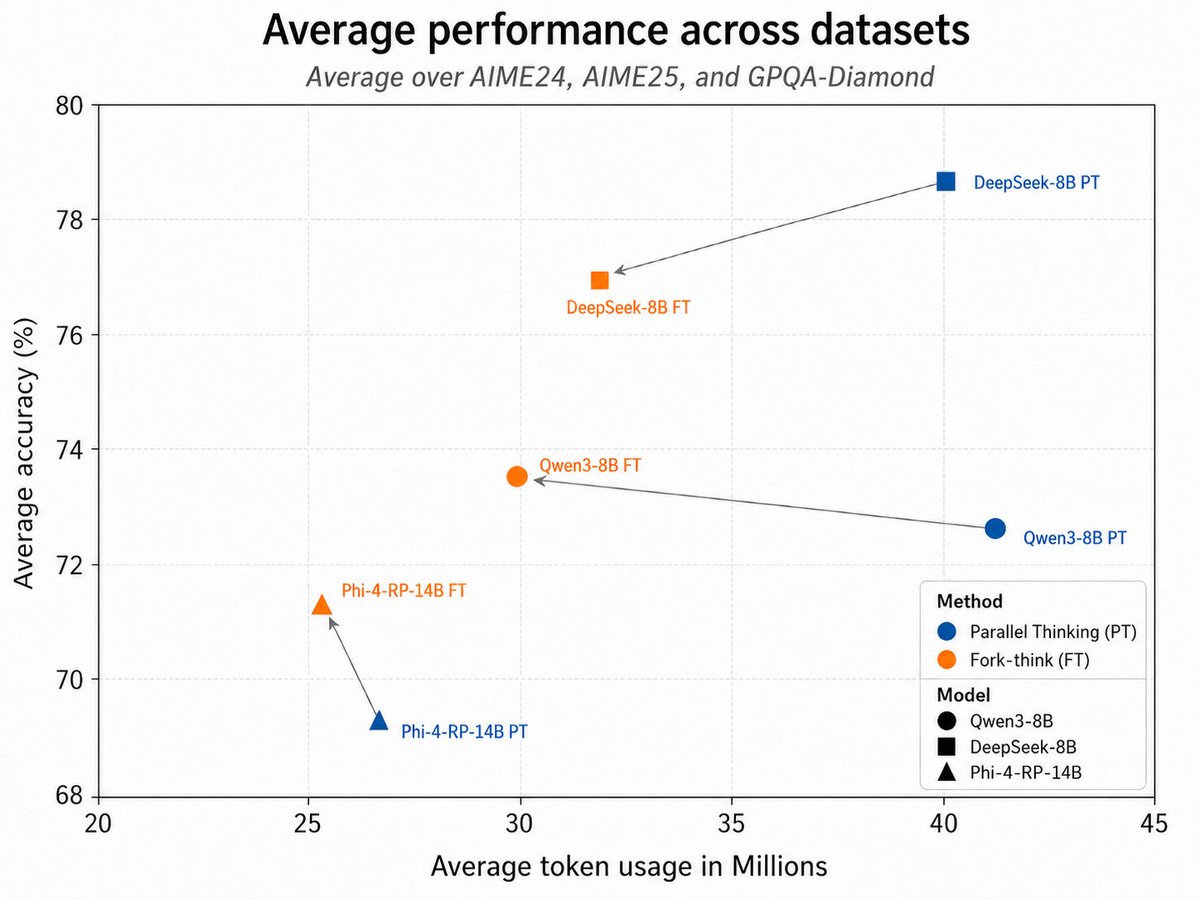
Across 3 LLM families and 3 reasoning benchmarks, we show that delaying parallel sampling can reduce token usage by up to 30%, while maintaining—and sometimes outperforming—the accuracy of parallel sampling. Additionally, Fork-think reduces inference runtime by up to 57%.
Better fork token selection remains an open challenge. We test metrics such as entropy, but stronger criteria could bring further gains. Our results point to predetermined forking as a promising direction for efficient inference-time scaling.
Paper: https://t.co/AFNNGj7QV7
Across 3 LLM families and 3 reasoning benchmarks, we show that delaying parallel sampling can reduce token usage by up to 30%, while maintaining—and sometimes outperforming—the accuracy of parallel sampling. Additionally, Fork-think reduces inference runtime by up to 57%.
Excited about this solution to a long-standing puzzle in Transformer theory. Via algebra+category theory, we achieve a highly predictive and detailed account of transformers’ state-tracking abilities.
been meaning to put together a reading path into latent reasoning for a while, here's the order I'd actually read these in
1/ Coconut, Hao et al, the paper that made continuous-space reasoning concrete
https://t.co/XABS3AYUtw
2/ Reasoning by Superposition, Zhu et al, the theory behind why it can beat token CoT
https://t.co/6o5utqsUdT
3/ A Formal Comparison Between CoT and Latent Thought, Xu and Sato, what each one can and can't compute
https://t.co/8EpsGxgaPm
4/ Thinking Without Words, Ramji et al, closes most of the performance gap with verbalized CoT
https://t.co/AtsBLx4LPp
5/ Beyond Tokens survey, maps out the whole space
https://t.co/A2qH2ayMHk
most underrated one on this list is Xu and Sato - methods papers are more popular that theory ones, and it's the only one that actually tells you when not to use latent reasoning. tasks that need approximate counting or sampling favor stochastic token decoding over the parallel latent version (knowing where a method breaks worths more than knowing three more methods that work)
Better pivot tokens selection remains an open challenge. We test metrics such as entropy, but stronger criteria could bring further gains.
Our results point to predetermined forking as a promising direction for efficient inference-time scaling.
Paper: https://t.co/AFNNGj7j5z
Across 3 LLM families and 3 reasoning benchmarks, we show that delaying parallel sampling can reduce token usage by up to 30%, while maintaining—and sometimes outperforming—the accuracy of parallel sampling. Additionally, Fork-Think reduces inference runtime by up to 57%.