If you f*******cked up your finances in the past and now in your 30s or 40s you are wondering if it is TOO LATE to get your money back on track (it’s not)…
I hope you find my twitter account.
My uncle was very right. All the "big people" in Nigeria know themselves, and they are friends even when they have different interests to protect. They all sit at the same table to make decisions that affect the rest of us most of the time. It is poor, foolish people who fight.
Treasure Okegbola developed a machine learning model that detects malaria from blood samples.
We ran a live test today, and it was amazing.
She will be training it on other diseases so that people can run quality and free tests in their homes. It can then detect even diseases people may not be aware of.
She says this will be her way of supporting poor families who can’t afford quality healthcare or are afraid to do tests because of cost.
I have always known that Treasure will make a great impact in the world.
What a start!
Just saw an Instagram reel that said:
“At some point you become the age that your parents were in your childhood memories, only you don’t feel like an adult, and you realize your parents were still just kids trying to figure it out too”
And that shit just fucked me up.
Kano’s decline is one of the most instructive deindustrialisation stories.
The dye pits at Kofar Mata were established in 1498 and were still being used by families in the traditional textile trade into recent times.
By 1980 Kano alone had 40 textile factories (my grand father owned one too). Nationally the industry employed over 350,000 workers directly and was the single largest employer of labour in Nigeria after the federal government. Between 1970 and 1987 demand for Nigerian textile products exceeded supply by 91%. That is a sector with more demand than it could physically meet.
The Structural Adjustment Programme came in the mid-1980s under external pressure, raised production costs, destroyed purchasing power, and removed policy protection. By 1995 employment had fallen to 100,000. Then cheap Chinese textiles moved through the Sahara in volume and there was no serious policy response because the federal government had already established a pattern of treating manufacturing as optional. By 2003 Kano’s 40 factories had become fewer than 10. The total human cost when indirect employment is counted exceeds 2m livelihoods. It is also funny how that number has never featured prominently in any federal policy document as a failure requiring accountability.
The leather industry never made the transition from raw material supplier to finished goods manufacturer at scale. The hides were processed and exported as wet blue skin and semi-finished leather rather than being converted domestically into bags, shoes, and luxury accessories. The value capture remained at the bottom of the chain. Italy, France, and Germany built luxury goods industries partly on Nigerian raw material and sold the finished products back to Nigerian consumers at prices that reflected the value Nigeria never captured. This did not require external sabotage. It required only the absence of an industrial policy that deliberately pushed investment toward vertical integration. That absence was consistent across every administration that governed through the relevant decades.
While I largely agree with the points raised, I still believe using the word "scam" to describe the model promoted by these influencers is completely justified.
They flaunt unearned luxury, designer fashion, and sports cars online to sell false hope to the general public. They convince complete beginners that generational wealth is within reach if they simply buy their trading courses, join their VIP Telegram channels, fund a trading account, and follow their signals.
It does not stop at mere promises. They go as far as fabricating MetaTrader screenshots, manipulating backend developer tools on trading dashboards to record fake profit videos, renting exotic cars and luxury apartments for content, and staging lifestyle skits. All of this is engineered to deceive their audience into believing that retail forex is an easy, mastered craft. Even the absurd claim of withdrawing $9 million is part of this calculated performance, designed to project absolute financial authority and make it seem as though they simply print dollars from 5-star hotel rooms.
The entire objective is to funnel unsuspecting followers directly into their affiliated broker platforms. Followers deposit their hard-earned savings into these brokerages, where the influencers and the brokers know the money will inevitably be lost. Victims often end up depleting their savings or borrowing funds because, despite their mounting losses, they continue to see the guru flaunting exotic vacations to Dubai and high-end lifestyle content. This keeps victims trapped in the delusion that blowing account after account is simply the "sacrifice" required to attain the lavish lifestyle being displayed.
This is why every forex guru is forced to constantly stage wealth and manufacture unsubstantiated withdrawal claims: they must serve as a living symbol of hope that the system works. When victims finally go broke and quit, the blame is shifted onto them for not "working hard enough" or lacking discipline, mirroring the exact psychological manipulation seen in classic pig-butchering and affinity investment scams.
In essence, the system they market is a scam. For it to be considered legitimate, they would have to:
1. Stop fabricating screenshots, edited platform balances, and fake withdrawal videos.
2. Explicitly disclose their Introducing Broker contracts and admit that they profit directly when their followers lose money.
3. Publish verified, third-party audited track records rather than unbacked mobile screen recordings.
4. Clearly warn their audience that over 90% of retail traders lose their entire deposit on high-leverage CFD platforms.
If they provided these full disclosures and people still willingly chose to deposit their money, it would simply be high-risk speculation. But as long as it relies on manufactured evidence, hidden revenue models, and deliberate deception, labeling it a scam is entirely accurate.
We have now institutionalized ISEE, and it is now a formally registered non-governmental organization.
ISEE was rejected several times by the Corporate Affairs Commission until we amended the name to INITIATIVE FOR SCHOOL EXCELLENCE AND EDUCATION FOUNDATION.
Our chairman is Prof. Bath Nnaji, and I will continue to lead the vision.
Our members are Nathan Nwachuku, Eke Urum, and Tony Udeani.
The goal is for the vision to outlive our generation and lead us to civilization.
This is the beginning of greatness for Africa.
During my second year in college, a close friend introduced me to the Forex market.
I was instantly fascinated by the seductive idea of sitting in the comfort of my small hostel room, pressing a few buttons on my smartphone, and effortlessly making clean, hard currency. Even though the concept sounded childish and too good to be true, there was no immediate reason for me to doubt it. A simple search on social media platforms revealed thousands of flashy accounts belonging to self-proclaimed trading gurus who swore that day-trading was the ultimate shortcut to financial freedom. Usually, these influencers recorded their promotional videos from rented luxury mansions, staged private jets, rented sports cars, and expensive studio setups specifically designed to flex wealth.
So, the problem for me then was not whether there was money flowing through the market; the real, scientific question was how to actually trade the market with a verified edge. My friend eagerly suggested that we pool our money together to buy an expensive online trading course from a particular guru, but that idea immediately rubbed me the wrong way.
If someone actually possessed a secret, money-printing algorithm that consistently beat the global markets, why on earth would they be desperately selling $200 courses to poor college students? The absurd narrative that a random guru abandoned his quiet life, his family, and his private investments just out of pure charity to teach me how to get rich was beyond silly.
YouTube tutorials were the next option on the table, but I quickly dismissed them as well. Historically, I have never learned anything concrete from YouTube videos. In fact, despite producing educational content myself, I can never truly comprehend how people learn complex subjects from watching videos. Whenever I sit down to watch a long instructional video, my brain completely checks out, and I end up falling fast asleep. I even tried watching a couple of highly recommended video series on technical analysis, but I ended up sleeping straight through the night with the video playing to an empty room.
I do not know if this is simply how my brain was structurally wired, since we never really had a television in the house growing up, and up until I was fifteen years old, I was never exposed to digital screens or social media at any serious level. Books have always been my primary companions. Furthermore, I find educational videos to be inherently shallow and completely lacking in intellectual depth. I learned complex LaTeX typesetting not from watching quick YouTube tutorials, but by quietly sitting down and reading the comprehensive official documentation line by line.
To this end, I downloaded heavy textbooks on technical analysis, and even spent my limited cash to physically print out all three massive volumes of Al Brooks' legendary price action trading books. I thoroughly read the first two volumes and meticulously skimmed through the third. Every single serious author in those classic texts explicitly emphasized that an investor must possess a deep, rigorous understanding of financial risk before ever placing a live trade. So, my next logical step was diving headfirst into quantitative finance, risk-management models, macroeconomics, portfolio theory, and statistical probability.
But after spending hundreds of hours deeply studying the mechanics of the market, a cold, unassailable truth finally dawned on me: as an isolated retail trader, I could not consistently make money trading.
Yes, this conclusion sounds completely counterintuitive to the average person, but that is precisely what the raw mathematics proved. After months of intense, grueling study, accumulating deep knowledge on candlestick patterns, price action, risk hedging, slippage, order-block dynamics, leverage ratios, and liquidity sweeps, I arrived at the firm mathematical conclusion that a retail trader cannot reliably beat the market.
First of all, according to the Random Walk Hypothesis, you cannot extract consistent, long-term profits from a mathematically random, highly chaotic market. In any random distribution, there will naturally be streaks where you get a series of winning trades, followed inevitably by devastating streaks of losing trades. Once you factor in broker commissions, wide spreads, overnight swap rates, execution delays, and unexpected slippage, your expected statistical value becomes negative, meaning you are guaranteed to bleed money over time. The only way to systematically extract wealth from such a market is the way institutional giants like Goldman Sachs, Renaissance Technologies, and Citadel do: by hiring armies of PhD holders in mathematics, physics, and computer science, modeling market microstructures with complex differential equations, building high-frequency trading algorithms that execute orders on a nanosecond basis, colocating their fiber-optic servers directly next to the exchange servers, and using their massive order flows to front-run retail traders. And on top of all that technical dominance, they do not merely sit back and watch charts; they spend hundreds of millions of dollars lobbying high-profile politicians, securing insider policy secrets, and getting regulatory favors.
That is not to say an individual trader can never find an edge. The market may be largely random, but there are still statistical anomalies and structural patterns to exploit, provided you trade on higher timeframes like the 4-hour or 1-day charts. Unfortunately, most naive beginners immediately jump onto the 1-minute or 5-minute graphs, which almost always ends in tears and blown accounts. The candlestick patterns and technical indicator signals on those micro-timeframes are essentially pure market noise compared to the dominant daily trend.
A beginner sits there thinking the market is overbought on a 5-minute chart, completely unaware that the asset is merely taking a breath on the 1-day chart before launching into a massive upward spike. This exact optical illusion is why beginners end up panic-selling right when a major boom is starting, and buying frantically right when the market reaches its absolute peak. The only players who possess the computational infrastructure, low-latency execution, and capital depth to trade those micro-timeframes are institutional high-frequency firms.
As an individual trader, you must operate on macro-timeframes and exercise immense patience. But back then, I was a broke university student. I knew my own material poverty and subconscious greed would never grant me that level of cold patience. I simply could not afford to lock up $200 of capital in a broker's account for months when I desperately needed that money to buy food, pay rent, and purchase mobile data. If I tried to force the issue by going full beast mode with high leverage on lower timeframes, I would be ruthlessly liquidated. So, I made the logical, disciplined decision to quit entirely, focus my energy on real-world skills, build capital first, and hope to return to the markets in the future as an institutional-level investor.
Naturally, my friend did not follow this path. He went ahead and bought the expensive online trading courses, which predictably turned out to be a complete scam. One day, he came into my room, saw a stack of about ten heavy trading books I had printed out, and tried to passionately convince me to start trading with him. I calmly looked at him and explained that after hundreds of hours of rigorous study, the mathematics proved that a retail trader in our position could not win, so I had quit.
He took two of my thickest Al Brooks books, but I knew with absolute certainty that he was never going to read a single chapter. Those dense textbooks were completely different from the flashy video courses online: the authors focused on cold, objective probability and statistical market analysis, which held zero appeal for my friend. He wanted quick dopamine and instant cash, not a dialectical analysis of market auction theory. After graduation, he even packed his bags and moved to Lagos to attend a specialized Forex academy. He completely ignored my warnings, and today, even after three full years in Lagos, he has not made a single kobo of sustainable profit from the market. I am not the least bit surprised, because my initial research had been thorough and mathematically rigorous.
My lifelong obsession with deep theory, mathematical rigor, and systems analysis has definitely denied me plenty of cheap fun in life. But that exact same analytical mindset has repeatedly shielded me from making catastrophic, ruinous, and financially devastating life choices, including the addictive trap of sports betting, which is a story for another day.
Thank you for reading!
How about we decongest Lagos by siting companies in other states other than Lagos.
Lady explains why Lagos state is more developed than other states in Nigeria.
We have been invited to Singapore for 2027. We will challenge their best students in Maths.
The winners of the 2027 South East Maths Olympiad will challenge the best in Singapore in 2027. 56 other countries will join too.
I like how the world is now taking an interest in our children.
I am benchmarking our education against that of Singapore, Finland, Shanghai, China, Canada, and the US.
This is how we can move from being a third-world country to a first-world country.
The future is looking exciting.
On 10 July 2026, I was called to the Bar and announced as the Overall Best Student in the 2025 Nigerian Bar Final Examinations. It was humbling to receive 12 academic prizes donated by some of the finest minds the Nigerian legal profession has produced.
Pls repost this post till E get to someone that know her or her family members
the girl had an accident not long ago 👇
Let them contact wofun hospital !!!!
The wait is over.
We have 2 golds: Chimdiebube Onwubiko and Don Anele Munachimso.
We are the best in the world!
Egejurum Onyedikachi’s name was omitted. He should have a gold.
Help Make My Scholarship Dream Come True 🙏
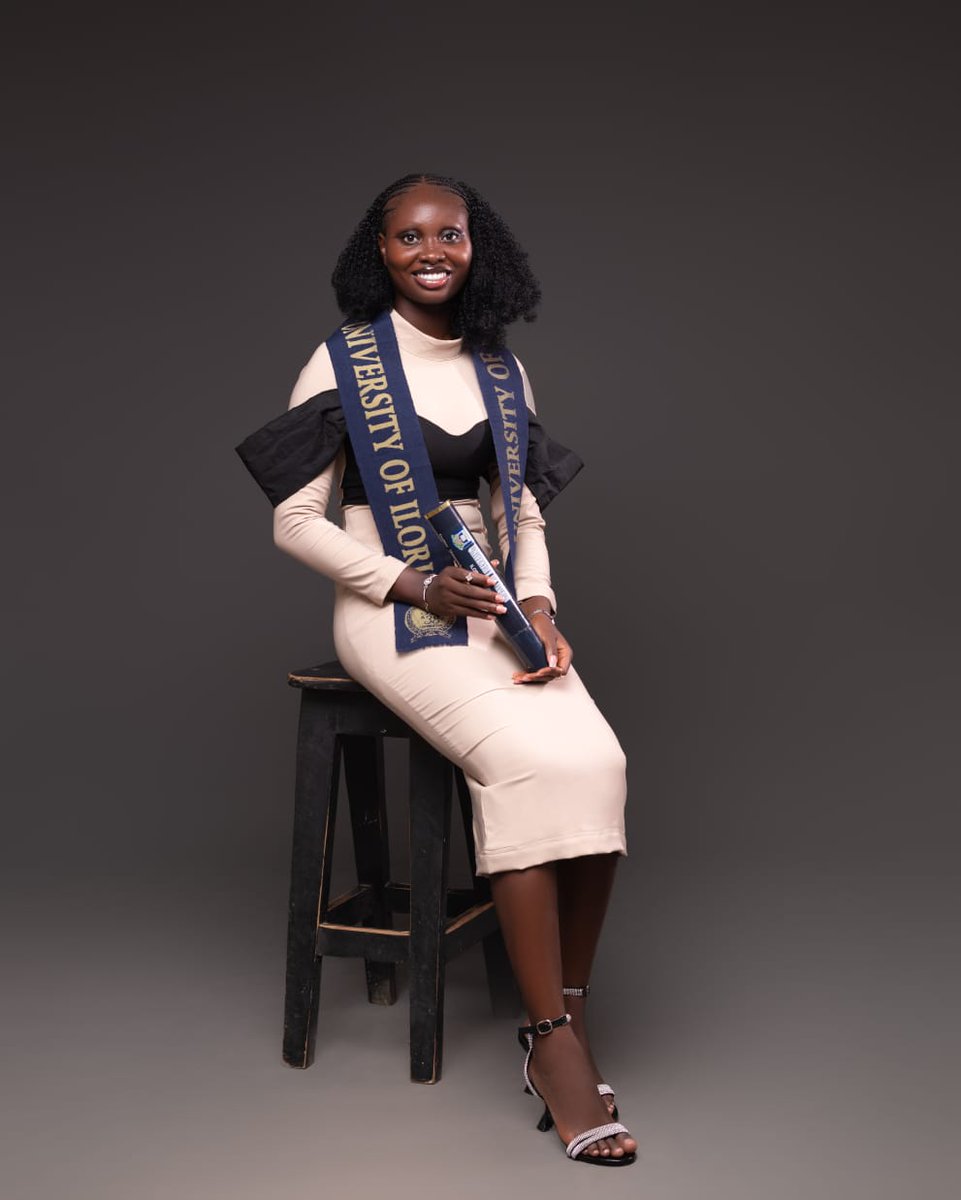
I'm Adisa Blessing Oluwafikayo, a First-Class Mathematics graduate (CGPA: 4.76/5.0) from UNILORIN.
I'm happy to have been awarded a fully funded Master's scholarship in Mathematics at the University of Calabria, Italy.
“Nigerian Soldiers broke into our school premises, ass@ulted our students and b£at them up. They also grap£d and h@rrass£d some of our female students. They destr0yed property and st0le their phones and money. This is very sad and unacceptable.”
- Vice-Chancellor of Osun state university finally speaks out after ehat happened yesterday in their school