📢Now out! Our narrative review offering an in-depth conceptual defnition of vigilance and its decrement over time, explanatory theories, modulating factors (inlcuding potential mitigators such as tDCS!), and neural correlates: https://t.co/JxOwii5Eq9
@khmmrch presented HD-tACS + EEG work revealing unexpected alpha-theta modulations in temporal sampling & statistical learning, highlighting the challenges of dual-task demands #icon2025
Ahoy Psych and CogNeuro community! We have openings for PhD and Postdocs. Are you interested in the impact of semantic congruity in (visual) cognition? Find more about my new ERC project and the positions at: https://t.co/SoNbmVxr1W. Spread the word!
Very happy to see our work on cognitive-load dependent effects of tDCS with @jlupiane and @Elsmarar published in @SciReports 🎉We observed that HD-tDCS exclusively mitigated the vigilance decrement under high congitive demands. More below 🧵
For the development of future research and applications in work settings or clinical populations we should: (i) carefully choose adequate tasks for online tDCS, and (ii) consider the viability of tDCS (or lack thereof) when cognitive load cannot be adjusted ☝️
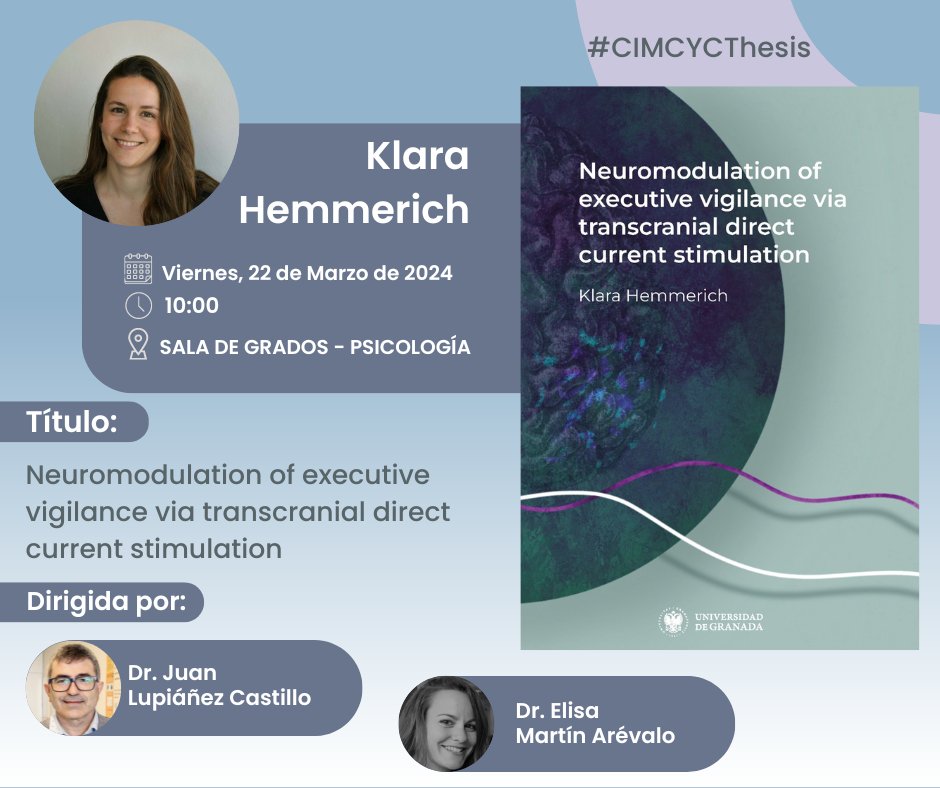
¡Esta semana hay defensa de tesis!
Deseamos mucho éxito a @khmmrch que nos presenta su trabajo sobre la neuromodulación de la vigilancia ejecutiva mediante estimulación transcraneal por corriente directa.
#CIMCYCThesis
This week there is a thesis defense!
We wish much success to @khmmrch who presents her work on neuromodulation of executive vigilance via transcranial direct current stimulation.
#CIMCYCThesis
¿Alguna vez te has encontrado al volante incapaz de mantener la atención conforme avanza el viaje?
Esto es el decremento en vigilancia: nos cuesta mantener la atención durante un tiempo prolongado.
En este estudio, @khmmrch y col. investigan como mantener nuestra atención.