The reason the South African economy is struggling isn’t just because things are expensive and people are broke. That’s the surface-level explanation. The deeper issue is that money isn’t moving; it’s accumulating in the wrong places.
It’s not that there’s no money. There’s plenty. The problem is that it’s mostly in the hands of people who, for all their wealth, can still only eat so much food at a time. They buy one house, maybe three, but at some point, there’s a limit to how many washing machines you can use.
If 1000 people each have R1000, you get 1000 transactions, 1000 grocery runs, 1000 school shoe purchases. But if one guy has R1 million, that’s still just one guy spending. He might buy a luxury watch or fly to Dubai, but that money exits the local economy and doesn’t come back. It’s one big transaction, then silence.
This is what happens when money gets concentrated at the top: the economy becomes unequal and sluggish. This is because a healthy economy needs circulation, movement, and a bit of chaos in the tills. You need millions of people buying bread and data bundles. You don’t grow an economy by locking money in a vault and calling it investment.
It’s not good enough to have just a few people rebalancing their portfolios, which is what South Africa suffers from.
And here’s where it gets darkly funny: we keep hearing that “the JSE is up”, as though that’s a national achievement. But over 90% of JSE shares are held by a few institutions and ultra-wealthy investors. So when the market goes up, it’s not like your neighbour opens a new hair salon. It’s just some bespoke suit in Sandton adjusting a spreadsheet and patting himself on the back.
Billionaires and asset managers might grow their portfolios, but it doesn’t mean more economic activity on the ground. It just means more value locked away in financial assets, doing nothing for the township, the informal sector, or even small formal businesses. You know, where most of the population is.
The real economy, the village with craters for potholes, shisanyamas, backyard salons, and spaza shops, doesn’t see any of that market euphoria. Because financial asset gains are not economic activity. They’re a scoreboard for people who have already won the game.
Now, look at what happens when ordinary South Africans get a little extra cash, like a bonus, a two-pot payout, or a SARS refund. The first thing they ask is: “What am I going to do with it?” And the answer is always: spend it. Because they have things to fix. School fees. Groceries. Debt. Real needs. Their money doesn’t sit in Jersey island trusts; it goes straight into circulation.
Meanwhile, the rich stack their returns into offshore funds, buy more ETFs, or diversify into unproductive property portfolios. In other words, they remove money from the bloodstream of the economy and frame it as fiscal responsibility. They call it “delayed gratification”, but it’s actually just permanent extraction.
The same rich people are always lecturing us about wasting money on takeaways and sneakers, but they neglect to mention that this spending is the economy. That’s the bulk of real GDP. It’s everyday people buying everyday things that keep businesses alive and jobs intact. They call it wasteful, but it’s actually economic oxygen.
If the people stop spending, the whole thing collapses.
The irony is hard to miss: those who hoard the most wealth contribute the least to the lifeblood of the economy: circulation. Meanwhile, the so-called frivolous spending is actually what keeps the economic engine running.
There are many other ways to organise an economy, around production, cooperation, and public provisioning, but the powerful social engineers chose consumption. They designed a system where the economy’s health is measured by how much we buy, not how much we build, share, or need.
Then they opted out of it.
The very people who set the rules for this consumer economy, corporate executives, high-net-worth investors, and policy influencers, do not meaningfully participate in it. They moralise consumption for ordinary people while abstaining from it themselves, storing wealth offshore, accumulating assets that produce nothing, and treating spending like a vice.
In other words, they built a game around spending, then sat in the VIP lounge watching everyone else scramble for coins. And when it stagnates, they blame the players, not the designers.
There’s nothing more painful than getting a report from SIU that dead people are receiving allowances from NSFAS every month, yet there are students sleeping outside because of lack of funding 💔
Then you have ANC MPs howling at the EFF in Parliament for raising these issues.
Make military 🪖 service Compulsory
It is mandatory for every South African youth who reaches the age of 18 to immediately undergo 15 months of compulsory military service.
If you agree repost
Julius Malema 5 years ago when he welcomed and warned Cyril Ramaphosa about the Stellenbosch mafias, Oppenheimers and Ruperts. But Cyril Ramaphosa chose not to listen.
Dear PG students,
Gaps in research simply refer to "what has not been covered" in previous studies. It takes an eagle eye to see it. Gaps in research can be broadly categorized into the following.
1. Methodology gaps (This relates to previously used methods)
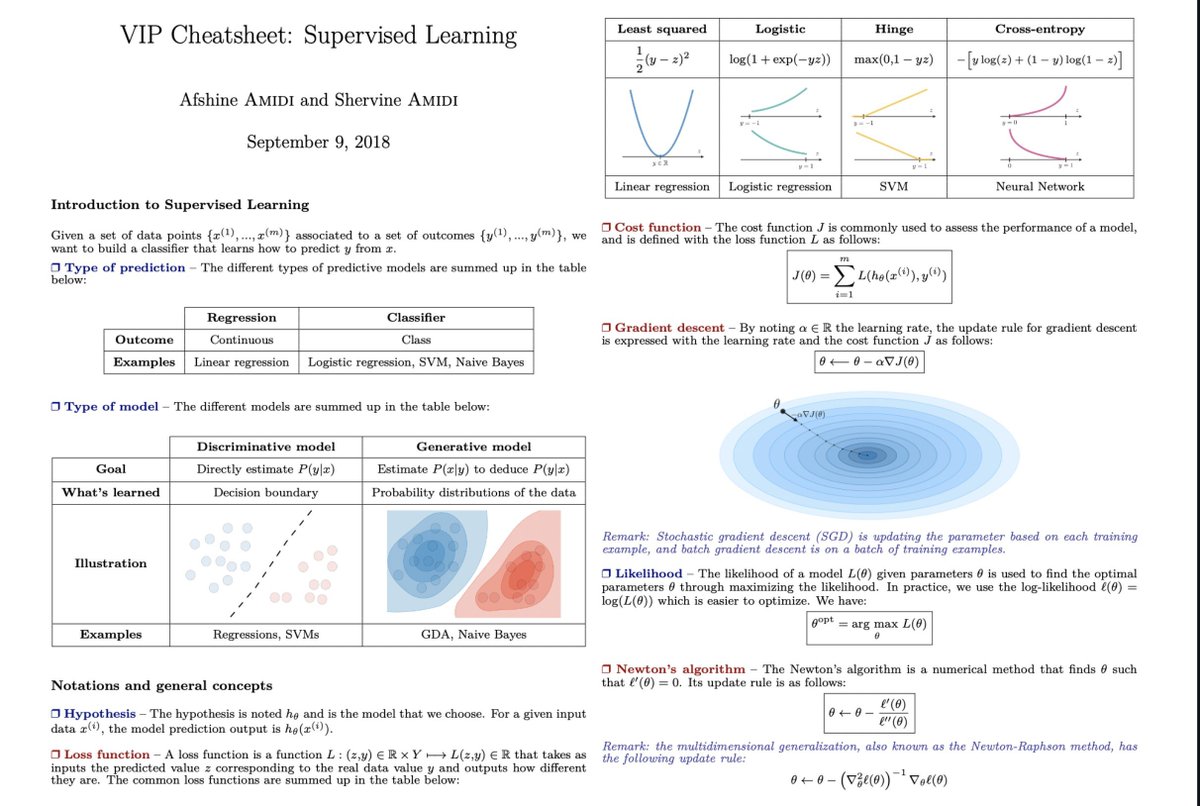
Stanford University has released these cheatsheets on Machine Learning, Deep Learning, Statistics, and Linear Algebra.
Use this as your reference next time working with them:
Thread🧵👇
Advice for ML beginners 💡
→ Your ML model, no matter how accurate it is, has a business value of $0.00, as long as it stays confined in the realms of Jupyter.
So this is what you need to learn next... ↓