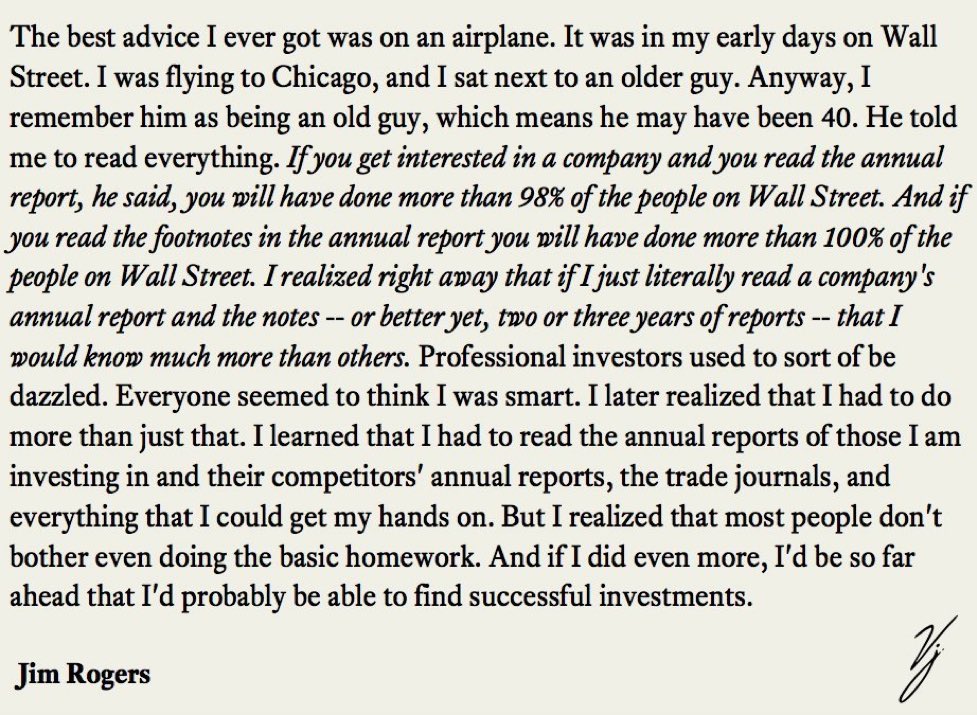
Jim Rogers said the best advice he ever received on Wall Street was to read and think critically about what you consume
Ironically, this advice is now more relevant than ever
Cannot tell you how many hedge funds and institutional analysts are simply asking a chatbot to summarize the 10K/Qs for them
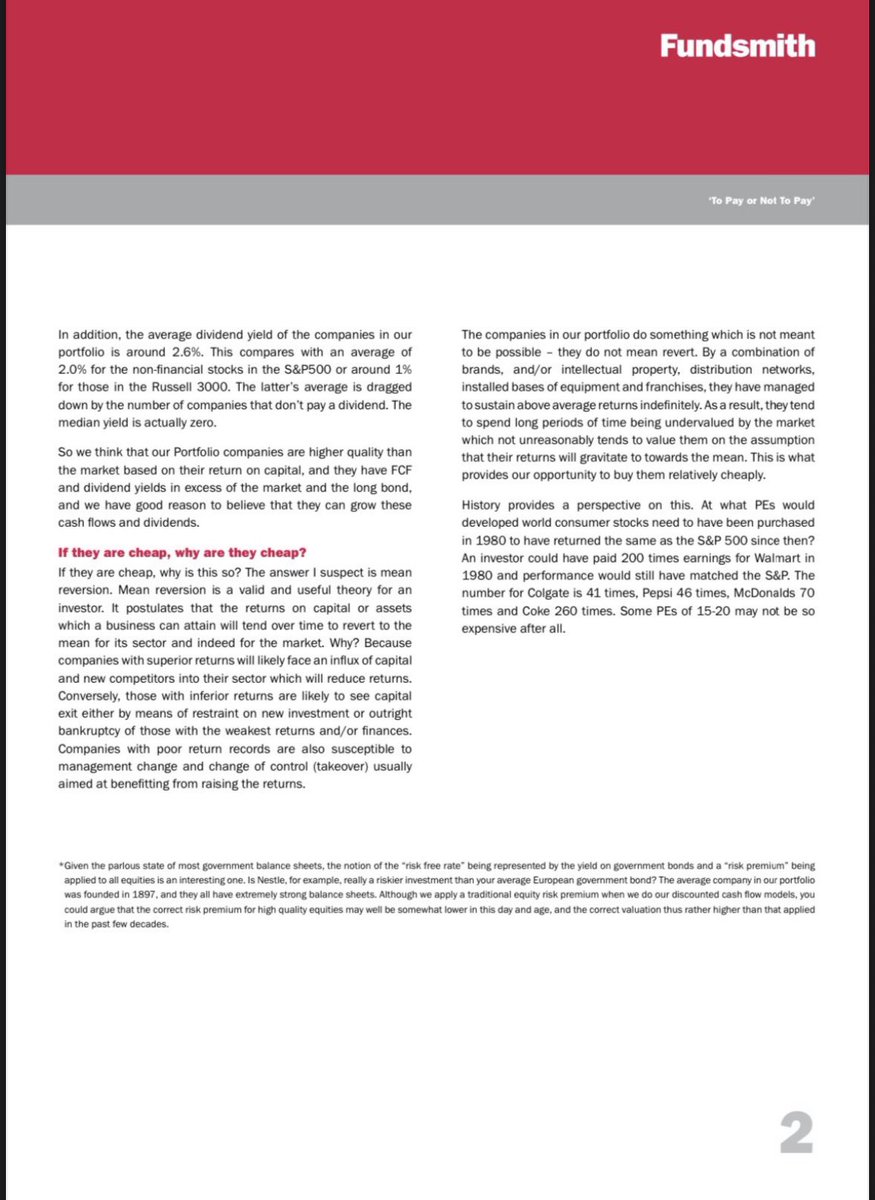
If you are one of the few people going to the source materials, you will pick up things that the rest of the market will miss. There is your alpha
China's full memory chip supply chain:
CXMT & YMTC are the main players here, but it supports a huge list of Fab equipment, cleaning producers + Semi material & chemicals + local components
As well as HBM related chain, OSAT, controllers, OEMs, modules, desingers & distribution
Memory chip is the main bottleneck of AI industry now. Everything will be expected to run larger & larger models in the future, so this supply chain will be expected to continue to grow really quickly.
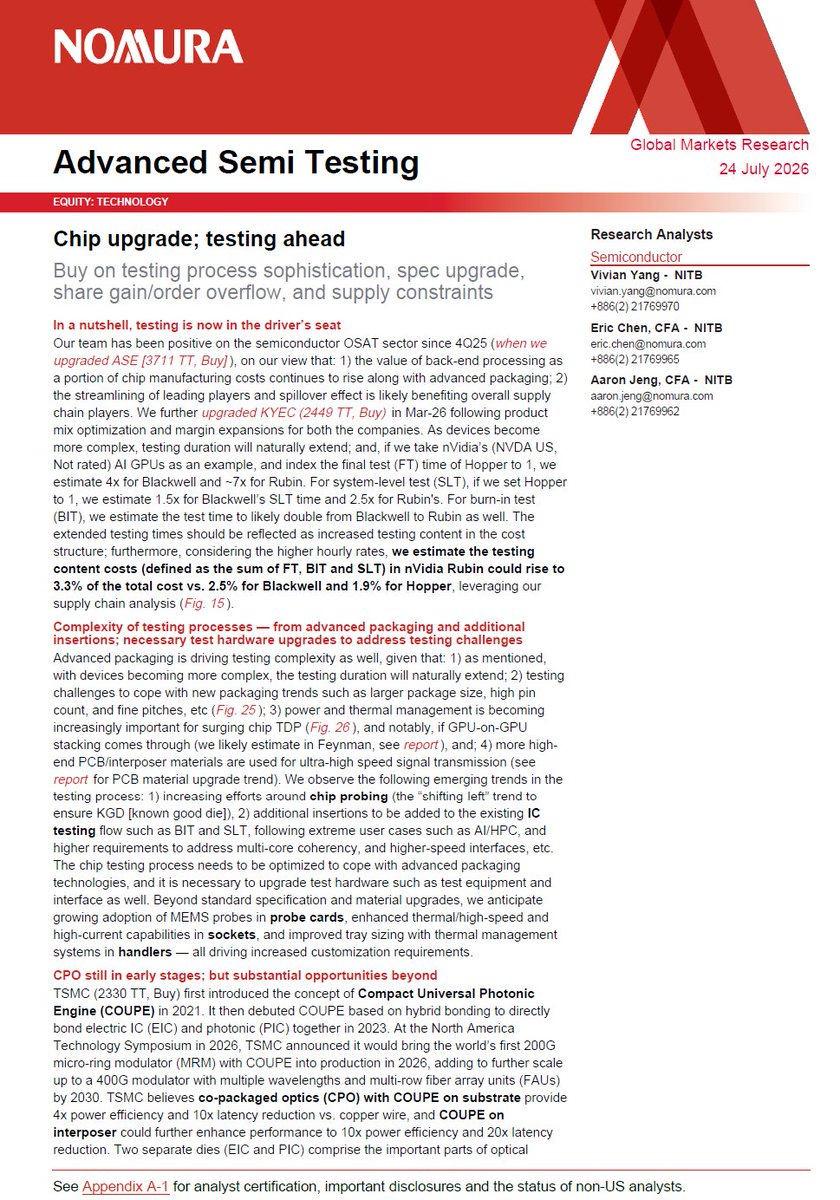
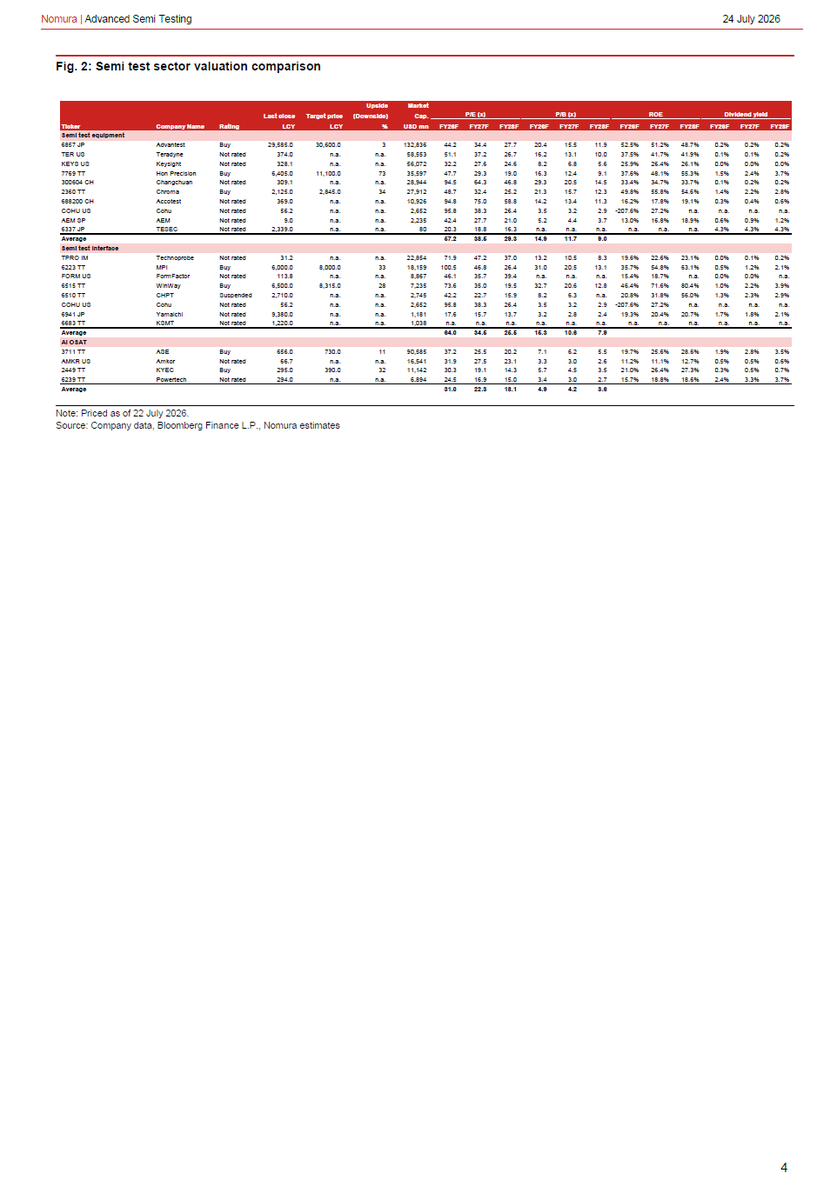
Nomura's report reinforces what we believe is one of the most underappreciated structural shifts taking place across the semiconductor industry today, namely that testing is no longer a low-value manufacturing step performed at the end of production, but is rapidly evolving into one of the most critical value-added processes within the entire AI hardware supply chain, because as chips become exponentially more complex through chiplets, stacked HBM, advanced packaging, silicon photonics and eventually co-packaged optics (CPO), the economic cost of failure rises disproportionately, making every additional dollar spent on testing significantly more valuable than it was during previous semiconductor cycles.
The market has understandably spent the past two years focusing almost exclusively on GPU designers, HBM suppliers and advanced packaging companies, yet what this report demonstrates is that testing is quietly becoming the next bottleneck, because increasingly sophisticated AI accelerators cannot simply be manufactured, they must be validated repeatedly throughout the production process to ensure every component performs flawlessly before being assembled into AI systems that may ultimately be worth several million dollars each, effectively transforming testing from a manufacturing support function into an essential yield protection mechanism.
Historically, testing was largely viewed as a necessary manufacturing expense whose primary objective was to filter out defective chips before shipment, but AI has fundamentally altered that equation because testing today is increasingly about protecting economic value rather than merely measuring quality, and when a single package contains multiple GPU chiplets, twelve stacks of HBM, advanced substrates, hybrid bonding interfaces, silicon photonic engines and increasingly expensive packaging materials, discovering a defect late in the production process can destroy vastly more value than in previous semiconductor generations.
That is precisely why Nomura estimates testing content continues to increase materially with every GPU generation, using Hopper as the baseline, where final testing time increases approximately fourfold for Blackwell and roughly sevenfold for Rubin, while system-level testing rises approximately 1.5 times for Blackwell and 2.5 times for Rubin, with burn-in testing roughly doubling, resulting in testing content increasing from approximately 1.9% of total GPU cost for Hopper to 2.5% for Blackwell and approximately 3.3% for Rubin, a progression that may appear modest when expressed as percentages but becomes extraordinarily meaningful when applied to AI systems whose selling prices continue rising dramatically.
Perhaps the most important observation in the report is not simply that testing content is increasing, but that testing itself is migrating earlier throughout the manufacturing process, effectively shifting from a single inspection performed after fabrication into a continuous validation framework that begins at wafer probing, continues through known-good-die verification, hybrid bonding validation, package testing, burn-in qualification and ultimately system-level testing before deployment inside hyperscale AI clusters, meaning the industry is increasingly adopting multiple quality gates rather than relying on one final inspection at the end of production.
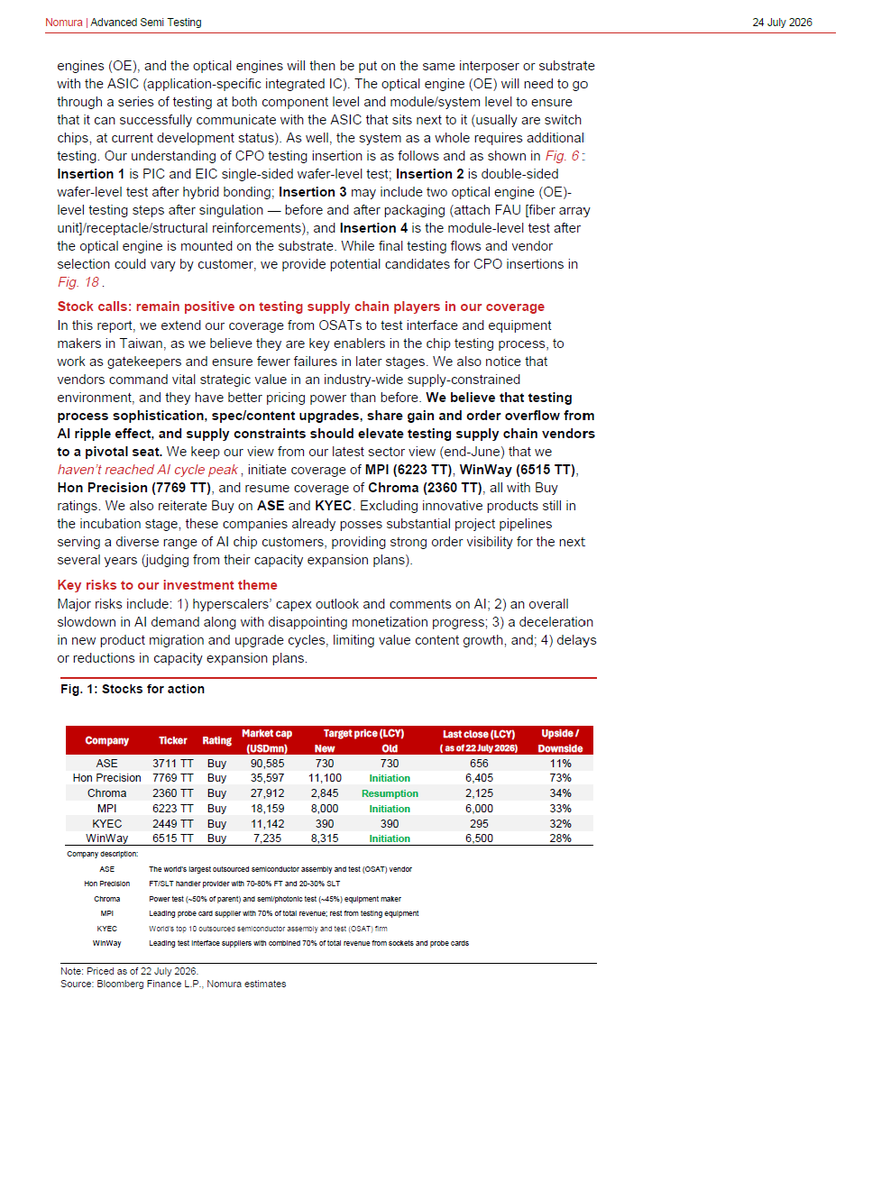
This shift has enormous implications for the supply chain because every additional testing insertion creates incremental demand for specialized equipment, probe cards, sockets, handlers, MEMS probes, thermal management systems and high-speed interfaces, thereby expanding the opportunity set well beyond traditional outsourced semiconductor assembly and test companies, which explains why Nomura has broadened its coverage to include interface suppliers and test hardware manufacturers rather than limiting its investment thesis solely to OSAT providers.
Another theme that deserves significantly more attention is the interaction between advanced packaging and testing, because while investors have understandably focused on CoWoS capacity as one of the industry's largest bottlenecks, packaging capacity alone cannot solve the industry's challenges if testing capacity fails to expand at a similar pace, since every additional layer of complexity introduced through chiplets, hybrid bonding, HBM stacking, heterogeneous integration and silicon photonics simultaneously increases the probability that expensive failures will occur after substantial value has already been added to the product, making testing increasingly indispensable as AI hardware becomes more sophisticated.
The discussion surrounding co-packaged optics is equally compelling because most investors naturally associate CPO with optical component suppliers, whereas Nomura correctly argues that the real opportunity extends much further into the testing ecosystem, given that every optical engine must communicate flawlessly with adjacent ASICs under extremely demanding thermal, electrical and optical conditions while maintaining signal integrity across increasingly complex architectures, thereby introducing entirely new categories of testing that simply did not exist in previous semiconductor generations and creating an additional secular growth driver for testing vendors.
We also agree with Nomura's conclusion that the AI infrastructure cycle remains considerably earlier than many investors assume, because every successive GPU generation is becoming disproportionately more difficult to validate than its predecessor, allowing testing content to grow materially faster than semiconductor unit volumes themselves, which means the industry's next major beneficiaries may not necessarily be the companies designing the chips, but increasingly the companies ensuring those chips actually function reliably inside increasingly expensive AI systems.
Our preferred way to position for this theme is to own the entire testing value chain rather than focusing solely on OSATs, because different parts of the ecosystem benefit from different stages of the testing process. ASE (3711 TT) remains our highest-conviction OSAT exposure given its scale, broad customer base and dominant position across advanced packaging and testing. Hon Precision (7769 TT) stands out as one of the most attractive pure-play beneficiaries of final testing and system-level testing, areas where AI complexity is expanding the fastest. WinWay (6515 TT) offers differentiated exposure through sockets and probe cards, which should experience rising content per AI accelerator as electrical and thermal requirements become increasingly demanding. MPI (6223 TT) is well positioned through wafer probing, benefiting directly from the industry's shift toward earlier testing insertions and known-good-die validation. KYEC (2449 TT) remains an attractive second OSAT exposure with meaningful leverage to AI testing demand, while Chroma (2360 TT) provides exposure to automated testing equipment, allowing investors to participate in the hardware upgrade cycle required to support increasingly sophisticated AI devices.
Ultimately, we believe semiconductor testing has quietly transitioned from a manufacturing support function into one of the industry's most valuable strategic chokepoints, and just as HBM suppliers, advanced packaging companies and foundries have enjoyed structurally stronger pricing power because they occupy indispensable positions within the AI value chain, testing vendors increasingly appear poised to achieve similar economics as AI hardware becomes more heterogeneous, more thermally demanding, more optically integrated and substantially more expensive to manufacture, making testing one of the highest-conviction secular investment opportunities across the broader semiconductor ecosystem.
$NOW CEO Bill McDermott:
“ServiceNow will become a $1T company by 2030.”
The current market cap is $99B = he’s calling for a 10x.
He bought $3M worth of shares at $107.
$NVDA CEO Jensen Huang says ServiceNow can 100x.
President Trump bought $5M.
$AMZN , $MSFT , $GOOGL OpenAI & Anthropic are all expanding partnerships.
And vibecoding an alternative would cost 5-10x more than just using ServiceNow.
Is ServiceNow the strongest buy in the market?
There it is folks. Right on schedule.
$NOW beat the quarter revenue $3.99B vs $3.93B, EPS 90c vs 85c and then guided the full year to $15.76–15.78B against a street at $16.19B.
The top of the range is $400M below consensus.
The “best” executing company in enterprise software just told you that its best case for this year is $400M short of what analysts modeled.
This morning i told you exactly how this breaks.
The quarter was never going to miss ServiceNow doesn’t miss quarters, that’s the whole reputation.
The guide is where the truth lives however, because the guide is where management has to price what customers are telling them in renewal conversations right now.
And what are customers telling them?
Go read the Reddit threads…enterprise admins comparing renewal quotes with AI features bundled at up to 2x, features they never asked for.
Do you mean to tell me not every customer wants to pay double for AI they can’t turn off?
The guide just told you the answer. Forced AI bundles don’t show up as churn in the quarter.
They show up as hesitation in the pipeline…deals that rescope, renewals that shrink, CIOs who say “let’s revisit in six months” because their agent pilot might make the whole module unnecessary.
A $400M guide down at a company priced for perfection is not a macro comment. It’s the first measurable data point of the structural thesis…workflow orchestration revenue is a function of enterprise workflow complexity, agentic AI compresses that complexity permanently, and the compression shows up in guidance before it shows up in revenue.
What was Adobe 18 months ago is now $NOW idc how the stock reacts tonight the destiny is the same
In June, Matthew Smith wrote a letter to a small group of confidants about the U.S. natural gas market.
"This will sound like heresy. Energy, power, and AI heresy."
In it, he projects an unprecedented natural gas shortage beginning in late 2028.
By 2030, working gas storage could be exhausted entirely.
Gas is the marginal fuel for electricity in most of the country. When it becomes scarce, everyone pays. Hyperscalers, LNG buyers, and households alike.
The letter was never meant to be public.
We asked if we could publish it so listeners could see the full work.
It includes the model, the math behind it, the winners and losers, and his rebuttals to every objection he expects.
He said yes. Full, 20-page letter in the comments.
I recommend everyone read Matthew's whole letter and watch the full episode before reacting.
Fwiw, Leopold's Situational Awareness had similar polarization when he published it.
WHAT INVESTORS SHOULD WATCH NEXT
1. EXPORT PERMITS
How many orders are waiting for approval?
Are permit timelines improving?
Can AXT ship meaningfully more product to customers outside China?
2. InP REVENUE GROWTH
Total company revenue matters but substrate growth is the real signal.
Investors should separate InP-driven growth from raw-material sales and other legacy applications.
3. GROSS MARGIN
Q1 gross margin reached 29.6%.
The next question is whether that level is sustainable as the company adds capacity.
Higher utilization should help margins.
Startup costs, lower yields and depreciation could initially pressure them.
4. 6-INCH QUALIFICATION
Announcements are not enough.
Investors need evidence that 6-inch wafers are qualified, shipping and generating repeat orders.
5. NEW CUSTOMER PREPAYMENTS
The Coherent and Casela agreements are important because customers are committing capital.
More agreements of this type would validate management’s decision to raise and invest $600M.
6. CASH DEPLOYMENT
How quickly is AXT spending the offering proceeds?
What capacity does each dollar create?
When does that capacity begin producing revenue?
7. INVENTORY AND CASH FLOW
Revenue growth without cash generation can still destroy shareholder value.
Accounts receivable and inventory should eventually convert into cash not continue growing faster than sales.
THE NEXT MAJOR CATALYST
AXT reports Q2 earnings on July 30.
The headline EPS number will matter less than:
• InP growth
• Permit commentary
• Backlog conversion
• Gross margin
• Capacity progress
• 6-inch customer qualifications
• Additional long-term contracts
MY VIEW:
AXT may own one of the most strategically valuable positions in the entire AI optical supply chain.
The demand signals are real.
The industry shortage is real.
The customer prepayments are real.
And the company now has enough capital to expand aggressively.
But AXTI is no longer a hidden, cheap materials stock.
At the current valuation, the market already assumes that AXT will become a much larger and more profitable InP supplier.
The bull case is not simply:
“AI needs more photonics.”
The actual bull case is:
“AXT can build, qualify and legally export enough high-quality InP capacity to capture that demand before customers develop alternative supply.”
That is a much harder thesis but also a potentially much more valuable one.
AXTI could become a critical upstream bottleneck for AI optics.
It could also remain trapped between enormous demand and an unpredictable regulatory system that prevents it from fully monetizing that demand.
The technology is compelling.
The balance sheet is strong.
The customer validation is improving.
But at roughly 26x annualized enterprise-value-to-sales, execution is no longer optional.
The market is already pricing in the factory AXT wants to become
not the business it is today.
$AXTI $COHR $LITE $AAOI
EVERYTHING YOU NEED TO KNOW ABOUT $AXTI:
AXT may be one of the purest but also one of the most complicated ways to invest in the AI photonics buildout.
The company sits at the very beginning of the optical supply chain.
It does not manufacture GPUs.
It does not build complete transceivers.
It does not sell finished networking systems.
AXT manufactures the specialized semiconductor wafers on which other companies build lasers, photodetectors and high-frequency chips.
That upstream position could make AXT a major beneficiary of the AI infrastructure cycle.
But at today’s valuation, investors are already paying for a transformation that has only just begun.
Here is the full bull case, bear case and what actually matters:
WHAT DOES AXT PRODUCE?
AXT manufactures three primary substrate materials:
• Indium phosphide — InP
• Gallium arsenide — GaAs
• Germanium — Ge
These materials are used when conventional silicon cannot provide the required optical, electrical or thermal performance.
The most important product for the current investment thesis is indium phosphide.
InP substrates are used to manufacture components such as:
• High-speed lasers
• Photodetectors
• Optical amplifiers
• Photonic integrated circuits
• Components for 800G and 1.6T transceivers
• Silicon-photonics light sources
• Telecom and passive optical network devices
Inside AI data centers, GPUs need to communicate across servers, racks and eventually entire campuses.
As data rates rise, copper becomes increasingly limited by distance, power consumption and heat.
The solution is optical connectivity.
Simplified supply chain:
AXT substrate
→ laser or photonic-chip manufacturer
→ optical transceiver
→ AI data center
This is why AXT is frequently described as a picks-and-shovels company for AI photonics.
It sells the physical foundation on which many of the optical components are built.
THE BUSINESS IS FINALLY INFLECTING
Q1 2026:
• Revenue: $26.9M
• Revenue growth: +39% YoY
• Substrate revenue: $19.3M
• Substrate growth: +74% YoY
• Gross margin: 29.6%
• GAAP net loss: $1.6M
• Non-GAAP net loss: $0.6M
For comparison, Q1 2025 gross margin was NEGATIVE 6.4%, while the GAAP net loss was $8.8M.
That is a major operational improvement.
Higher revenue allowed AXT to spread fixed manufacturing costs across more wafers, while a more favorable product mix improved profitability.
The company is now approaching break-even despite still operating at a relatively small revenue base.
But zooming out shows why investors should remain careful:
2025:
• Revenue: $88.3M
• Revenue declined 11% YoY
• Gross margin: 12.7%
• GAAP net loss: $21.3M
The current bullish thesis is therefore not based on a long history of consistent growth.
It is based on the belief that AXT is moving from a permit-constrained downturn into a multi-year InP capacity cycle.
THE DEMAND SIGNALS ARE BECOMING REAL
The strongest validation arrived through two major agreements.
This piece was extremely satisfying to put together for several reasons.
Not the least of which being that we made a concerted effort to challenge our priors on a number of names we’d been negative on, but began to outstay our bearish welcome (as teams begin to wake up).
This reminds me of something. A few days ago, I read the transcript of an expert call hosted by DB. It said that shipments of homegrown Chinese chips had already reached 2.5 million units this year. I scoffed at the figure, thinking there was no way it could be true—but now I’m starting to think it might actually be plausible.
Who’s Afraid of Chinese Models?
Everyone is worried about Chinese models, but the frontier labs will be fine; we need to enable open U.S. alternatives.
https://t.co/Q5cbH229jj