Sri Lanka launched its global outreach Expo 2026 last week.
A landmark national export exhibition will be held in June 2026, bringing 1,300 international buyers and investors to Sri Lanka, opening unprecedented opportunities for our exporters and entrepreneurs.
At the same time, an official announcement was made granting duty-free access for Sri Lankan apparel exports to the UK, strengthening one of our most important export sectors.
This is also the first year the government has extended LKR 96 billion in concessionary loans to support Sri Lankan entrepreneurs, a decisive step to unlock private sector growth.
Against this backdrop, Sri Lanka has achieved a notable turnaround in exports in 2025.
By November 2025, exports reached USD 15.8 billion.
What stands out is:
Over 20% growth in agricultural exports
More than 20% growth in our targeted markets — Southeast Asia, Africa, and Europe
Looking ahead, 2026 marks the rollout of Sri Lanka’s Export Strategic Plan, while the EDCM initiative launched in early 2025 continues to gather strong momentum.
If you are an entrepreneur local or global, this is the moment to integrate into global value chains from Sri Lanka
Let us work together to make Sri Lanka a USD 36 billion export economy by 2030.
We will move forward with data driven decisions. #Srilanka #exports #CA
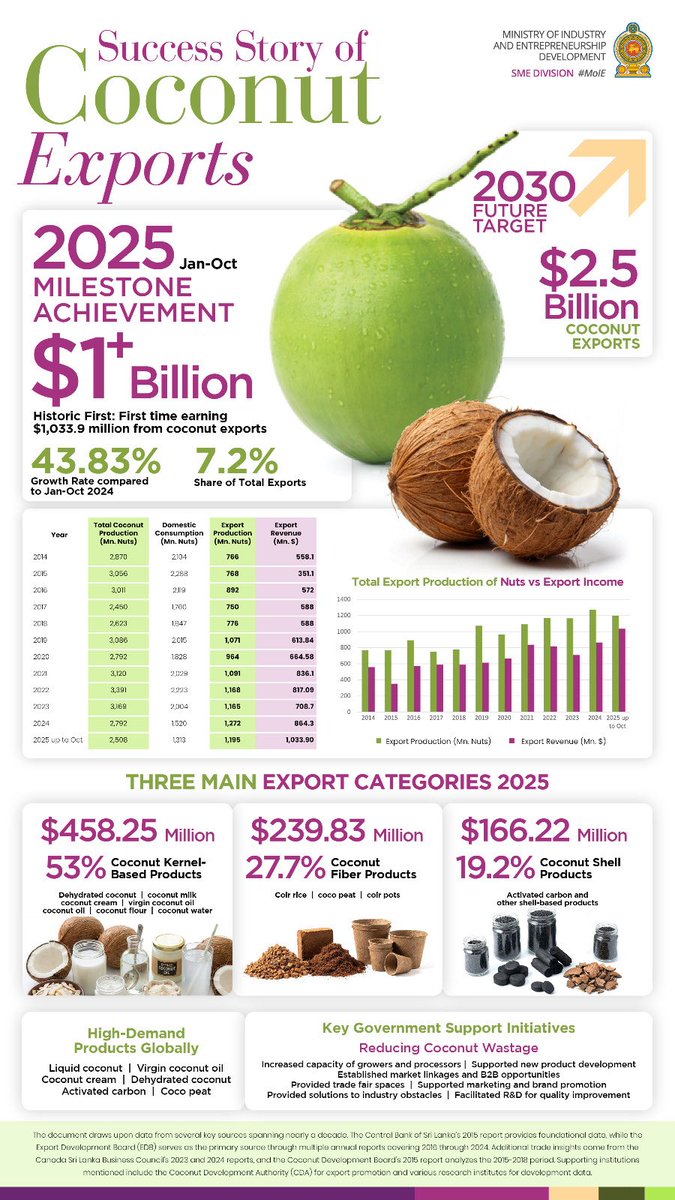
One of the key highlights of Sri Lanka’s export performance in 2025 has been the remarkable growth of the coconut sector.
Coconut based exports surpassed USD 1 billion in 2025 and are expected to close the year at around USD 1.2 billion, a substantial increase from USD 800 million in 2024 representing over 40% year on year growth. This marks a major milestone for Sri Lanka’s coconut industry.
The primary constraint facing further expansion remains nut productivity. Recognising this, the Government initiated several structural interventions in 2025 to improve crop productivity and expand coconut cultivated land. However, these measures will yield results only over the medium to long term.
In the short term, the critical lever available in 2025 was behavioural change in domestic consumption.
This required:
More efficient household usage of coconuts
Adoption of alternative products for daily consumption
Use of simple technologies to reduce domestic waste
Simultaneously, the Government enabled coconut exporters to import coconut milk and kernel-based products strictly for re export purposes.
While only minimal quantities were imported, this timely policy decision ensured no shortage in the local market, while safeguarding the momentum of the export industry.
This achievement reflects the collective determination of the industry and the coordinated efforts of the Plantation Ministry, Ministry of Industries, Export Development Board, and most importantly, the citizens of Sri Lanka, who understood the scientific basis for redirecting wasted domestic consumption towards higher value exports.
The coconut sector has now emerged as a strategic export crop. With ongoing productivity reforms and sustained market development, Sri Lanka has the potential to reach USD 2.5 billion in coconut-based exports by 2030 and we are firmly on track to achieve it.
Thank you for those who helped me in spreading the word ☺ and the message has been recived by all conners of Sri Lanka.
Your squad to take on the Grand Slam Tour ☘️🏴🏴🏴
Congratulations to Tevita Mafileo who has been named as an All Black for the first time 👏🏼