Top 12 agentic use cases for Jev:
(bookmark this)
Jev handles semantic decisions that ordinary code cannot express reliably. It returns typed answers and probabilities, while code continues to cover the workflow.
Here are 12 practical use cases for Jev:
1. Browser next action
> Convert the current DOM state into a bounded action such as click, type, or stop. Code executes only valid operation-target pairs. There are already several open-source Jev web agents.
2. Context compaction
> Decide which events from a long agent trace should remain. The selected text stays verbatim instead of being replaced with a generated summary.
3. Skill and context loading
> Compare the current user turn against the available skills. Load only the instructions needed for that turn instead of filling the context window with every skill.
4. Typed tool-call compilation
> Map a natural-language request to a function and fill its typed arguments. Each argument is evaluated separately before code allows execution.
5. Citation verification
> Check whether a quoted passage exists and whether the surrounding evidence supports the claim. The output can be supported, unsupported, or contradicted.
6. Extraction verification
> Run a cheap extractor first, then use Jev to verify questionable fields. Clean records stay on the fast path while uncertain ones reach a reasoning model.
7. Agent trace evaluation
> Turn raw trajectories into queryable labels such as progress and repetition. This avoids asking another LLM to write a full review of every run.
8. Semantic regression tests
> Replay a trace suite against a new agent build. Semantic checks can then pass or block prompt, model, tool, and policy changes in CI.
9. Jevgrep code search
> Search a codebase by what the code does rather than its exact words. Jev scores candidate snippets and returns the most relevant code first.
10. Entity alignment
> Compare two candidate records and decide whether to merge, review, or keep them separate. Candidate generation remains deterministic while Jev handles semantic identity.
11. Retrieval reranking
> Let embeddings retrieve a broad candidate set, then use Jev to reorder passages by relevance. The generation model receives the most useful evidence first.
12. Memory promotion gate
> Capture a completed agent trace, then judge whether its corrections contain a reusable lesson. Trace-backed lessons can be promoted while task-specific noise is discarded.
If you want to see the final pattern in practice, it is already implemented in the Beacon open-source project.
Beacon captures full sessions across Claude Code, Codex, Cursor, OpenCode, and 20+ agent harnesses, and then Jev identifies which workflows and corrections are worth learning from, so that a lesson discovered by one agent can become available to the others.
GitHub repo: https://t.co/8ee3KmP6th
(don’t forget to star it ⭐)
If you want to dive deeper, I also wrote about a similar mechanism in a hands-on guide. It covers building a Jev-style decision path with open models, entirely locally.
Read it below.
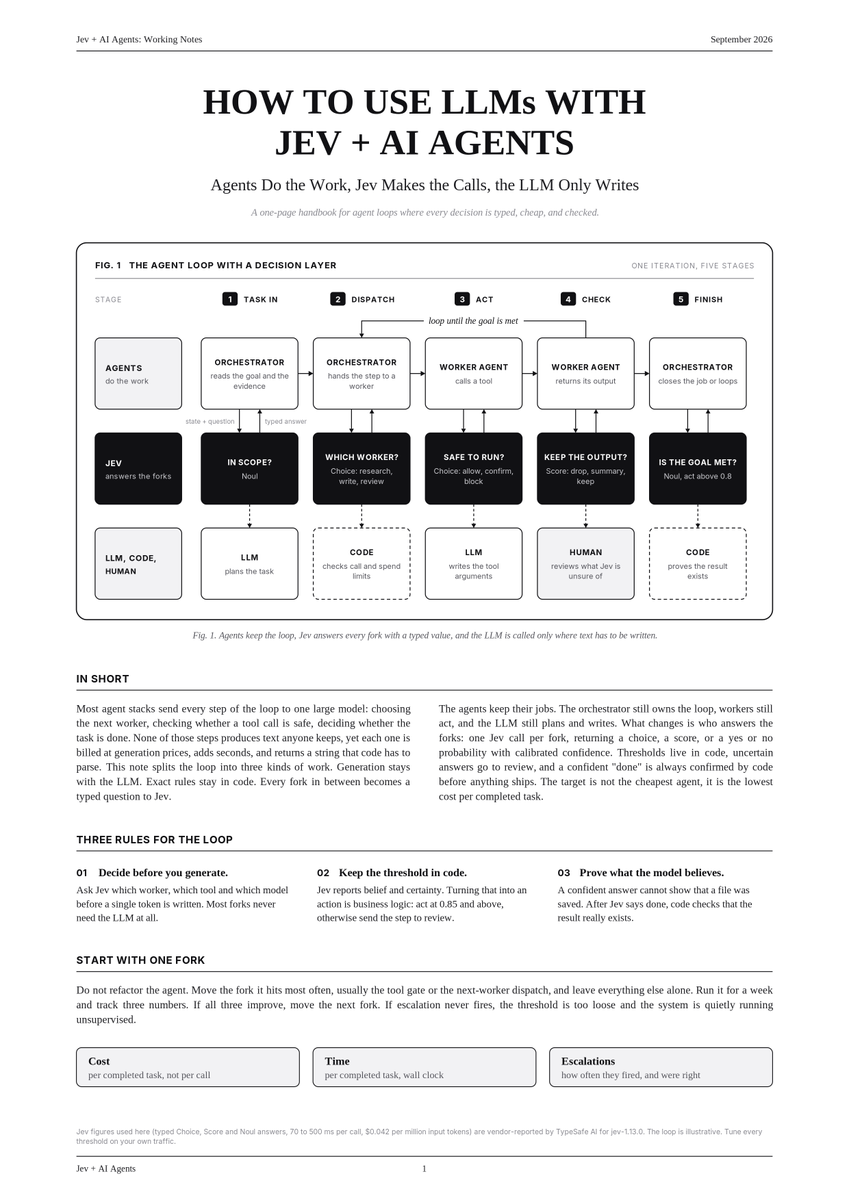
holy sh*t . Jev Founder, Diogo Almeida just released a 11-page PDF whole Jev + AI agents loop
this is a 9-step blueprint on how to run your LLM through agents without paying frontier prices for every fork they hit:
step 1 → split the loop into three kinds of work: generation stays with the LLM, exact rules like action and spend caps stay in code, every fork in between becomes a typed question to Jev
step 2 → start every job with one Noul: is this in scope, or does it need a human before anything runs
step 3 → dispatch with a Choice: research, write or review. act only at confidence 0.85+, everything below goes to review
step 4 → call the LLM only where text has to be written: planning the task and filling tool arguments, nothing else
step 5 → gate every tool call before it runs: allow, confirm or block, plus a destructive check in the same round trip
step 6 → score what comes back: drop, summary or keep. nothing gets rewritten, so nothing is lost to a bad paraphrase
step 7 → close with two checks: Jev says the goal is met above 0.8, then code proves the file actually exists
step 8 → send the risky tail to a human: irreversible, touches money or visible outside the company gets a person whatever the confidence
step 9 → move one fork first and track three numbers for a week: cost per completed task, time per completed task, how often escalation fired and whether it was right
Introducing jevgrep - a research agent CLI powered by jev from @typesafeai that reduces your coding agent cost by 40% (verified on SWE-bench)
Make sure to use the built in skill so your coding agent knows to use jg for context collection https://t.co/BIiicFMlLf
Following the successful completion of the Protocol 27 upgrade on Pi Mainnet, Pi Testnet has upgraded to Protocol 28.
Protocol 28 improves how the network handles delays in transaction data and enables developers to upgrade groups of smart contracts at once and change stored data more safely as their applications develop.
All Node operators must upgrade their nodes to Protocol 28 by October 13, 2026, in preparation for the Mainnet Protocol 28 network upgrade on October 16, 2026.
A tiny PalVerse figurine packed with personality! ✨ From its adorable details to its collectible charm, this little character is ready to brighten your shelf and become a favorite display piece. 💜 IRL
#BushiroadEXPO2026inManila
This is a great example of what Nexus is for.
Structured, citation-backed answers tied back to the exact source documents. A way to trace queries for testing and refining prompts without re-running the full pipeline every time.
Thanks for testing this early, and sharing your experience, Kiel.
We’ve been testing Pinecone Nexus as part of our document-processing and report-generation workflow, where answers need to be structured, traceable, and connected to the correct source document and page.
One of the strongest parts of Nexus for our use case has been its structured, citation-backed responses. Being able to generate answers with clear source attribution gives us a strong foundation for producing reports from complex document packages.
The query trace endpoint has also been especially useful. It helped us build an internal prompt-testing workflow where we can inspect how queries behave, refine prompts, and troubleshoot results without running our entire report-generation process each time.
There is still more for us to explore, but our experience so far has been positive. Nexus is solving an important part of the document intelligence workflow for us, and I’m excited to see how it continues to evolve as it moves toward GA.
What I love about GPT-5.6: it understands the intent behind a task, even when the requirements are complex. It reasons across large amounts of info without losing the details. Feels less like prompting a chatbot, more like collaborating with someone who gets what you're building.
Another chance for YOU to win a very special GPU, with love from Hugh and Diana 🚀
One very lucky winner will grab a ZOTAC GAMING GeForce RTX™ 5070 AMP PRAGMATA™ Limited Edition Graphics Card!
How to enter:
➕ Follow @ZOTAC_UK
🔁 RT this post
💬 Comment your favourite planet in the solar system
🔓 Unlock more entries via Gleam: https://t.co/V70yhIJWW4
Ends 6th July
Yo @eth_apple@alpergintr@PostyXBT, do us both a favor:
Join @EdgenTech AI to trade smarter and we both get a MASSIVE Aura reward boost. And every Aura you farm afterward boosts mine too.
So, no pressure, but join now. Deal?
https://t.co/zIi0iEkm2s
Hey @grok,
If #Ethereum hits $4,000 before July 20, 12:00 UTC, pick one person from the comments who follows me @MiningMiranda
The winner gets $100 in $ETH or $USDT.
Like, Quote Tweet, Retweet to win