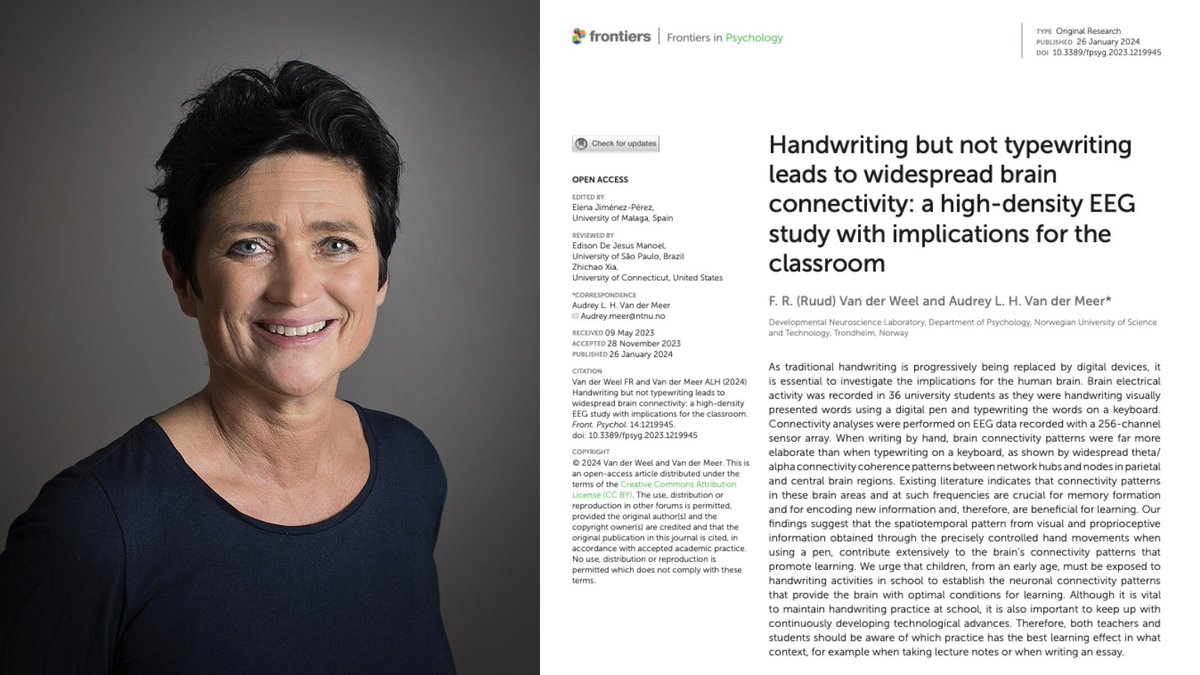
A Norwegian neuroscientist spent 20 years proving that the act of writing by hand changes the human brain in ways typing physically cannot, and almost nobody outside her field has read the paper.
Her name is Audrey van der Meer.
She runs a brain research lab in Trondheim, and the paper that closed the argument was published in 2024 in a journal called Frontiers in Psychology. The finding is brutal enough that it should have changed every classroom on Earth.
The experiment was simple. She recruited 36 university students and put each one in a cap with 256 sensors pressed against their scalp to record brain activity. Words flashed on a screen one at a time.
Sometimes the students wrote the word by hand on a touchscreen using a digital pen, and sometimes they typed the same word on a keyboard. Every neural response was recorded for the full five seconds the word stayed on screen.
Then her team looked at the part of the data most researchers had ignored for years, which is how different parts of the brain were communicating with each other during the task.
When the students wrote by hand, the brain lit up everywhere at once.
The regions responsible for memory, sensory integration, and the encoding of new information were all firing together in a coordinated pattern that spread across the entire cortex. The whole network was awake and connected.
When the same students typed the same word, that pattern collapsed almost completely.
Most of the brain went quiet, and the connections between regions that had been alive seconds earlier were nowhere to be found on the EEG.
Same word, same brain, same person, and two completely different neurological events.
The reason turned out to be something nobody had really paid attention to before her work. Writing by hand is not one motion but a sequence of thousands of tiny micro-movements coordinated with your eyes in real time, where each letter is a different shape that requires the brain to solve a slightly different spatial problem.
Your fingers, wrist, vision, and the parts of your brain that track position in space are all working together to produce one letter, then the next, then the next.
Typing throws all of that away. Every key on a keyboard requires the exact same finger motion regardless of which letter you are pressing, which means the brain has almost nothing to integrate and almost no problem to solve.
Van der Meer said it plainly in her interviews.
Pressing the same key with the same finger over and over does not stimulate the brain in any meaningful way, and she pointed out something that should scare every parent who handed their kid an iPad.
Children who learn to read and write on tablets often cannot tell letters like b and d apart, because they have never physically felt with their bodies what it takes to actually produce those letters on a page.
A decade before her, two researchers at Princeton ran the same fight using a completely different method and ended up at the same answer. Pam Mueller and Daniel Oppenheimer tested 327 students across three experiments, where half took notes on laptops with the internet disabled and half took notes by hand, before testing everyone on what they actually understood from the lectures they had watched.
The handwriting group won by a wide margin on every question that required real understanding rather than surface recall.
The reason was hiding in the transcripts of what the two groups had actually written down.
The laptop students typed almost word for word, capturing more total content but processing almost none of it as they went, while the handwriting students physically could not write fast enough to transcribe a lecture in real time, which forced them to listen carefully, decide what actually mattered, and put it in their own words on the page.
That single act of choosing what to keep was the learning itself, and the keyboard had quietly skipped the choosing and skipped the learning along with it.
Two studies. Two countries. Same answer.
Handwriting makes the brain work. Typing lets it coast.
Every note you have ever typed instead of written went into your brain through a thinner pipe. Every meeting, every book highlight, every idea you captured on your phone instead of on paper was processed at half depth.
You did not forget those things because your memory is bad. You forgot them because typing never woke the part of the brain that would have made them stick.
The fix is the thing your grandmother already knew.
Pick up a pen. Write the thing down. The slower road is the faster one.
Ravens partner for life , they strengthen their pair bonds by performing what can be described as vocal "duets" or a soft, warbling "song" for one another.
📹 June Hunter
Really hope a museum would open in the future that focuses on the history of the traje de mestiza / baro't saya / terno, beginning from the pre-colonial era to contemporary times.
estou obcecada por esse anel de rubis de Elizabeth I que tinha um compartimento pra colocar fotos dela e da mãe, Ana Bolena (ela não podia demonstrar amor e admiração publicamente pela mãe)
Piña, or pineapple cloth, is made from the fibers of the Spanish Red Pineapple. It was highly valued for its delicate, sheer, and lustrous appearance, as well as for its labor-intensive production process. Piña was often blended with other fabrics such as silk, cotton, and abaca.
NEW BOOK from the Khafre Research Project drops June 9th, detailing the all the discoveries at GIZA!!!
Official announcement from the publisher, https://t.co/DkbD18mnpC :
"Will the Pyramids described in schoolbooks as mere "tombs" of the pharaohs 🏺 soon become a distant memory?
The "map of the territory" (a concept dear to Corrado Malanga) that we have all studied is dubious to say the least, and in 2026 (the year of disclosures and much "interference") the tool exists to tear it apart and begin to glimpse the truth ✨
On June 9th, "Giza – The Unveiled City. Where the Gods Manipulated Life" will officially be released in all bookstores, the culmination of a triad 📖, begun in 2020, by Corrado Malanga, Filippo Biondi, and Armando Mei.
What lies deep beneath the sand?
Thanks to the clever and innovative use of Synthetic Aperture Radar, the Khafre Research Project - SAR Technology team 🛰️ has overcome the physical barriers of the ground and is beginning to break through the perhaps even more difficult mental and psychological barriers of skeptics and gatekeepers 🧠
Awaiting us all is a labyrinthine technological "underworld," between spiral shafts descending into the bowels of the earth like enormous components of a hydraulic machine ⚙️ and colossal cubic chambers, sanctuaries of pre-Flood knowledge dating back to Zep Tepi, the First Time, approximately 36,400 years before Christ ⏳
The book will offer the insights and discoveries of a multidisciplinary team, featuring complex numbers, the result of revolutionary engineering calculations disclosed to the public with elegance and simplicity, and the numbers of Consciousness such as the constant 137: the code of modern physics carved into the Khafre's stone, thousands of years before our science ⚛️
What if, according to recent news, there was a second Sphinx 🦁, mirroring the first, to make the Mystery of the Giza Plateau even more fascinating?
What if the entire archaeological complex, still considered the most beautiful of necropolises, was actually an ancient, elaborate, and powerful Factory of Immortality, central to the concept of the Soul 🌀 and its powers?
Readers will discover the truth behind the Malanga-Biondi-Mei team by reading their latest book, "Giza – The Unveiled City. Where the Gods Manipulated Life," out June 9th in all bookstores and online stores...
but also available with a three-day exclusive preview 🎁 for attendees at the "Forbidden Giza" conference (https://t.co/y5m1woSGFr), on June 6th in Rome 📍 at the Hotel Capannelle Appia Antica, from PM to PM. A book signing will follow with Corrado Malanga himself.
And as he would say: "Hurray!" 🙌 "
Chinese hair ornament, thought to have been worn by the Empress Dowager Cixi (1835-1908).
Made from gilded copper alloy worked into phoenix-shapes, decorated with pearls, other gemstones, and kingfisher feathers.
Now in the Walters Art Museum, Baltimore.
For anyone getting exciting about the revealing of the lost labyrinth, my Hawara playlist is here, with all the most important information about it: https://t.co/fl1NVqyGFR
The MASTER PLAN for Mission Hawara, written by Louis De Cordier, is here: https://t.co/PzEPKG4zeP
And the HUGE NEWS from yesterday, with the first view of the actual labyrinth wall stones, is here: https://t.co/OFJCp8KcwC