Most of the stereotypes about India in Western countries are true.
The reason you get defensive and try to push back is because you don't fit in those stereotypes and it infuriates you to be judged by the lowest common denominator. You push back because you confuse Bharat, the great ancient civilization, with modern India, the democratic socialist republic, and passionately fight for the sacred honor, philosophy, and heritage of the former, entirely ignoring the crude realities of the latter. You reject the humiliation of a collective reputation you did nothing to create, refusing to be grouped with the lawless, the uncivic, and the vulgar when your own values are entirely at odds with them.
But you're part of the quiet minority. The harsh truth is that the rest of the country, the overwhelming majority, simply does not care. They are a hopeless, unreformable mass of selfish, ignorant, and shameless parasites who lack even the basic capacity for self-reflection. Operating on a primitive threshold for crime and corruption, they are far too pathetic and lazy to care about rules, progress, or the public good. They would eagerly wallow in filth, chaos, and shortcuts just to satisfy their immediate personal greed, leeching off the system while leaving the few civilized people like you to carry the dead weight of a demographic dividend that lacks the decency and dignity to ever grow up.
Children who take music lessons develop a larger corpus callosum, the bridge between the two halves of the brain, and the change is permanent. A 2005 review in the Annals of the New York Academy of Sciences found that early music training produces structural brain changes that persist into adulthood, even if the person stops playing.
The review was led by Gottfried Schlaug at Harvard Medical School, one of the leading researchers on music and the brain. He found that children who started instrumental training before age seven had a significantly larger anterior corpus callosum than non-musicians, and the size difference was still visible in adults who had not touched an instrument in years.
The corpus callosum carries signals between the left and right hemispheres. A larger one means faster, richer communication between the two sides, and the effect shows up in tasks that have nothing to do with music: spatial reasoning, verbal memory, and the ability to process multiple streams of information at once. The music built the highway, and the brain uses it for everything.
Schlaug also found that musicians had larger cerebellums, the region involved in timing and motor coordination, and more grey matter in the areas that process sound. The brain had physically reorganised itself around the demands of the instrument, and the reorganisation was visible on a scan.
The age window matters. Children who started before seven showed the largest changes. Children who started after ten showed smaller ones. Adults who took up an instrument for the first time showed the least structural change, though they still showed some. The brain is most willing to be rebuilt by music during the years when most parents are debating whether to sign their child up for lessons. https://t.co/hrHlmtHjjg
I also realised the importance of rear windshield wiper & washer.
(also defogger)
On the expressway, it started raining heavily and I had zero visibility from the IRVM because of the rear windshield
Going at 100kmph, it can be so risky
The wiper helped me there
It should be standard, period.
(visibility is always the bare minimum of safety, everything else comes later)
THIS WEBSITE LETS YOU SIT IN THE WINDOW SEAT OF ANY PLANE FLYING OVER YOUR HOUSE RIGHT NOW.
no download. no app. no account.
you open the tab and you are in the sky.
it's called Stowaway. https://t.co/WFCxwmTfQi.
it finds your location. pulls every plane and satellite passing over you right now. click one. hit "Stow away" and you are in the window seat. real terrain. real weather. real light for this exact minute.
the guy who made it, jheising, said on Hacker News he built it because as a kid he would watch planes cross the evening sky and try to imagine what the world looked like from up there. Stowaway is that, without the airport.
441 points on Hacker News. people are not bookmarking it. they are flying in it.
just a website that lets a normal person see Earth from a stranger's window seat for a few minutes.
we built the internet and somehow one of the best things on it right now is still:
open tab.
sit in a stranger's plane.
watch the sunset from 35,000 feet.
If you are an engineer or scientist or doctor turning to business, the first thing I would suggest is "Please go on a lot of sales calls, face rejection if necessary, but persist".
You will develop better communication skills as you realise that explaining your ideas is not so easy.
You will develop respect for sales people.
You may even become good at business!
There is no such thing as a business without selling something. Sometimes the most obvious thing has to be said!
Want to learn to chant a difficult Sanskrit shloka - Use Vagbodhini. Type and shloka, it breaks it down to parts, teaches how to pronounce and gives you feedback on your chant. Works with multiple Indian Scripts. Try it out - Link in the first reply.
यदी आपके घर का मुखिया प्रसिद्धि और वाहवाही का भूखा है तो वह गैरों की जरूरत और औकात से ज्यादा मदद करेगा।
जब धोखा मिलेगा तो वह अपनी आपबीती का बखान ऐसे करेगा कि वह कितना महान है।
ये अपने बच्चों पत्नी को छोड़ समाज को आलिंगन देते हैं।
१९४०-१९७० की पीढ़ियाँ ऐसे मूर्खों से भरी पड़ी हैं
if your pipeline isn't growing and you think it's because one channel is failing or underperforming, stop. read this before you move that budget to a new channel.
oftentimes the channel is doing its job. the real issue is one of the five layers every channel depends on.
here's how to build your GTM system so pipeline grows predictably:
1/ foundation
everything that has to be true before you spend a dollar on any channel.
can you quote a real buyer describing their problem in their own words? if not, your messaging is a guess, and a channel doesn't fix a guess. it just delivers it to more people. we pull those exact phrases from sales call recordings.
the inbox matters just as much: gmail now rejects unauthenticated bulk mail outright. if open rates dropped and the copy didn't change, check SPF, DKIM and DMARC before you touch a subject line.
2/ strategy
most teams run one channel until it has a bad quarter, then call it dead. every channel has a bad quarter eventually, and when it's the only one you run, that quarter looks like the end.
we run three that cover for each other: content warms people up, ads keep us in front of them, outbound starts the conversations. that shift alone took us from $40K to $90K a month.
3/ execution
the channels themselves, where everyone starts and where most budgets get wasted.
the most common version: paying for ads to reach strangers while the audience your content already earned sits there untouched.
we get 100+ inbound meetings a month from linkedin without spending a dollar on ads, and the same people who read that content get our cold emails. by the time we show up in their inbox, they already know who we are.
4/ compounding
most replies arrive on the later touches, but most teams stop following up long before that, look at the thin results, and conclude the channel stopped working.
the follow-up is only half of this layer. the other half is what you count: meetings booked is a vanity metric any tool can inflate. pipeline created and revenue closed live in your CRM, and those are the numbers the business actually runs on.
5/ learning
every tactic decays eventually. the teams that survive it sit down once a week and close the loop: which signal converted, which message landed, which channel paid for itself.
the teams that skip this keep running the same play long after it stopped working, and when results dry up, the channel gets the blame. sound familiar?
find your broken layer:
> replies fine, revenue flat = layer 4
> one great month, then two dead ones = layer 1
> everything works a little, nothing compounds = layer 2
> open rates dropped, copy didn't change = layer 1, the inbox
> busy team, nobody knows what worked = layer 5
fix the lowest broken layer first.
if pipeline feels random, start at layer 1.
Ribbit Capital founder @mickymalka shares “the eye of the tiger”
The 5 traits he looks for in founders:
- The energy of a scientist
- The conviction of a missionary
- The heart of a partner
- The dreams of an athlete
- The obsession of an owner
Box CEO Aaron Levie’s 5 lessons for startup founders
Lesson 1: Do something that wasn’t possible 3 years ago.
“If you’re looking at a business opportunity that you could have done 5 or 10 years ago, it might be too late, or it might not be different enough to make a lot of people care. And that’s ultimately what it takes to scale. So look for new technologies that are enabling your solution. Box wasn’t possible in 2000. The enabling technology was cheaper storage, better browsers, more connected devices, faster internet.”
Lesson 2: Do something you’re extremely passionate about.
“Startups are very hard. There’s a lot of bad news that happens every single day. Bad things in the competitive space. Bad things with hiring. And you have to be able to push through. So you have to do something that’s actually really exciting, and that you’re going to be inspired about.”
Lesson 3: Don’t compromise.
“One of the coolest things about starting your own company is you get to make a lot of decisions. You don’t actually have to compromise or sacrifice on a lot of things. You don’t have to sacrifice on who you work with. You don’t have to compromise on how you’re going to do your marketing or how you’re going to build your technology… Ultimately, this is all in your control. you get to make these decisions and it’s a really exciting opportunity when you do.”
Lesson 4: If you feel comfortable, you’re probably not doing it right.
“There’s a lot of hard decisions that go into business. Who you’re going to work with, how you’re going to compete, what’s the right strategy? Are you going to raise money? Are you going to leave school? You’re going to have to go well beyond your comfort zone.”
Lesson 5: Don’t write your obituary too early.
“This is a mistake we’ve made a handful of times. We’ve been extremely competitive with Google, Microsoft, EMC, and these other large companies who normally we shouldn’t be afraid of. The venture capitalists are often afraid of these guys, but don’t write yourself off. Make sure that you keep on pushing. Make sure that you’re optimizing the right dimensions and areas you can beat [your competitors] in. That’s really important why we still have the company today.”
Source: Stanford (Jan 2011)
Mesopotamia was never the cradle of civilisation. India was.
I spent forty years in international shipping, not academia. When I began researching the history of maritime trade, I had no orthodoxy to defend. I followed the evidence, and it kept arriving in the same place: the Indian subcontinent.
Nineteenth century archaeologists dug in Mesopotamia because the climate preserved artefacts, the biblical sources pointed them there, and the Ottomans allowed the excavations. That is the entire basis for the myth of Mesopotamia as "the cradle of civilisation."
Nobody applied the same rigour to India. Mohenjo-daro was not discovered until 1922. By then the narrative had already hardened.
What was actually there was the largest civilisation of the ancient world. Three hundred cities. Fifty thousand people in each, by 2600 BC. Two thirds of them stood on the banks of the Sarasvati, the central and greatest of the seven rivers described in the Rig Veda, flowing down from the Himalayas before the river vanished entirely by 1900 BC. The Vedic kings claimed territory stretching "sea to sea," from Afghanistan to Maharashtra, some 1.5 million square miles, against Egypt's 13,000. A dock at Lothal built to handle thirty ships of sixty tons, unmatched in Europe for four thousand years. When it was first excavated, it was recorded as a bathing pool.
When the scale became impossible to dismiss, the theory was not corrected. It was replaced with a story of pale-skinned nomads from the steppe who supposedly arrived around 1500 BC and brought civilisation with them. There is no evidence. The chronology doesn't work. The Vedas describe no invasion.
In 2019 a Harvard-led genetic study revived the claim, and the press reported it as confirmation. It was not. The same study found the builders of these cities were indigenous. The Sarasvati river that the Rig Veda described had already dried up before these newcomers arrived. What the study also found is that a small group of men, arriving after the Sarasvati had already dried up, interbred with the existing population and left a genetic signature. That is all.
So, where they chose to dig was mostly an accident of climate and access. The Aryan invasion theory was constructed because an Indian civilisation that owed nothing to Caucasians was a fact the late nineteenth century could not accommodate.
Link to full Substack essay with sources in the comments below.
𝗘𝗫𝗣𝗟𝗢𝗥𝗘 𝗛𝗘𝗥𝗜𝗧𝗔𝗚𝗘
𝗩𝗜𝗚𝗡𝗔𝗦𝗔𝗡𝗧𝗛𝗘 𝗪𝗵𝗲𝗿𝗲 𝗧𝗵𝗿𝗲𝗲 𝗛𝗼𝘆𝘀𝗮𝗹𝗮 𝗚𝗲𝗻𝗲𝗿𝗮𝗹𝘀 𝗖𝗿𝗲𝗮𝘁𝗲𝗱 𝗮 𝗟𝗶𝘃𝗶𝗻𝗴 𝗜𝗻𝘀𝘁𝗶𝘁𝘂𝘁𝗶𝗼𝗻
📍 Vignasanthe · Tumakuru District · Karnataka
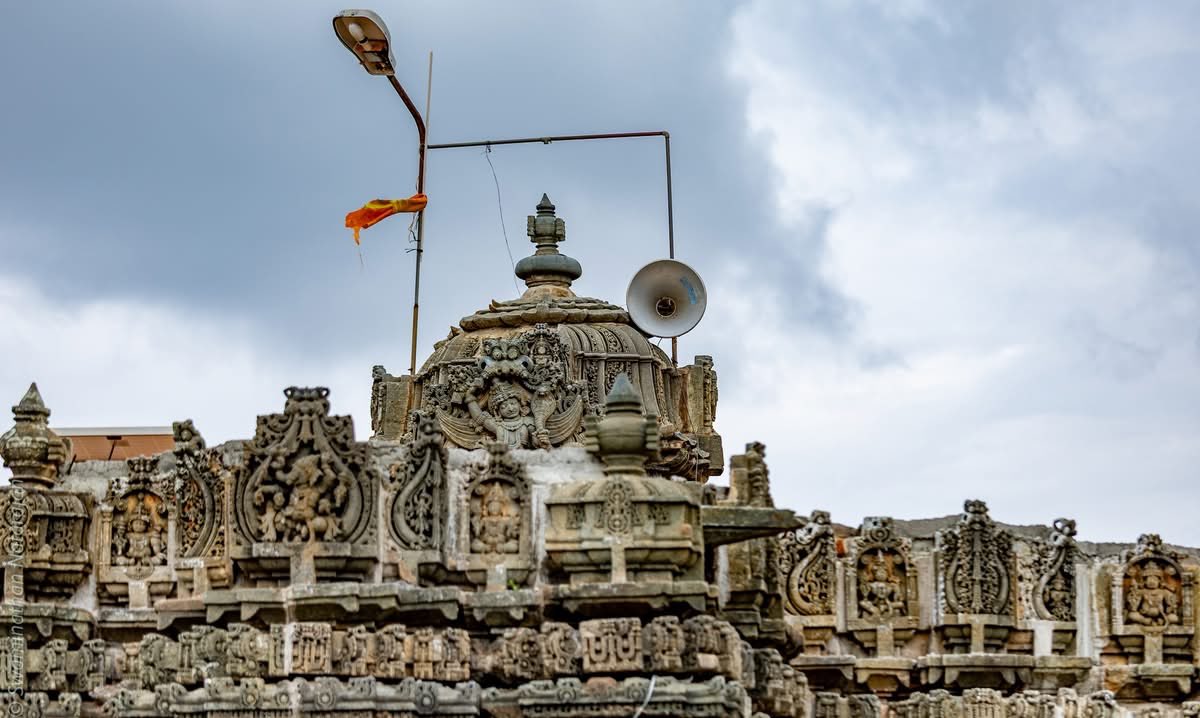
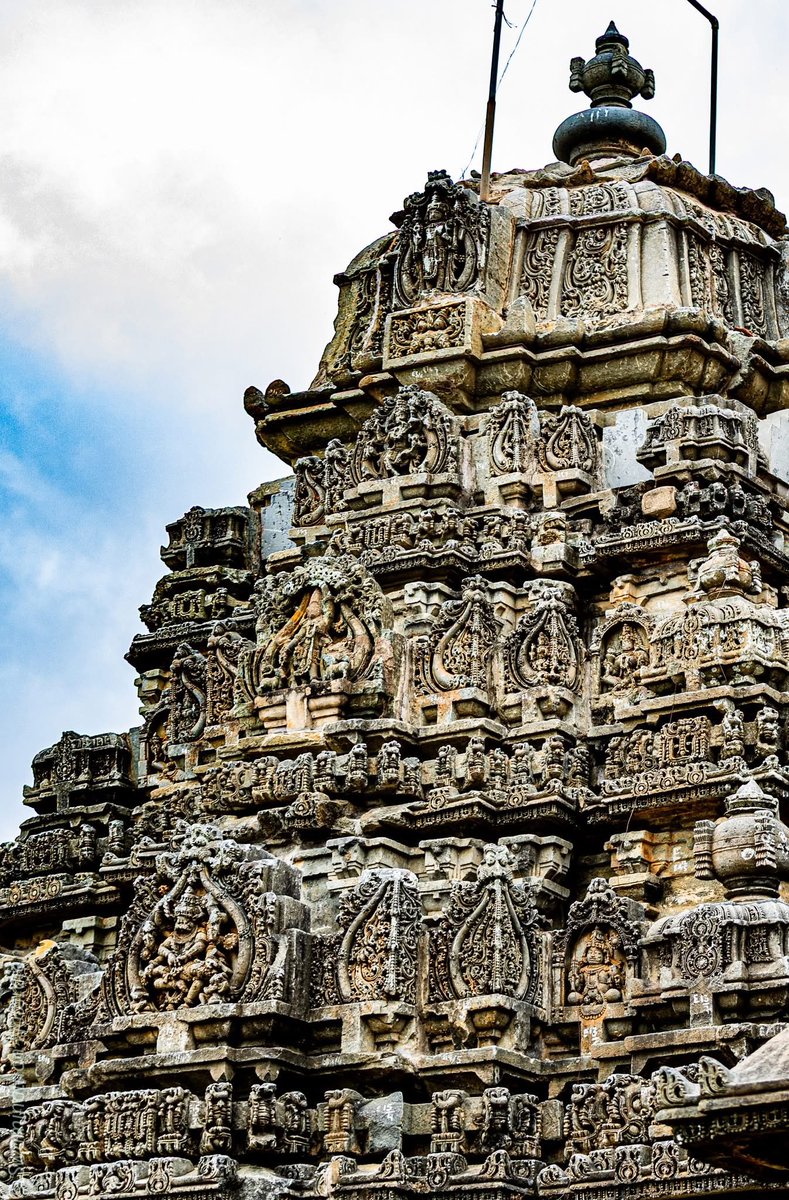
The Lakshminarasimha Temple is immediately captivating. Its interconnected shrines, polished pillars, and surviving Hoysala superstructure invite us to study every movement of the stone.
Yet the most powerful introduction to Vignasanthe is found upon an inscription standing quietly beside it.
𝗧𝗛𝗘 𝗙𝗢𝗨𝗡𝗗𝗔𝗧𝗜𝗢𝗡 (𝟭𝟮𝟴𝟲 𝗖𝗘)
Issued during the reign of Hoysala King Narasimha III, the record (EC XII, Tp 40) introduces three brothers—Appayya, Gopala, and Madhava serving as senadhipas (commanders).
“Narasimha-mahipalad labdhva te simha-vikramat gramam Igganasanthakhyam dvijebhyah pradishams tatah.”
“Having obtained from King Narasimha... the village named Igganasante, they thereafter granted it to the Brahmanas.”
They reorganised the village into an endowed agrahara and established three forms of Vishnu: Prasanna Keshava, Lakshmi Narasimha, and Gopala.
This inscriptional triad gives direct historical meaning to the temple’s elegant trikuta (three-shrine) plan.
𝗔 𝗧𝗘𝗠𝗣𝗟𝗘 𝗖𝗥𝗘𝗔𝗧𝗘𝗗 𝗧𝗢 𝗙𝗨𝗡𝗖𝗧𝗜𝗢𝗡
The endowment was built to sustain a living ecosystem:
“tri-sandhya-nitya-naimittika pujanga-bhoga... jirnoddhara-purana-vyakhyana-atithi-satkara…”
This provision funded worship, festivals, ongoing repairs (jirnoddhara), exposition of the Puranas, and the honouring of guests.
To sustain these obligations, the brothers secured agricultural revenues from the village of Jabagatta.
𝗖𝗢𝗡𝗧𝗜𝗡𝗨𝗜𝗧𝗬 & 𝗔𝗗𝗠𝗜𝗡𝗜𝗦𝗧𝗥𝗔𝗧𝗜𝗢𝗡 (𝟭𝟯𝟵𝟰 𝗖𝗘)
A second record on the same stone (Tp 41) shows how this survived. The Brahmana residents of the settlement, now called Sri Vijayagopalapura, acted sarvaikamatyavagi (“with complete agreement”).
They collectively formalised one hundred vrittis (shares), assigned rights, and declared that disputes would be settled by the mahajanas.
The first inscription records foundation. The second records collective administration.
𝗘𝗫𝗣𝗟𝗢𝗥𝗘 𝗧𝗛𝗘 𝗛𝗘𝗥𝗜𝗧𝗔𝗚𝗘
When you visit Vignasanthe, study the lathe-turned pillars, carved ceilings, and the Garuda on the sukanasi.
But remember the invisible structure that once sustained them:
Jabagatta’s fields, recurring revenues, ritual personnel, teachers, and mahajanas.
The architecture preserves its beauty. The inscriptions preserve its people, resources, and responsibilities.
Together, they allow Vignasanthe to speak again.
𝗦𝗼𝘂𝗿𝗰𝗲: B. Lewis Rice, Epigraphia Carnatica, Vol. XII, Tiptur Nos. 40–41.
#ExploreHeritage #Vignasanthe #Heritage #Epigraphy #incredibleindia @ChristinMP_
it is insane that 80% of the meetings in a white-collar environment could have been emails. we have an epidemic of fake jobs and people pretending they work hard just to look relevant.
Sonará duro, pero tu clase social se nota en cómo tienes tu casa:
🥉 Nivel bajo
· Todo acumulado
· Ropa por todas partes
· Cocina descuidada
· Cero orden visual
→ Viven en ruido y luego se preguntan por qué están agotados.
🥈 Nivel medio 👇
driving to work this morning making observations as a man who worked for the Coroner for seven of my 20 years service in the Funeral industry
I can tell you if more people drove normally most of us, or certainly many more of us, would get to work and be very much alive and healthy.
Sadly some won’t.
Why do some people drive like such fucking imbeciles?
I suspect because they have not yet witnessed the outcome of a fatal road traffic accident.
I am a firm believer that anyone caught speeding for a second time should be forced to watch an autopsy of a person killed in a road traffic accident caused by excessive speed (with the families of the victims consent of course).
So they could see, hear and smell the injuries firsthand and process the consequences that they’re frankly lunatic driving is edging them ever closer to being responsible for or even suffering themselves.
Trust me once you’ve picked up a few pieces of someones son or daughter or mum or dad from the road by torchlight - you drive slower trust me once you smelled fresh lamb and piss you’ll drive more normal.
Please fucking slow down people before you experience a really life changing event.
It only takes one nutter to ruin many lives forever