Script in, reviewed footage out: every shot, prompt, and take organized for you.
Built after making THE GATE (100k+ views) with spreadsheets.
Free trial ↓
@ciguleva This is exactly what I've noticed from most of the Midjourney 8.2 images I've seen. Nano Banana and ChatGPT are both excellent for a lot of cases, but the sense of scale that I'm seeing Midjourney generate is a class in and of itself.
After being down for an outage, it sounds like Claude access is starting to come back.
Reminder: our tool works primarily on top of Claude, so worth waiting a bit on existing project work until it returns.
If backup routing to other LLMs is an ask, I can add into the product.
@JSFILMZ0412 SD 2.5 had a bit more fluidity overall, but one of the guys flung back as if he was hit without ever being touched.
I've seen these same kind of quirks in gens I've done too. Just goes to show, newer doesn't always = better.
If I had to pick, I'd go with the Seedance 2.0
I made many mistakes over the last few months while launching my first SaaS.
Here's some of the biggest failures that could've ruined it before even launching and what I've done (or am still doing) to fix them:
One of the biggest mistakes - I spent several months of development without talking to a single potential customer. I was building something that I had use for, so I built it to solve my pain points, but I never once stopped to validate what the actual pain points were, how they were being solved currently (or the lack thereof) and what would make a solution worth paying for.
I also tried to do things that could scale or could "go viral" when really, at the start, I should focus on doing things that can't scale. The biggest players in the AI Video Generation space have massive budgets, huge teams and much more of the most valuable resource than I do: time.
As a solo founder, I have to pick and choose what I focus on and when. So in a world where potential customers are seeing fancy short form videos, highly-targeted paid ads campaigns or really enticing promo offers, I should have focus more on direct 1:1 outreach. Massive companies don't have the time nor is it worth the ROI to do this. But as a solo founder trying to win my first customer, that's where I should have focused.
I also never properly scoped the project. I simply "started building" and iterated based on my own use of the tool. This is not the proper way to build a tool. The fundamentals of project management apply whether it's a solo project or something being tackled at the enterprise level.
That said, I also found myself doing things at some points that were "productivity theater" rather than actual work. Automating unnecessary tasks, looking at dashboards - all stuff that "feels" good, but doesn't actually drive the needle.
Also, and a critical failure I had that I had to correct after zero new customers in the first week - I did not launch with a free trial. For an unproven new tool in a very crowded space, asking potential customers to just "trust me, it works!" is a non-starter.
Lastly, in hindsight, I simply waited way too long to ship the product. I wanted it to be "perfect" and have every little feature I could possibly want in my "dream" version of the tool, when, in reality, simply getting it into market in the simplest form possible, getting REAL customer feedback and pivoting based on what adds value to them - not me - is a playbook with a MUCH higher probability of success vs. staring at development windows for months without talking to a potential user.
Fortunately, a lot of these were things I was able to fix pretty quickly, but some are things I'm still working on. And I'm still guilty of refreshing analytics dashboards too often. Not a healthy or helpful habit, but it's one I'm working on.
But at the end of the day, the biggest lesson I've learned, even through all of my mistakes, is that - at some point - you just have to ship.
I've had countless ideas before this project over the course of my life, most of which are sitting half-baked on a hard drive somewhere. Or still in my head, on the list of things I'll do "one day"
With where technology, AI, LLMs, "Vibe Coding", etc. are nowadays, starting a project is quite literally as easy as typing out a few sentences.
But to ship - and ship something that's good - still takes real dedication. For now.
I'm still continuing to develop the tool, and feedback is a gift - but for now, I'll be doing things that don't scale and see where we can build this tool in the long run.
Thanks for reading.
Brad
This is exactly how you can generate characters inside of Kimeric:
1 - Script is auto-processed
2 - Neutral face established
3 - Neutral Body established
4 - Wardrobe Face established
5 - Wardrobe Body established
All recursively referenced with no manual prompting needed.
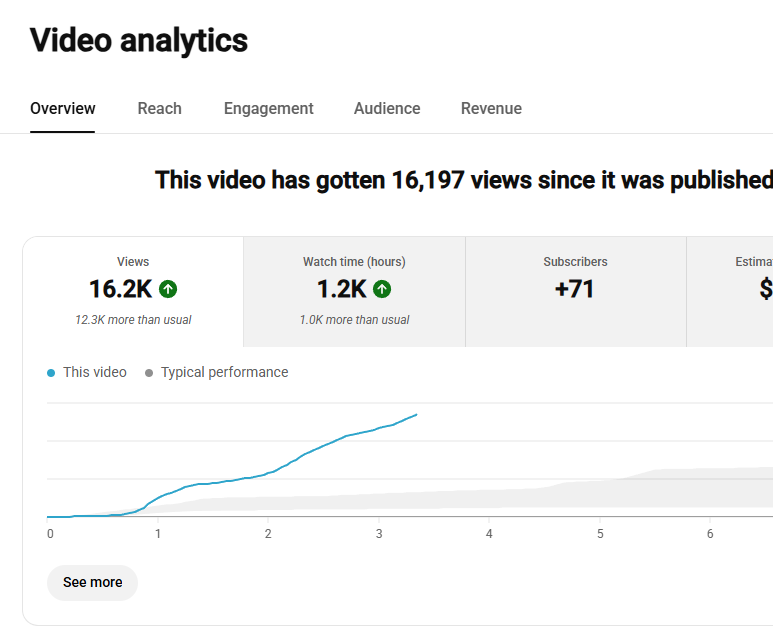
An AI Short Film I made with Kimeric is close to 20k views in under four days on YouTube.
Here are some of the lessons learned:
1 - The story ALWAYS matters most. It's easy to get caught up in spectacle, and visuals can grab, but a story holds. I spent a week or two brainstorming multiple ideas, three of which I brought to full-length short film scripts - but two of them weren't good enough.
Know when to scrap an idea when it's just an idea, rather than generating everything you come up with.
(And even this script isn't perfect, but getting end-to-end reps in is a skill you should practice in and of itself - don't let perfect get in the way of "good enough")
2 - Relentlessly edit. I generated about 30-35 minutes of raw generative video which edited down to about 16-18 minutes of actual continuous film.
From there, I edited down to a final cut around the 12-minute mark, removing full-length dialogue scenes that made the film drag on rather than adding to it.
Did I lose sunk cost? Yes - I could have saved money had I not generated clips which ultimately didn't make the cut. But the MOST important thing is the end product.
Don't force something to be in the project just to "justify" the time/cost of generation. The viewer doesn't care that you used all of your generations. They care if you respected their time.
3 - Work quickly but decisively, and have a focus on shipping. It's easy to endlessly tinker, test things, overthink, etc. - know what you want to do, and once you decide to do it, commit and see it through with focus and intensity.
All of these tools unlock a ton of technical capabilities, but they still need you in the driver's seat.
Seedance 2.5 is now live on Kimeric.
If you're looking for a new platform to generate cinematic AI videos, you can access Kimeric for a flat monthly fee + direct API costs.
Try free for 14 days. Link in bio.
This is exactly how we manage character spatial continuity with Kimeric.
Before we create storyboards, we create a new class of image: a "Cluster Scenic"
This is less of an image and more of a visual datapoint.
Who is where, objectively - then this seeds the actual storyboard
Second Earth - a 12 minute AI short film, made start to finish in Kimeric.
200+ shots. One script in, one film out. No manual prompting. My most ambitious Sci-Fi AI Short Film to date.
The hardest part wasn't the visuals - it was the story. It took over a week to write, and then several days in editing to fine-tune the pacing to really make it work.
Sound on. 🎬
Working on a number of new Kimeric product updates right now which should be out in v1.0.5 in the coming days:
- Support for non-visual dialogue speakers (i.e. a character speaking over a radio, phone, etc.)
- Option to build custom Cluster Canonical images outside of the current vertical dependency structure
- Seedance 2.5 & Opus 5 product integration (we currently API Seedance 2.0 via Wavespeed, so as soon as it's rolled out there, we'll follow)
- Optimized flexibility for image reference auto-assignment
- Optimized assignment for Cluster Canonical images (to better assign only in the cases where character movement has not occurred; if characters have moved which invalidates character position within the Cluster, new image generation will now be auto-dispatched)
- A number of UX quality of life improvements & bug fixes
- Significant performance improvements to decrease latency, redundant loading and overall responsiveness
Targeting as soon as this weekend, otherwise likely early next week.
Thanks for the feedback as it truly is invaluable when shaping the product direction & roadmap
PSA to AI Filmmakers:
Relentlessly edit in post. Even if you paid to generate something.
The worst thing you can do with a 'sunk cost' is force it into a project where it doesn't fit.
Focus on making a stellar project - not on using everything you've generated.