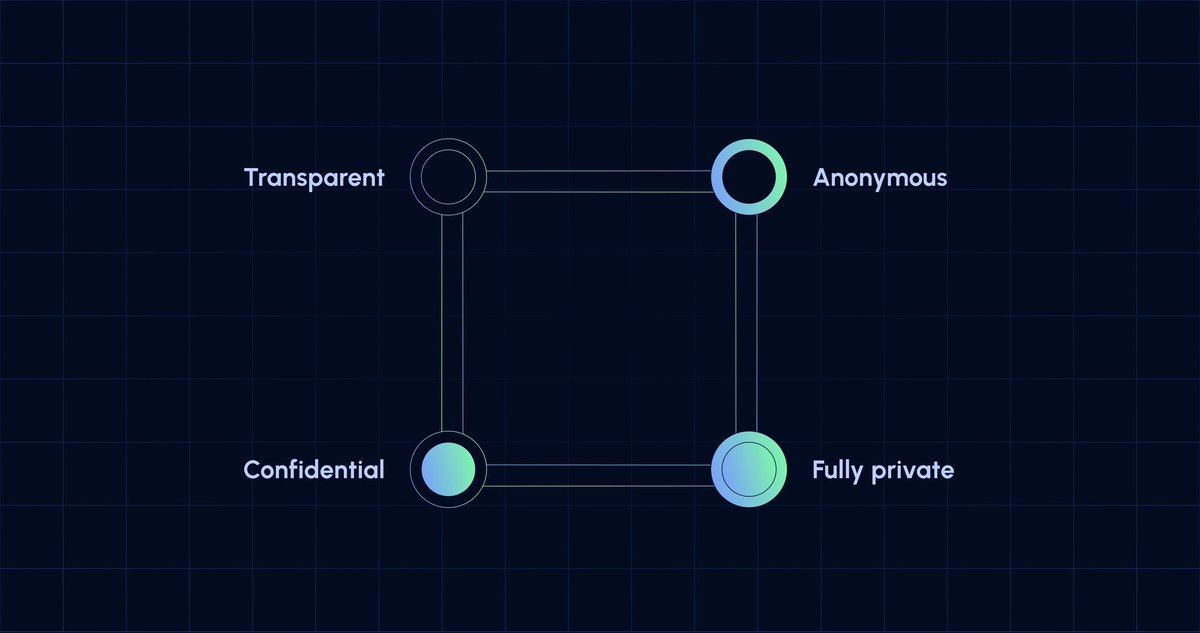
Inco Network and the future of private web3
web3 was built on transparency but total transparency is not freedom. It is exposure.
Real economies run on privacy, salaries are private, business strategies are private, personal finances are private. Without this, systems break.
This is why web3 cannot scale without confidentiality.
@inconetwork is building the missing layer.
Inco is a modular Layer 1 focused purely on privacy. It brings programmable confidentiality to smart contracts using advanced encryption, while keeping computation verifiable and secure. Data stays private, logic still works and trust remains.
Inco is built with the Cosmos SDK and secured by Ethereum through EigenLayer, not only that. Inco combines modular design with strong economic security, Inco is not builfing a new layer 1 blockchain or competing with any chain.
Inco’s goal is simple: make privacy native to web3.
With Inco, developers can build private DeFi, confidential identity, secure voting, and enterprise-grade applications without sacrificing decentralization.
Privacy changes everything, it unlocks real users, real businesses, and real adoption.
Inco is not just another blockchain.
it is the foundation for a private, usable, and scalable web3.
In the past few months, many new layer-1 blockchains launched and ended in a bad way. Projects like Irys, Monad, and Berachain all struggled because they didn’t have real users. This shows that web3 doesn’t need another layer-1 blockchain. What the space needs is a protocol that solves the problems people have been dealing with for years.
So I give credit to @remi_gai, the founder of @inconetwork, for building a modular layer-1 protocol that fixes the privacy issues the whole web3 space has faced for a long time. Inco aims to solve the privacy problems that the entire web3 space has been dealing with for years.
Public blockchains expose all data, which limits privacy and real-world adoption. Inco Network fixes this by adding a confidentiality layer using Fully Homomorphic Encryption (FHE), allowing smart contracts to compute on encrypted data without revealing it.
This unlocks private payments, anonymous governance, MEV-resistant DeFi, private gaming, secure identity, and compliant disclosure all while keeping the openness and security of public blockchains.
Starting from Base Network and Ethereum, Inco will expand to all other EVM chains and beyond.
Billions of stablecoins are sitting across multiple blockchains not only because of fragmented liquidity but also due to factors like the complexity of DeFi, regulatory uncertainty, high entry barriers for institutions, and the lack of simple, accessible yield solutions.
Lack of accessible solutions: until recently, there were few simple or accessible ways for holders of stable coins to generate yield across different blockchains.
The global economy is fundamentally shifting its focus from idle or underutilized assets to strategies that generate active value and @reflectmoney is right at that shift. Reflectmoney is not just a stablecoin project, it’s where every USDC you hold starts working for you, earning yield while staying fully liquid.
Everyone knows that 80% of stablecoins sit still across many blockchains, earning nothing. Reflectmoney changes that by turning deposited USDC into USDC+, a yield-bearing stablecoin backed by liquid deposits in blue-chip money markets on Solana which keeps your funds accessible anytime. DeFi is made simple with Reflectmoney because there are no lockups, no complexity, just smart contracts running delta-neutral and lending strategies in the background.
The timing couldn’t be better. About $280B stablecoins market earns zero yield today across many chains. Reflectmoney is turning the tables, starting on Solana. With time, idle stables will start generating yield as it should be and DeFi will finally start paying for the liquidity it already holds.