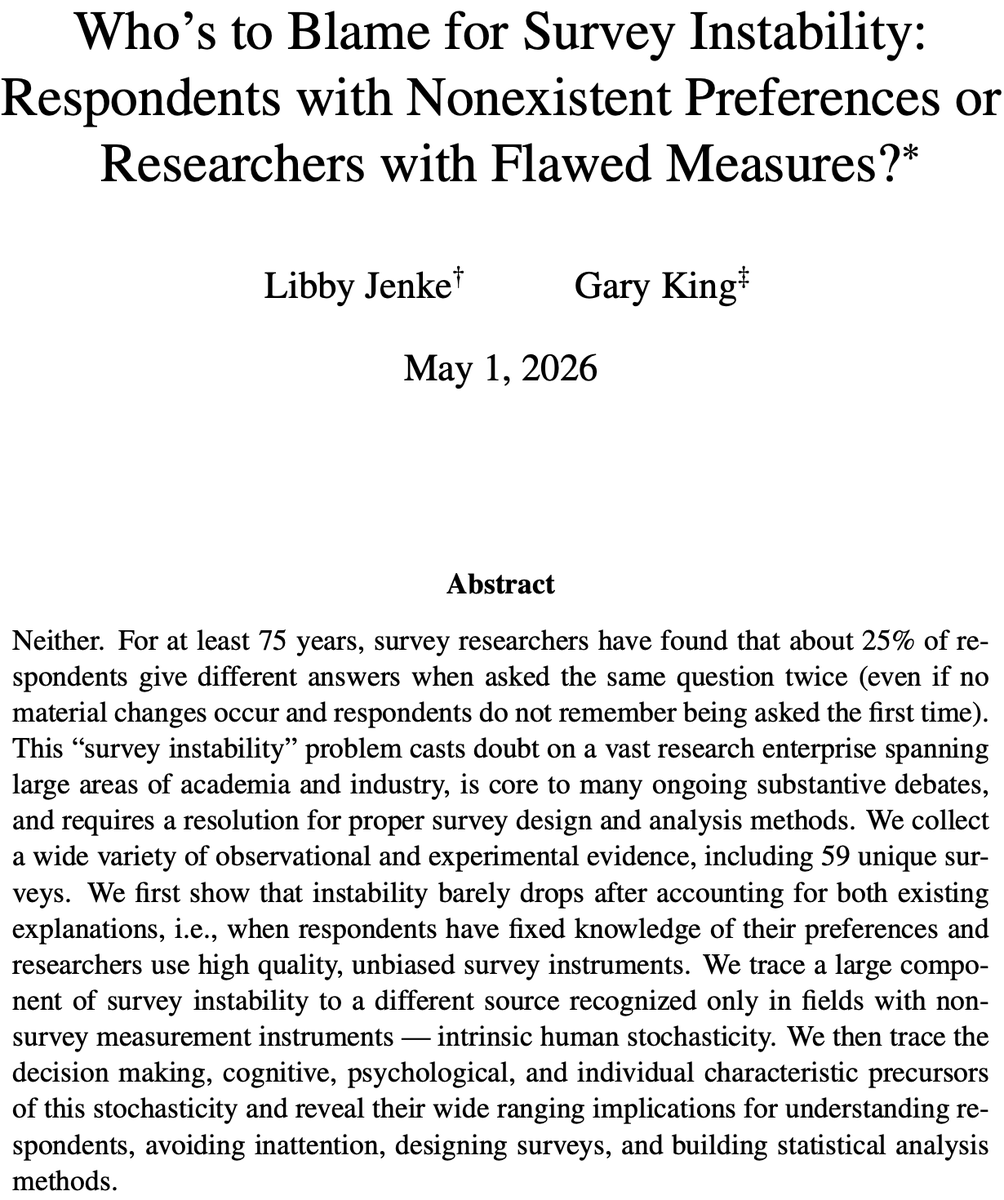
New paper: "Who's to Blame for Survey Instability: Respondents with Nonexistent Preferences or Researchers with Flawed Measures?" with @LibbyJenke. Comments welcome! https://t.co/5LhPD68qux
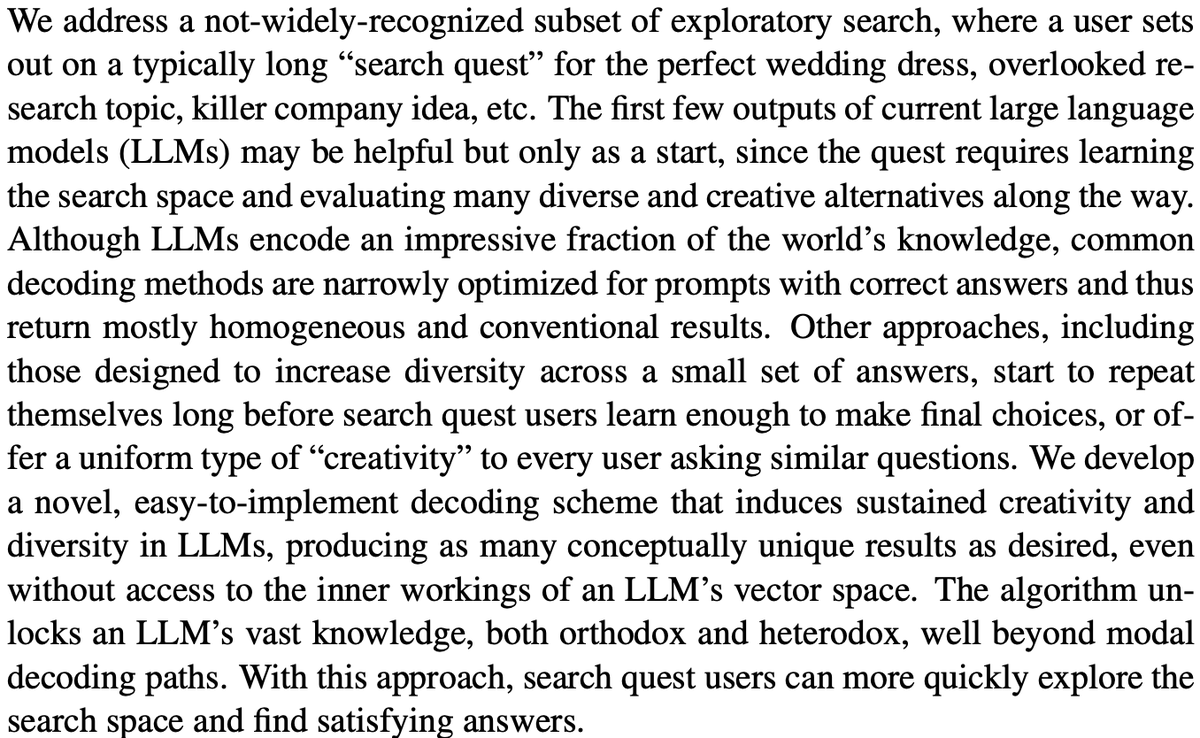
If you're asking a question with a correct answer, then everyone should get the same answer. But if you're asking for creative or diverse thoughts, out-of-the-box concepts, or contrarian or heterodox ideas, then you raise a real problem. Here's a solution: https://t.co/A7KmwaYOT9
Thanks everyone at @JohnsHopkins for coming to my talk & for the fabulous conversations. Great to see all the wonderful changes (with more in progress) in the social sciences there... Slides from my talk on "Who’s to Blame for Survey Instability: Respondents With Random Preferences or Researchers With Flawed Measures": https://t.co/kTc3tEfzq2
@SeanLangenfeld You might have a look at this article which explains "why propensity scores should not be used for matching" https://t.co/sCODrYSg3A
It really is not ambiguous.
New software: "Projoint: The One Stop Conjoint Stop" (with @aaronrkaufman & @YusakuHoriuchi), makes conjoint surveys easier & less biased, including everything from a drag-and-drop web survey design tool to specialized analysis software. Comments welcome. https://t.co/5cyTohjWBa
New paper:"Experimental Evidence on the (Limited) Influence of Reputable Media Outlets" w/Bharat Anand, Kiran Misra, Sascha Riaz at https://t.co/J3HJRuy8G6
My talk on measurement error in conjoint survey analysis at UCF.
https://t.co/nkxncZ2FjK using slides (download and view in Adobe Reader or Skim): https://t.co/ZpgxrikASr
Slides for my talk at UCF on "Correcting Measurement Error Bias in Conjoint Survey Experiments" (now forthcoming in the AJPS; https://t.co/DAnonnk7Zj) along with work on Survey Instability: https://t.co/ZpgxrikASr
Thanks to everyone at UCF for a great visit!
Super excited to announce the #PerusallExchange 2024 keynote speakers @stephen_wolfram (CEO/founder Wolfram Research) and @MIT Prof. Jesse Thaler (Director, Institute for AI & Fundamental Interactions). Don't miss this! register https://t.co/lVVibac0Y5 #AI#teaching
Slides for my 3/13 Caltech talk about "Is Survey Instability Due to Respondents who Don't Understand Politics or Researchers Who Don't Understand Respondents" based on a paper-to-be with Libby Jenke https://t.co/fGURIWTbSu Venue: https://t.co/3dppW9bCbI
Slides for my 3/12 UCLA talk about "How American Politics Ensures Electoral Accountability in Congress" based on paper w/ @Jonathan_N_Katz & @DannyCEbanks https://t.co/s3W9IojdCf
#Dataverse2024@kinggary won't physically join us this year, but in 2017, everyone was trying to catch those marshmallows!
#10thannualmeeting
The 2024 meeting starts on 3/4/24 and Zoom access and registration will be available until Monday at 3pm. https://t.co/AwC8jVZCPv
@rmkubinec@namalhotra@carlislerainey@matt_motta Our behavioral models (our observation mechanisms) can be tremendously important. Economists originally liked it because they can still get (stochastic) rationality, but only by assuming humans have no stable preferences. much evidence rejects this model
@namalhotra@matt_motta Thanks the comment, Neil. The random utility model is an assumption (humans have random preferences & never make mistakes in survey responses) not supported by the evidence. This often doesn't matter but does here. Have a look at our supplementary appendix, which discusses this.
Slides for my Friday talk at the Harvard Experimental Working Group on "Correcting Measurement Error Bias in Conjoint Survey Experiments" https://t.co/H32jIZL86v based on https://t.co/ECrDDO0Xhd w/
@katie_clayton14, @YusakuHoriuchi, @aaronrkaufman, @MayyaKomis
Slides for my talk at Harvard Law School tomorrow on "How to Measure Legislative District Compactness If You Only Know it When You See it" https://t.co/pnUypPqgbZ