New Era of Technical Analysis: Anonymous Hi.
Focusing on high-probability technical setups with the 'Kingtrident' pattern. We provide data-driven market scans for Global Macro and Crypto assets.
- Daily Chart Studies
- Kingtrident Logic
- No Noise, Just Data
Disclaimer: One-way information channel for educational purposes only. No individual investment advice.
The crypto market has lost almost all dopamine.
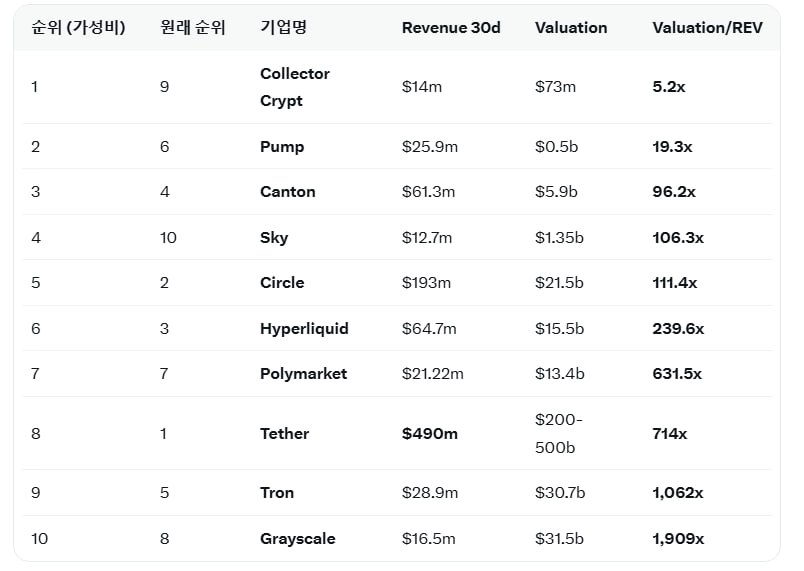
But this table gave me a new point of interest.
Everyone knows Hyperliquid’s rise came from high fee revenue and buybacks.
In equities, that makes perfect sense.
A platform that makes real money,
and returns part of that value to the token.
But in crypto,
high platform revenue doesn’t always translate into token price.
Many projects talk about buybacks,
but either don’t do them properly
or don’t do them at all.
So in crypto,
chasing a project purely because it has revenue
is usually not the cleanest path.
But one name stood out here.
Collector Crypt.
The so-called CARD coin.
On a valuation-to-revenue basis,
it sits at 5.2x.
That was interesting.
When CARD first appeared,
I briefly paid attention to it.
Later, with Pokémon’s 30th anniversary coming up
and Pokémon cards gaining attention again,
I wrote a few pieces about that theme.
But I didn’t think there was a direct crypto beneficiary.
While I stopped paying attention,
CARD quietly kept growing.
Now it has become
a surprisingly revenue-generating platform
relative to its size.
“Do you still believe in crypto?”
No.
I don’t.
And you probably shouldn’t.
But some things
are still worth observing.
And this one happens to be moving toward
one of my favorite structures:
a Mazinger King Jichang.
Collector Crypt is an RWA project
that takes physical trading cards,
grades them through trusted institutions like PSA,
stores them with a third-party custodian,
and issues 1:1 NFTs.
Burn the NFT,
and you can receive the physical card.
A strange market.
But still, an interesting one.
$Collectcrypt $Cards
The overall market is not in great shape.
But that doesn’t mean every coin falls together.
In markets like this,
liquidity tends to concentrate in one place.
The coins that rise keep rising.
The coins that fall keep falling.
If the position you’re holding
only keeps going down,
it may be worth asking yourself:
Am I really holding this
because I expect a rebound?
Or am I just holding it
and praying to be saved?
Once a decline passes a certain point,
objective judgment becomes harder and harder.
This isn’t about telling anyone to cut losses.
But in a bear market,
selection and focus matter even more.
What rises,
and what doesn’t.
If you look closely at that difference,
you can see where the market’s attention is.
Even in a downtrend,
money doesn’t disappear.
It simply moves
to where there is still life.
$Crypto
Bitcoin is now beyond screams.
It feels like the cries are coming from the underworld.
Saylor selling Bitcoin concerns.
Tether selling Bitcoin rumors.
Massive ETF outflows.
The market feels like it’s falling into an endless nightmare.
What makes this bear market even more brutal is that while KOSPI rose nearly 3.5x, Bitcoin kept falling.
The FOMO and sense of loss from that comparison feel even heavier than the decline itself.
I’m still a Bitcoin believer.
But even for me, this comparison makes the current situation feel much darker.
Still, since last year’s top was forming, I had been thinking in terms of the end of the old cycle and the beginning of a new one.
So now, I want to look at it again through numbers rather than emotions.
In the previous three halving cycles, Bitcoin took roughly 61 weeks, 52 weeks, and 52 weeks from the cycle top to the next major bottom.
In this cycle, only about 35 weeks have passed since the October 2025 top.
Based on past cycles, the possible bottoming window would be around 17 weeks from now.
Around October this year.
That has been my big-picture view since last year.
There is one more variable.
After previous monthly MACD death crosses, Bitcoin formed bottoms after 5 months, 5 months, and 10 months.
Right now, we are 7 months past the death cross from last November.
By that standard, the bottom may have already formed, or it may form sometime between now and around October.
Of course, some may say:
“Why apply theory to Bitcoin?”
“Are you just clinging to past data?”
But as everyone knows, Bitcoin has no intrinsic value.
And historically, its price has moved around the larger halving cycle.
So I think the most objective reference we have is the pattern left by previous cycles.
Then where could the price bottom be?
In previous cycles, the decline from the monthly death cross price to the bottom was:
-52%
-47.5%
-55%
The average is about -51.5%.
Applying that to the November death cross price of $97,900 gives a rough calculation of around $48,000.
That number won’t be pleasant for anyone.
No one knows when this living hell will end.
The weather keeps getting hotter, yet crypto winter remains frozen.
But when everyone is exhausted, I wanted to bring up these numbers again.
Because I still believe this decline will eventually stop.
And to everyone still left in this market:
Hang in there a little longer.
$BTC $CRYPTO
The biggest factor breaking the crypto market, in my view,
is the reckless expansion of perps.
Everything gets turned into a derivative,
leverage gets pushed,
and what used to be a place for innovation
now feels closer to a casino.
There were always coins that went to zero.
But they bled out slowly.
Not like now—
where things can drop 10x, 100x in a day.
Now it’s a habit:
new listing → short first.
Foundations and VCs want fast exits.
Traders assume downside
and position for it.
As the market picks up again,
we’re seeing aggressive pump cycles from market makers.
Good for longs, sure.
But rallies built on mass liquidations
don’t feel healthy.
Maybe “good vs bad” doesn’t matter
in a market built for profit.
Still,
there should be some limits.
These fast pump-and-dumps
may just be planting the seeds
for the next downturn.
And yet—
watching these charts complete
still feels like a lesson.
That contradiction
is probably the market itself.
$Crypto
Two weeks ago,
I talked about the possibility of a weekly MACD golden cross on Bitcoin
for the first time in a year.
Since then,
the market has shown a solid bounce.
And now,
the weekly MACD of TOTAL3 —
which represents the altcoin market cap excluding BTC and ETH —
is also about to confirm a golden cross.
This would be the first time
since July last year,
around 9 months ago.
Personally,
it feels like many coins have already made significant moves
over the past two weeks (some even 10x to 100x),
so it’s a bit surprising
to see the golden cross only happening now.
In reality,
TOTAL3 itself hasn’t shown a strong rebound from the bottom.
That’s likely because
it doesn’t include the millions of tokens in the market,
but only a few hundred major altcoins.
Which could imply
that the real move in major altcoins
hasn’t fully started yet.
Of course,
I still have doubts
about whether the market has truly bottomed.
But one thing seems clear:
Crypto is getting ready
for a new season.
$Crypto $BTC $TOTAL
The biggest factor breaking the crypto market, in my view,
is the reckless expansion of perps.
Everything gets turned into a derivative,
leverage gets pushed,
and what used to be a place for innovation
now feels closer to a casino.
There were always coins that went to zero.
But they bled out slowly.
Not like now—
where things can drop 10x, 100x in a day.
Now it’s a habit:
new listing → short first.
Foundations and VCs want fast exits.
Traders assume downside
and position for it.
As the market picks up again,
we’re seeing aggressive pump cycles from market makers.
Good for longs, sure.
But rallies built on mass liquidations
don’t feel healthy.
Maybe “good vs bad” doesn’t matter
in a market built for profit.
Still,
there should be some limits.
These fast pump-and-dumps
may just be planting the seeds
for the next downturn.
And yet—
watching these charts complete
still feels like a lesson.
That contradiction
is probably the market itself.
$Crypto
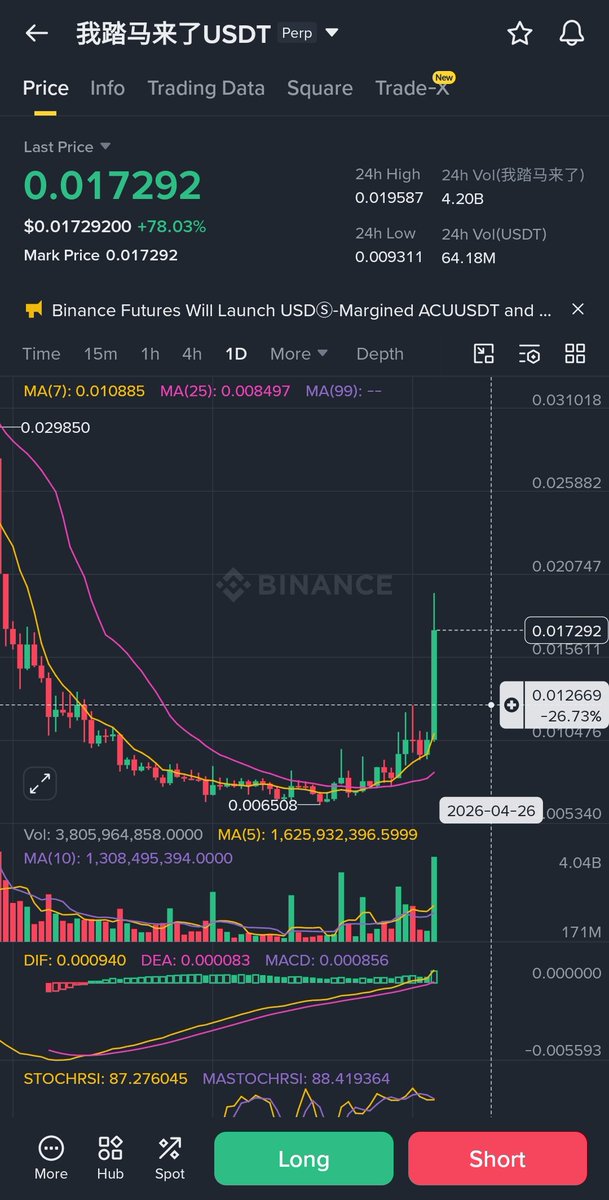
RAVE —
from 20x in a week
to 50x in two.
“Two weeks” sounds long,
but the move happened in just 6 days.
On the weekly chart,
it looks like a massive run.
But this week alone?
Only about 3x.
Most of the move
already happened last week.
$10K this week → $30K
$1K last week → $50K
It’s not about size.
It’s about timing.
Catching something like this from the start
and holding till here
is nearly impossible.
Still, anyone who reads charts
ends up asking the same question:
“Where would I have entered?”
Probably somewhere
around the early breakout zone —
what I’d call the “King Jichang” line.
Exits are an art.
Entries are a system.
Without your own entry criteria,
you can’t even define risk/reward.
As Warren Buffett says,
buy good assets cheap and hold.
Crypto isn’t a company,
but the idea of buying cheap
applies anywhere.
$Crypto $RAVE
Bitcoin nearing a weekly MACD golden cross
for the first time in 11 months.
Q1 was all downside —
retail sold, institutions bought.
Bottom is uncertain,
but crypto winter may be ending.
A late spring could be coming.
$Crypto $BTC
Did it just run too hard?
All the way up,
and now sliding down
without a pause.
NIKE.
After a dead cat bounce last year,
it’s trending lower again.
Still not a great look,
but it’s getting close
to what looks like a final support zone
around $45.
Starting to put it back
on the watchlist.
From here—
can NIKE draw
its signature V-shaped rebound?
$Stock $Nike
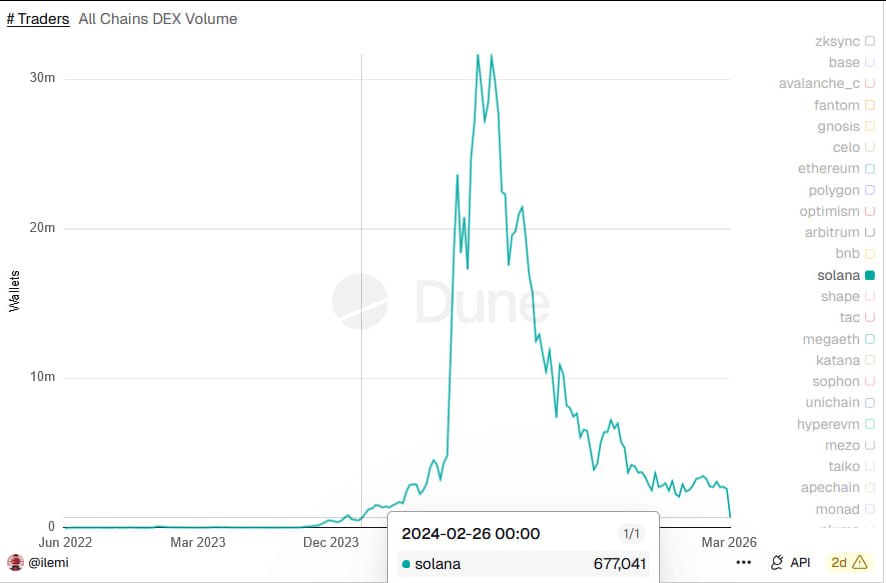
Solana’s DEX volume and price chart.
A textbook Hyman Minsky model.
From BONK to PEPE,
it led the last cycle’s frenzy.
Watching the fall of a former leader
feels… strange.
Another era fading away.
Next cycle —
who will lead the new meta?
$Crypto $Solana
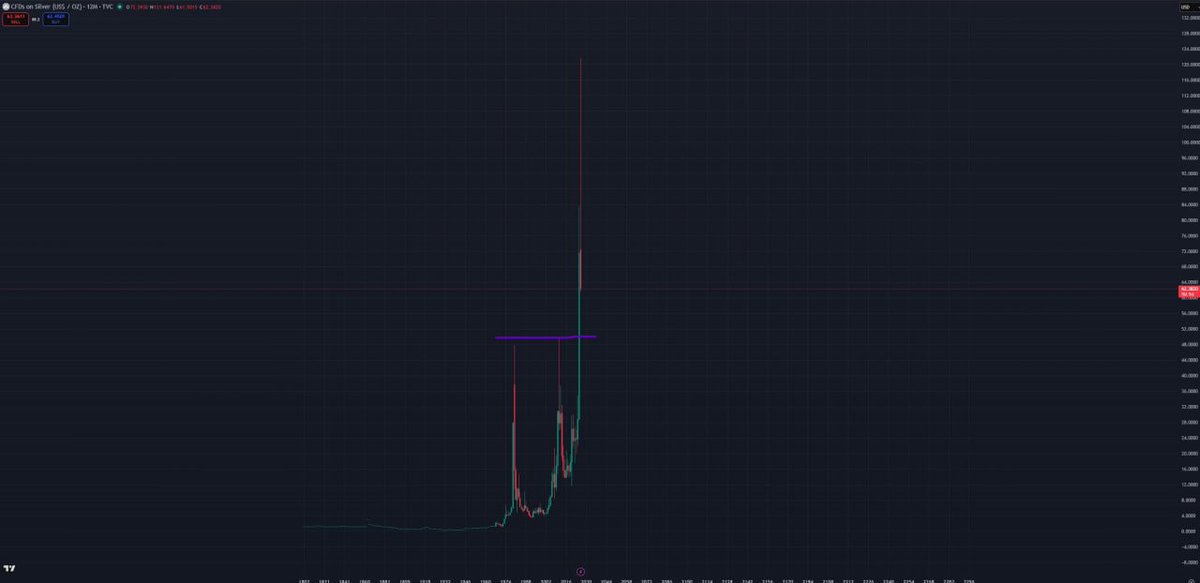
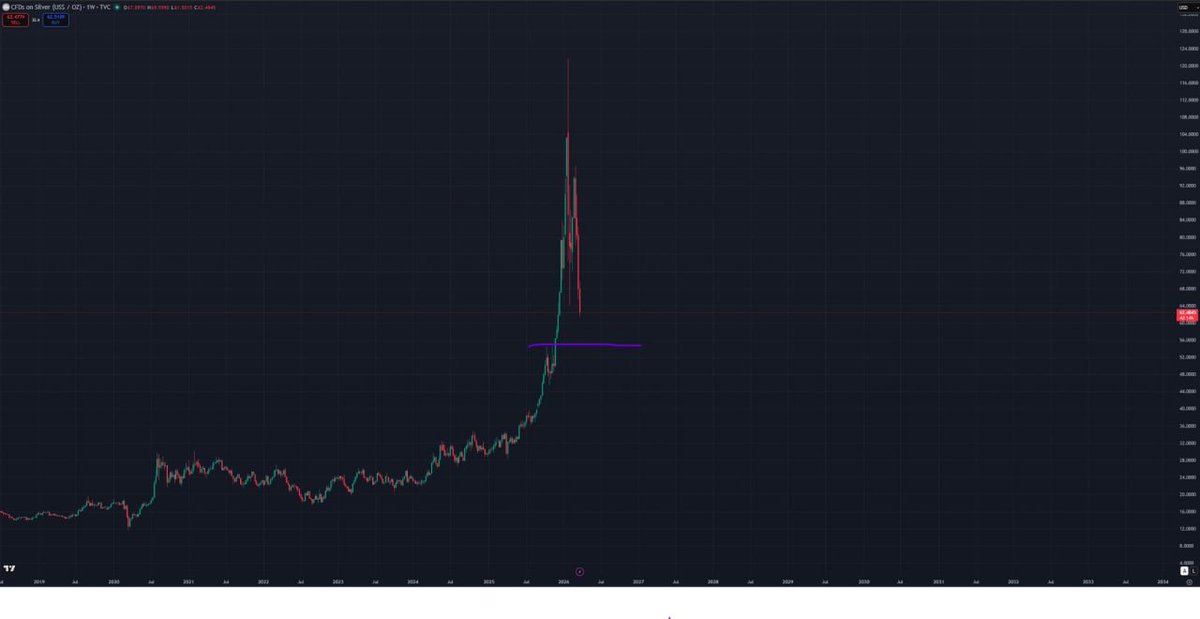
2 months ago,
I went to a gold shop in Jongno
to sell physical gold around $5,000.
I saw some younger guys there buying silver bars.
Back then, silver was around $120–130.
Now it’s been cut in half.
I’m not saying I timed it right
or that they were wrong.
But seeing gold and silver —
assets many consider “safe” —
move like this
reminds me how difficult investing really is.
The faster something goes up,
the faster it can fall —
with little support on the way down.
We’re still in that kind of move.
Only now,
a potential support zone is starting to show.
Around the $54–50 range.
What kind of reaction we get here
is worth watching.
$Silver
Do gold cycles repeat?
People see gold
as a long-term upward “safe asset.”
That’s not wrong.
As currencies lose value over time,
scarce assets like gold, real estate, and Bitcoin
tend to hedge inflation.
But gold doesn’t just go up forever.
In 2011,
after 11 straight years of gains,
gold reached $1,920.
Then over the next 4 years,
it corrected to $1,046 —
nearly cut in half.
Go further back.
1979 — the Iranian Revolution,
and the Soviet invasion of Afghanistan.
Amid uncertainty,
gold surged to historic highs.
Then in 1980,
Paul Volcker raised rates to 20%.
The rally stopped there.
Gold peaked at $875,
and within just 2 years,
collapsed to $285.
It took 21 years to form a bottom,
and 28 years
to make a new high.
It may feel different this time.
But markets rarely are.
History repeats.
Nothing should be taken as absolute.
The market moves
regardless of belief,
regardless of conviction —
or even prayer.
$Gold $BTC
The number of altcoins has grown 2000x in just 4 years.
Back in 2017,
when I first entered crypto,
Upbit’s KRW market had only around 50 coins.
I used dozens of exchanges,
managed over 100 OTPs,
but there were barely any coins I didn’t know.
Then came DeFi and NFTs in 2020.
The number of tokens exploded,
and at some point,
it all became impossible to keep track of.
Even back then, people said:
“Most altcoins will eventually disappear.”
Four years later,
altcoins have gone from ~20,000
to tens of millions.
At this point,
no one truly knows what all these tokens are anymore.
Upbit now lists close to 300 coins.
Binance has over 600.
Crypto, at its core,
is a market that absorbs liquidity.
But if liquidity isn’t growing,
while the number of tokens keeps expanding,
the outcome is almost inevitable.
Most will trend downward.
A market born from greed —
shaped by greedy investors, VCs, projects, and exchanges.
A thought experiment:
What if there were an exchange
that only listed the top 100 “real” coins
and maintained that list carefully?
…No one would use it.
Is there even an answer
in this market?
$Crypto $Altcoin
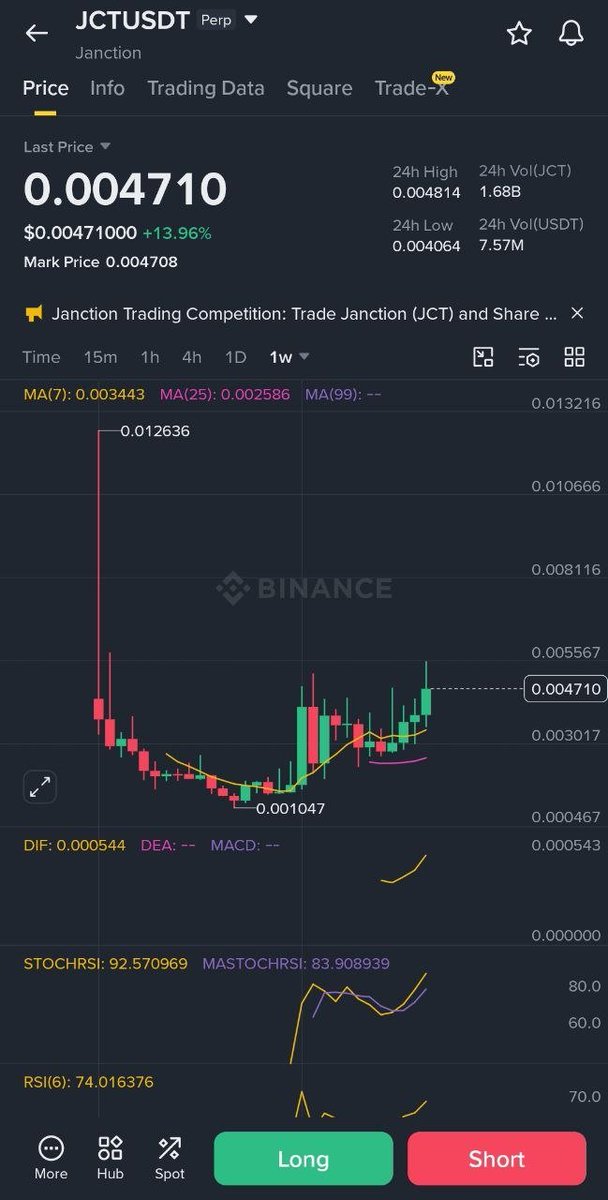
A coin that’s been interesting to watch
slowly building what I’d call a King Jichang structure.
Since the NFT era,
I haven’t paid much attention to most crypto meta.
In the end,
many of them felt like different flavors
of the same thing —
often drifting toward Ponzi-like dynamics.
At some point,
the word innovation almost disappeared.
Still,
if there’s one area where crypto could genuinely grow,
I think it’s payments.
No banks.
No currency exchange.
Just crypto assets —
usable anywhere in the world
for payments and rewards.
They call it a neobank model.
Of course,
dozens of crypto card projects already exist.
But this one is relatively new,
and the community participation looks quite active.
So for now,
I’m just watching how it develops.
$Crypto $Tria