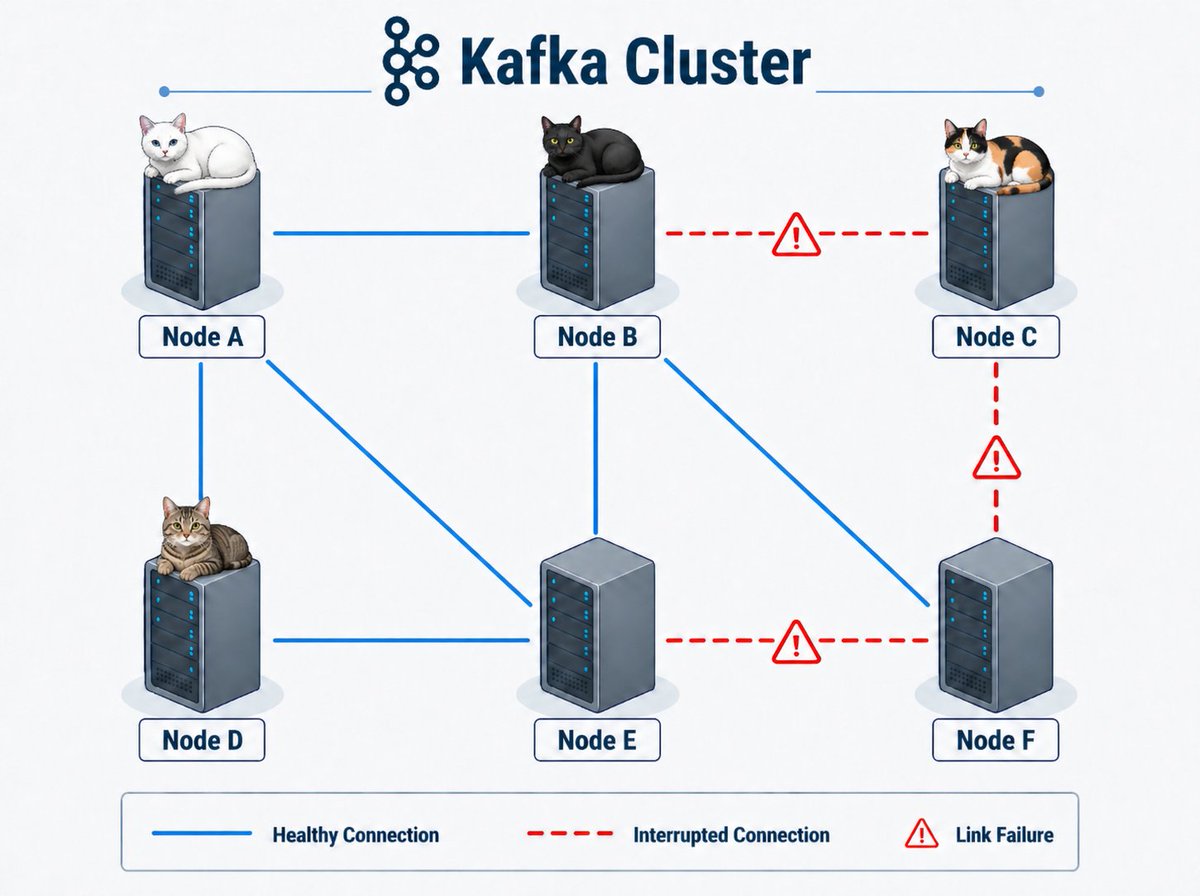
You probably heard of the CAP theorem.
It's about distributed systems operating during network partitions.
But what happens when there are no partitions? 🙃
Then you'd choose between consistency and latency, open to see my example 👇
Who's preparing for a developer job interview? 👓
Comment below if you want me to write about:
- a CAP theorem and a PACELC theorem
- the different kinds of consistency to choose from when designing systems
Or any of your ideas.
Developers, do you know what a thundering herd is?
If you never heard of it, read below 👇
It happens when a large group of processes is is waiting for a single resource. When that resource becomes available, they all wake up and try to use it at the same time.
This overloads the system, basically a DOS: it suddenly has to handle a ton of requests.
For example: a big chunk of Redis/Memcache keys expire a the same time. All the requests hit database, slowing everything down.
What can you do?
A couple of things:
1. Use locks. Allow one process to do the expensive work, while the others wait for cache to get populated.
2. Implement randomized TTL using jitter. Make sure the records don't expire all the same time.
3. Pre-warm the cache with the most popular keys when cache layer is reset and before traffic starts flowing through the service.
If you are a developer preparing for a System Design interview in 2026, you are going to need this 👇
Remember how long things take to make calculated decisions.
1/ Nanoseconds
CPU register access -- <1 ns.
CPU clock cycle -- <1 ns.
L1 cache access -- ~1 ns.
L2 cache access -- ~4 ns.
L3 cache access -- ~10 ns.
DDR5 RAM access -- ~15 ns.
Simple Linux syscall, like getpid() -- several hundred ns.
MD5 hash of 64-bit number -- ~100 ns.
2/ 1–100+ μs
Linux thread context switch -- a few μs.
Nginx static file HTTP request -- ~50 μs.
Read 1 MB from DDR5 RAM -- ~20 μs.
NVMe SSD write 1 page of 8 KB -- ~50 μs.
Intra-zone cloud RTT -- a few hundred μs.
3/ ~1-10ms
Redis/Memcached GET from client -- ~1 ms.
HDD write 1 page of 4 KB -- ~5-15 ms
Inter-zone cloud RTT -- 1–10 ms.
4/ 10-100+ ms
*RTT = round trip time.
US East ↔ US West RTT -- 10–100 ms.
US East ↔ Europe RTT -- 10–100 ms.
Read 1 GB from DDR5 RAM -- 10–15 ms.
TLS 1.3 handshake 1RTT -- 20-100 ms.
Bcrypt password hash -- ~300 ms.
US West ↔ Singapore RTT -- 100–1000 ms.
Read 1 GB from SSD -- 100–1000 ms.
6/ 1+ second
Transfer 1 GB inside same cloud region -- 0.3s - 8s depending on the bandwidth.
Subscribe for more system design tips!
Hey Devs, do you feel drained after a day of working with AI?
This is called AI fatigue, and no one talks about it.
My name is Roman, I just survived a burnout and today I came to share my story of how I solved a new challenge that I faced at work and maybe inspire some of you.
I was so happy to come back to work, to surprisingly find myself managing 4 agents, and endlessly reviewing ClaudeCode-generated code.
Switching from Jira to Github to Terminal to Slack back and forth makes me feel dead at the end of the day.
One thing that you can do is minimize the number of tools or apps you use. There is a research that says that using 2 tools is optimal.
I as a backend developer, I built for myself a Terminal UI Github wrapper that uses `gh` cli to show me the status of the PRs I am involved in. It shows unresolved threads, approval counts, deployment statuses.
The next step is to make it alert me when someone wants a review from me or when I have a question pending on my PR.
And even further step would be to spawn Claude straight from my app to resolve comments, or run a summary for PR review.
Your case might me different. If you are in HR or Marketing, you are probably suffering from AI fatigue.
Use these AI tools to make you own life easier.
Prototype design and idea with ChatGPT, build minimal version with claude, codex, cursor, antigravity or whatever, polish it and make it work for you!
Subscribe if you want to stay sharp and healthy in this age of AI agents.
Age of agents lol 😅
What is the point of joining a super early startup as a Founding Staff engineer for a compensation that is 20-30% lower than market + assuming 2% equity (which cannot be cashed out anyway)?
There are some alternatives like Busuu that are supposedly better than Duo, you can check what they are doing better.
Pesonally, I don't like a strict learning path set by Duo. I want to be able to focus either on different vocabulary topic or on learning some particular grammar rules.
For vocabulary, I want to learn words that people use at work. I also want to be able to learn what people write on WhatsApp because it is usually shortened versions of words.
For grammar, I want to be able to have a skill tree or graph where I can mark the nodes that I know and work on the nodes that I need to know for my level.
I like what Duo does with the lessons and animation, but I want it to be more flexible, build my own path.
Hey! It is a bit hard to put into words. I think I am not that motivated to follow my goals, and no app can help with this.
I just check in at the end of the day to collect my reward without really caring about it.
I really like the bying clothes, furniture, gifting something to friends, sending gratitude.
I think sending gratitude part could be more diverse and customizable.
First aid kit is great but without learning it and making using it a habit, it's not very useful.
I did not like that all tasks are the same energy, when it is not usually the case in real life. A "simple" call to make a vet appointment can feel more draining than loading a dishwasher that you do every day.
What is your experience with it?
For 30 years I would speak in a high pitched voice because my parents would say that I am "mumbling" and I need to speak louder.
I recently noticed that I can also speak in a lower register and it takes less strain from my throat.
I am still not used to using it every day. But it is hell of a funny observation.
If having 3 cats in real life is not enough, you can.. get a self-care cat!
It is a cute self-care app I found, called Catzy.
Choose your catzy that will help you build your habits, track your mood and help you focus.