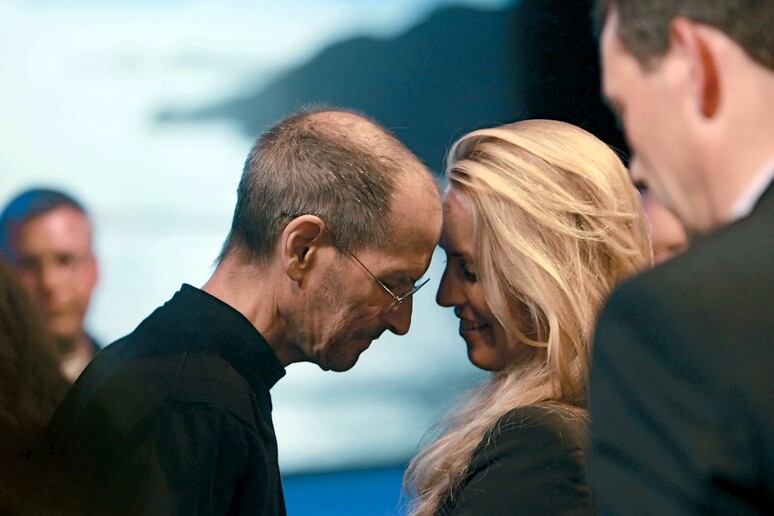
Steve Jobs' death was supposed to be the government's biggest estate tax collection.
Instead, it made his wife a billionaire overnight.
Here's how Jobs planned for this satisfying outcome years before he passed:
When Steve Jobs died on October 5, 2011, his net worth stood at $7 billion.
The U.S. government was ready to collect billions in estate taxes.
Under 2011 estate tax rules, only $5 million was exempt, and everything above that got taxed at 35%.
The expected tax payment? $2.45 billion (that's more than many countries' entire budgets!)
But Jobs had been planning for years ↓
Back in March 2009, over two years before his death, Jobs and his wife Laurene quietly transferred three California properties into two separate trusts.
Then his attorneys moved the biggest assets:
• 38.5 million Apple shares
• 138 million Disney shares from the 2006 Pixar sale
• Three California properties including his Palo Alto residence and the Woodside mansion he purchased in 1984 for $3.5 million
All funneled into the Steven P. Jobs Trust.
The strategy was elegant in its simplicity...
Jobs exploited the unlimited marital deduction, a cornerstone of U.S. tax law that allows unlimited asset transfers to a surviving spouse without immediate estate tax.
The only requirement? The spouse must be a U.S. citizen.
Laurene qualified perfectly.
When Jobs died, his simple "pourover" will directed all remaining assets into the private trust.
No public probate.
No court battles.
No tax bill.
The IRS collected exactly $0.
Overnight, Laurene transformed from a successful venture capitalist into one of the world's wealthiest women, controlling over $10 billion in assets.
But here's where it gets even smarter ↓
Because the assets passed through the trust at death, they received a "stepped-up basis" to fair market value.
This means all the capital gains Apple stock accumulated over decades were erased for tax purposes.
Laurene didn't stop there.
After 2011, she deployed Grantor Retained Annuity Trusts (GRATs) to transfer roughly $500 million tax-free to their children, dodging another $200 million in gift and estate taxes.
By 2025, her net worth hovers around $11.9 billion.
The government's anticipated $2.45 billion windfall? Still $0.
Jobs built revolutionary products throughout his career, and his estate plan was no different.
Turns out, the best financial strategy is often about keeping what's already yours.
—
Thanks for reading!
Enjoyed this post?
Follow @BigBrainBizness for more content like this.
Rule of thumb for investment in fundamentally solid stocks:
1. If price drops 10%, just hold
2. If price drops 20%, add 10%
3. If price drops 30%, add 30%
4. If price goes up 10%, just hold
5. If price goes up 20%, still hold
6. If price goes up 30%, sell 10%
7. If price goes up 40%, sell 20%
8. If price goes up 50%, sell 30%
9. If price goes up 60%, sell 40%
10. If price goes up 100%, sell all
In 1998, Warren Buffett gave a 1-hour masterclass on how to never lose money investing.
His frameworks:
• The 10% ownership test
• Castle & moat thinking
• Circle of competence
• Why smart people go broke
12 timeless lessons from his masterclass:
1. The 10% ownership test
In 1985, Warren Buffett sat down for his most iconic interview ever.
If you want to understand the psychology of wealth, this is 10 minutes of pure gold.
Save this rare footage, you’ll be coming back to it.
“Read 500 pages every day. That’s how knowledge works. It builds up, like compound interest. All of you can do it, but I guarantee not many of you will do it.” - Warren Buffett
My week of Henry Mancini music continues. This one is my favorite. The iconic Moon River, written for the movie Breakfast at Tiffany’s in 1961. Turn up the volume and give it a listen.
https://t.co/kZG9kC3H6v
This is Jeff gordon. Four time NASCAR Cup Series champion. 93 career wins. He's a racing legend, but in my opinion, this commercial is the best thing he's ever done.🤣🤣🤣